 Film Soundtrack, 1997 (Walt Disney Records)
  (3 / 5) Hercules may not be a Disney masterpiece, but it’s one of the studio’s wittiest animated musicals, leaning heavily on meta-humor and pop-culture riffs — especially those skewering celebrity, sports, and marketing. Loosely based on a mash-up of Greek myths, it follows a gangly, misfit demigod as he gains strength and confidence, battles monsters, finds love, and learns what it truly means to be a hero. But instead of taking a traditional, noble-story-telling route, the Mouse House counterintuitively turned this ancient epic-for-the-ages into a goofy, full-tilt screwball comedy fueled by thunderous funk and gospel music that could wake the entire Olympian pantheon. Like all adapted musicals of the Disney Renaissance, it has deep theatrical roots, including, in a special flourish, some of the film’s character designs having been inspired (sometimes obviously so) by the sinuous linework of none other than Al Hirschfeld. And looming over it all is the symposium of divas who periodically wail out the sung narration: Real-life Broadway goddess Lillias White leads a sassy, syncopated Greek chorus of Muses that includes her fellow Broadway veterans LaChanze, Cheryl Freeman, and habitual scene-stealer Roz Ryan alongside Vaneese Y. Thomas. Much of Alan Menken’s rousing orchestral score for the movie is heard on the album, plus about 20 minutes of original songs that Menken wrote with lyricist David Zippel. All of the songs land solidly, including an obligatory, humongous Disney production number, “Zero to Hero,” which chronicles Herc’s meteoric ascent from nobody to action-figure media star. Praise also for Susan Egan as fast-talking love interest Megara, wryly channeling Barbara Stanwyck in The Lady Eve; Danny DeVito as Herc’s crotchety trainer/satyr Philoctetes (“Call me Phil”); and, of course, Roger Bart, who in singing the title role offers two wondrous performances of the Oscar-nominated motivational anthem “Go the Distance,” first as a reflective ballad and then an exhilarating, clarion reprise in which Bart flies high as Pegasus. — Mark Robinson
 Original London Cast, 2025 (Walt Disney Records)
  (2 / 5) After its 2019 debut at the Delacorte Theater in Central Park and subsequent tune-ups in New Jersey and Germany, Hercules finally muscled its way into an open-ended West End run in 2025. As with many Disney screen-to-stage ventures, the show sands down some of the film’s action — and, in this case, its snark — to appeal to the broadest audience and allow the performers to survive eight shows per week. Beloved characters were trimmed out (farewell, Pegasus), and others, such as Phil and Herc’s villainous Uncle Hades, reinvented into oddly familiar cousins of Aladdin‘s Genie and The Lion King‘s Scar, with puppetry stepping in for the action set pieces. This production was notably more ethnically diverse than the film, and the new songs lean even harder into Black musical traditions, pedal firmly to the floor, with mixed results. For instance, while one doesn’t expect the symphonic power heard in the film, the orchestra here often sounds surprisingly thin for a Disney release. “Go the Distance,” sung by the earnest and scantily togaed Luke Brady, here feels less about discovering heroic destiny and more about belting for applause. Hades’s new song, “Getting Even,” only occasionally has a discernible melody, and in fact, none of the new numbers are equal in quality to those from the film. Yet there is good news, mortals: All of the songs originally heard in the movie have been smartly expanded with new intros, bridges, and verses, and some of them — for example, “Zero to Hero” — have been effectively slowed down in tempo, letting us savor Zippel’s nimble wordplay. Mae Ann Jorolan’s formidable Meg matches Susan Egan’s sardonic original in “I Won’t Say I’m in Love,” while Trevor Dion Nicholas’s Phil channels his inner Little Richard in a gleeful, gloating Act II opener, “I’m Back.” Most importantly, the vocally acrobatic Muses have been given more to do; their expanded “Gospel Truth” sequences, now in five parts, allow Brianna Ogunbawo, Candace Furbert, Malinda Parris, Robyn Rose-Li, and Sharlene Hector to sweep in and comically elevate every track in which they appear, helping to rescue the album from the River Styx. — M.R.
 (3.5 / 5) One of Broadway’s most versatile composers, David Yazbek collaborated with Erik Della Penna in creating the music and lyrics for Dead Outlaw, his most unusual project yet. The first half of the show’s book, by Itamar Moses, covers the life of train robber Elmer McCurdy. A botched robbery leads to McCurdy’s untimely death, and the second half of the show (and the cast album) portrays his body’s absurd, 60-year odyssey as a mummified carnival attraction. Inevitably, the full scope of Andrew Durand’s acclaimed performance as McCurdy is partly diminished on the recording, most obviously because his second-act mastery of physical stillness as a mummified corpse is not captured. Still, his vocal navigation of McCurdy’s vulnerability and rage is fully evident here; Durand is alluring in the show’s opening, “Ballad,” but his voice is full of ferocity in the punk-tinged “Killed a Man in Maine.” The colorful ensemble cast includes Broadway veterans Jeb Brown, Thom Sesma, and Ken Marks, along with relative newcomer Julia Knitel, who plays several roles. Knitel’s strongest moment is in the second act ballad “Millicent’s Song,” as she plays a teenage girl who confides her thoughts and anxieties to McCurdy’s corpse and his available, if unhearing, ears; here, her calming voice gives listeners a break from the score’s high-speed pace. The band, led by narrator Jeb Brown, shows off Yazbek’s blues-infused, rockabilly score and rips through the irresistibly catchy tune “Dead” while also leading the haunting chorus of the song “Crimson Thread.” That said, the most significant flaw of Dead Outlaw is the fact that too many of the songs were written for Brown and the onstage band to comment on the action of the play, rather than moving the story forward. “Up to the Stars,” “Nobody Knows Your Name,” and the aforementioned “Dead” are all fine songs, but they may leave the listener grasping for narrative threads. Ultimately, this unique endeavor can’t be counted as Yazbek’s best score, but don’t be surprised if some of the tunes stick in your head long after they should have died. [Note: Audible also released a complete recording of the entire show that is only available digitally.] — Forrest Hutchinson
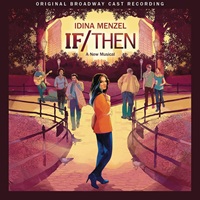
 (2.5 / 5) At the time of its opening, If/Then was hailed as Idina Menzel’s return to the Broadway stage after starring in Wicked almost a decade earlier. Pairing her with writers Tom Kitt and Brian Yorkey, only a few years removed from Next to Normal, seemed like a sure bet for success. But, similar to other “sure bets,” If/Then ended up muddled. Kitt’s music and Yorkey’s lyrics are as nebulous and meandering as the show’s title might suggest, and the characters they created sound like ciphers as they travel down one too many narrative side streets in the show’s book, also written by Yorkey. Menzel’s character, known as “Beth” when she chooses one path for her life and as “Liz” when she makes a different choice, is assigned an expected amount of ballads, but the character’s indecisiveness leads to her singing in circles. As a result, listeners may find it difficult to care about Beth/Liz, and may struggle to follow the two separate story lines. All of that said, the cast of If/Then is spectacular, as Menzel is joined by LaChanze in the role of her friend Kate; Jenn Colella as Anne, Kate’s love interest; James Snyder as Josh, the father of Liz’s children; Menzel’s former Rent co-star Anthony Rapp as Lucas, a friend to Liz and more than a friend to Beth; and Jason Tam as David, who becomes Lucas’s boyfriend in one of the story lines. All of these performers’ voices are so distinct that they are instantly recognizable on this recording, in the best way. Unfortunately, their characters’ plotlines are soap-opera-level bad, and even a description of those subplots is difficult because of the show’s dueling realities. The album does end on with a string of memorable cuts: “Love While You Can” is a fascinating song for Menzel, LaChanze, and Colella; “What Would You Do?” is a sweet solo Tam; and the score culminates with a predictable, bloated, but undeniably cathartic “11 o’clock number” for Menzel titled “Always Starting Over.” Don’t be shocked if you find yourself returning to this particular track, if only to hear Menzel push herself to her vocal limit. —-Forrest Hutchinson

 (1 / 5) It’s unfortunate that we have to judge the 2013 Off-Broadway production of Here Lies Love based solely on this audio recording, as the immersive presentation at The Public Theater was such a key part of its appeal. The show was sung-through, and some songs heard on the concept album were cut while others were added, to overall little effect. The cast album pulsates with synthesized beats, but similar to its predecessor, the songs become repetitive, without providing interesting lyrics or any understanding of the characters’ motives. Imelda is sung by the extremely talented Ruthie Ann Miles. She nails the title song, one of the many melodies that might get stuck in your head as you listen. Her voice cuts through the monotonous music, and though the role itself lacks depth, Miles is a consistently charismatic presence. Ferdinand Marcos is given an unremarkable performance by Jose Llana; surprisingly, Marcos is not the most prominently featured male character in the show; that would be Ninoy Aquino, a political reformer who had a relationship with Imelda when they were young, but who became one of the leading critics of the Marcos administration. (Think of Che in Evita.) Aquino is played by Conrad Ricamora, who gets to show off more emotional range than the others in songs such as “Child of the Philippines” and “Gate 37.” (This character largely replaces the role of the nanny, Estrella Cumpos on the concept album as a grounding presence in Imelda’s life and a reminder of her impoverished childhood.) The album is primarily an endless procession of funk music, interrupted briefly by the penultimate song, “God Draws Straight,” a soft melody accompanied by a single ukulele. The bulk of the score is better suited to a dance club setting than to close listening. If you can get your hands on a physical copy of the CD edition, it’s a colorful double-disc set that includes an 80 (!) page booklet with summaries for each track on the recording. Perhaps the feeling that it was necessary to include song summaries should be seen as an indication that prospective listeners may want to exercise caution. [Editor’s Note: A Broadway production of Here Lies Love, which attempted to recreate the immersive quality of the Off-Broadway presentation, opened in the summer of 2023. It ran for only 150 performances and three previews, and it yielded no cast album.] — F.H.
 (4 / 5) Hell’s Kitchen is one jukebox musical — in this case, celebrating the artistry of R&B singer-songwriter Alicia Keys through the semi-autobiographical story of teenage rebel Ali (Maleah Joi Moon) — that receives a significant upgrade in the translation from stage to cast recording. On the one hand, the misguided inclusion here of substantial portions of dialogue gives us too much of the show’s paper-thin story and near non-existent character development. (The most frustrating track in this regard is “You Play These Notes” featuring a wildly silly and unconvincing piano pedagogy.) But also showcased are the extraordinary vocals and rousing arrangements of Keys’ songs that a shorter version of the album could have offered with fewer distractions. Rather than simply recreating the sound of Keys’ original hit recordings, Hell’s Kitchen reimagines them: the sped-up, jazzy take on “Fallin’” and the impassioned mother-daughter duet recrafting of “No One” are two exemplars. Keys penned four new songs, including the lovely “The River,” for the musical, but the bulk of the score consists of items familiar from nearly 25 years of her albums. As jukebox musicals go, this one boasts unusual orchestral reinvention; Tom Kitt and Adam Blackstone engage in symphonic spread with rich scoring for strings that never overwhelms the piano-driven gold at the core of Keys’ compositional mines. And there’s a generosity of spirit in Keys’ willingness to spread the wealth of her solo songbook to other vocal artists, an unselfishness rewarded by the four central performances well represented by numerous tracks on the album: the deliciously melismatic rasp of newcomer Moon’s “The River” and “Kaleidoscope,” the seductive syrup of Brandon Victor Dixon’s “Not Even the King” and “Fallin’,” the rafters-raising electricity of Shoshana Bean’s “Pawn It All” and “No One,” and, best of all, the richness and warmth of Kecia Lewis’ “Perfect Way to Die,” “Authors of Forever,” and “Like Water.” — Dan Rubins
 (1.5 / 5) This musical based on the real-life story of Bonnie Parker and Clyde Barrow, those infamous outlaws of the 1930s, has a book by Ivan Menchell, music by Frank Wildhorn, and lyrics by Don Black. The show opened on Broadway on December 1, 2011 and closed after only 36 performances. The cast recording starts out pleasantly by introducing us to Laura Osnes as Bonnie and Jeremy Jordan as Clyde. Jordan’s first song is a strong ballad, “The World Will Remember Me,” while Osnes croons a sweet-sounding ballad of her own, with the score’s catchiest tune: “How ’Bout a Dance.” Wildhorn has composed some praiseworthy music using jazz, blues, and gospel elements, but the score also includes several songs written in a nebulous pop style that makes no attempt to represent the time period. On the rare occasion when Wildhorn avoids the first-person ballad, we get misfires such as “God’s Arms Are Always Open,” a tonal mess in which the couple’s villainous deeds are underscored by a preacher’s fiery sermon. The song “Made in America” does delve into some of the deeper themes of the story and motivations of the characters, but it’s quickly followed and counteracted by multiple anemic ballads. Making matters worse, Black’s lyrics are bland and rarely more than skin-deep, resulting in stagnant songs that don’t push the story forward. Certain individual numbers might be enjoyable when extracted from the show; for example, Clyde’s love song, “Bonnie,” and Bonnie’s 11 o’clock number, “Dyin’ Ain’t So Bad” are particularly memorable and could perhaps serve as fine cabaret material. But listening to this album from start to finish may well prove to be an unsatisfying experience for those expecting a cohesive musical theatre score. The recording’s major recommendations are the performances of Osnes, Jordan, and Melissa Van Der Schyff a s Clyde’s long-suffering sister-in-law. All three are given ample opportunity to show off their vocal dexterity. — Forrest Hutchinson
 (0.5 / 5) As F. Scott Fitzgerald’s famous and revered novel The Great Gatsby lapsed into the public domain, it was perhaps inevitable that stage adaptations would begin to appear. This musical version had the good fortune of employing two extremely talented vocalists, Jeremy Jordan (Newsies, Bonnie and Clyde, etc. ) as Jay Gatsby and Eva Noblezada (Miss Saigon, Hadestown) as Daisy Buchanan. Noblezada was cast against type for this role, yet she comes across better than Jordan on the recording, finding genuine emotion in songs such as “For Better or Worse” and “Beautiful Little Fool.” Though Jordan’s singing voice is distinctive in ballads including “For Her,” his accent in his spoken dialogue sounds out of place. And while John Zdrojeski and Sara Chase are well cast as Tom Buchanan and Myrtle, respectively, Noah Ricketts struggles in the role of Nick. The story of Gatsby’s pursuit of the married Daisy is narrated in the novel and the musical by Nick, who has just returned home from serving in World War I, and who also plays a key role in the unfolding drama as he carries on a romance with professional golfer Jordan Baker (Samantha Pauly). Nick is the audience’s reporter on the show’s primary subjects and themes: the tragedy hidden behind the decadence of the Roaring ’20s in America, the life of the mysterious Gatsby, and the everlasting hope or the unreachable dream represented by a single green light in the distance. But narration is much more difficult to execute in a stage show than in a novel, and Nick’s lines often feel shoehorned into the musical. The score for this adaptation was written by Jason Howland (music) and Nathan Tysen (lyrics), and the book by Kait Kerrigan. Howland is not untalented; his melodies for the songs “For Her,” “Only Tea,” and “Past is Catching Up to Me” are enjoyable, and “My Green Light” plays well as the obligatory, highly-anticipated duet between the two leads. But some of Tysen’s lyrics are of shockingly poor quality. For example, in the song “One-Way Road,” a pregnant Myrtle sings “Though I’m not showing, a baby’s growing,” along with “He’s mine, and this baby here is genuine.” Lyrics like these prevent the recording from gaining any real momentum, and further, the score as a whole is structured so generically that some listeners may be able to predict the type and style of each successive song before it plays. Although the standout visuals of this show’s physical production and the presence of two bankable musical theater notables may keep the party moving well enough on stage, this Great Gatsby‘s lack of nuance is clear from the cast album, especially in comparison to the source material. — Forrest Hutchinson