

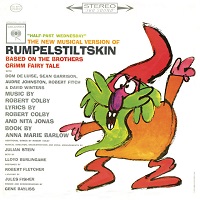
 Original Off-Broadway Cast, 1962 (Columbia/no CD) No stars, not recommended. The success of Once Upon a Mattress inspired several other fairy tale musicals, including this one — but the authors of Mattress knew how to adapt their source material for the stage so that it would appeal to adults. In contrast, the writers of Half-Past Wednesday — Robert Colby, Nita Jones, and Anna Marie Barlow — took the story of Rumpelstiltskin and changed almost nothing. This is the original tale: straight, unadorned, and very involving if you’re six years old. The songs aren’t even run-of-the-mill in quality, there’s not a fresh idea to be found here, and despite the fact that the score contains a number of supposedly comic songs, there are no jokes. Columbia tried to repackage and retitle this LP to sell it as a children’s album, but it’s not even clever enough for kids, and they’ll hate the soppy love songs. The most notable member of the cast is Dom DeLuise, most of whose mannerisms were in place by the time of this recording. — David Wolf
Fermat’s Last Tango
 Original Off-Broadway Cast, 2002 (Original Cast Records)
  (3 / 5) A musical about a math problem? It’s a crazy notion, but composer-lyricist Joshua Rosenblum and librettist-lyricist Joanne Sydney Lessner make it work. Their show was inspired by the controversial last theorem of French mathematician Pierre de Fermat, which has the mythical qualities needed to support a dramatic framework. Fermat’s Last Tango is a bizarre, surprisingly effective, mostly true musical detective story. The creators changes few of the real-life facts beyond renaming the central figure Daniel Keane. Femat himself appears, taunting and yet assisting Keane throughout the show; if the device seems a bit silly at first, it works because of the epic scope of the musical. (Euclid, Newton, Pythagoras, and other mathematicians also appear.) The score is often operatic in weight, and the talented cast is more than up to the challenge. Chris Thompson displays a booming baritone as Keane, Jonathan Rabb’s pompous Fermat is lots of fun, and the members of the ensemble (Christianne Tisdale, Carrie Wilshusen, Gilles Chiasson, and Mitchell Kantor) are excellent. Perhaps the best performance on the cast album comes from Edwardyne Cowan, who plays Keane’s wife. With her beautiful voice, Cowan puts over the show’s one concession to traditional musical comedy, a terrific number titled “Math Widow.” But there are several other enjoyable songs here. Although Fermat’s Last Tango is not recommended as light background music, it’s definitely worth a listen or two. — Matthew Murray
Cowgirls
 Original Off-Broadway Cast, 1996 (Varèse Sarabande)
  (2 / 5) This cute little show, with music and lyrics by Mary Murfitt and a book by Betsy Howie, had a decent run Off-Broadway in 1996. The song titles alone — “From Chopin to Country,” “Love’s Sorrow,” “Don’t Call Me Trailer Trash,” “Saddle Tramp Blues,” “They’re All Cowgirls to Me” — give you an idea of what sort of entertainment you’re in for if you give the cast album a listen. The material is very slight but lots of fun, and the charming cast consists of co-author Murfitt and Howie plus Rhonda Coullet, Mary Ehrlinger, Lori Fischer, and Jackie Sanders. They all give their all, and the recording is a pleasant diversion — Michael Portantiere
Greenwich Village U.S.A.
 Original Off-Broadway Cast, 1960 (20th Century Fox/no CD) No stars, not recommended. Some people have a blind affection for 1950s and ’60s revues, but being blind doesn’t mean that you have to be deaf, too. There isn’t anything in Greenwich Village U.S.A. that’s worth five seconds of your time. Although the section of New York City that’s the subject of this review was admittedly more distinctive in the ’50s that it has been in later years, it was never exactly Borneo, yet the authors of this show consistently depict its residents as some rare breed of exotics. That basic lack of honesty is one main reason why nothing here is funny. Another reason is the sheer lack of talent displayed in the writing. Those responsible for this fiasco were Jeanne Bargy, composer-lyricist; Frank Gehrecke, book writer-lyricist; and Herb Corey, lyricist. The only item of (minor) interest in this recording is that one of the performers, ballad singer Dawn Hampton, was an early influence on Bette Midler — David Wolf
The Show Goes On: A Portfolio of Theater Songs by Tom Jones and Harvey Schmidt
 Off-Broadway Cast, 1998 (DRG) (3 / 5) There are plenty of small delights — simple little things, one might say — to be found in this live recording of the York Theatre Company’s revue, in which lyricist Tom Jones and composer Harvey Schmidt (The Fantasticks, 110 in the Shade, I Do, I Do!, Celebration) offer us a tour through their back catalog. (Suffice it to say this is not an album that will make much sense to anyone who doesn’t know “Soon It’s Gonna Rain” from the “The Rain Song.”) Vocally speaking, none of the three singers — Emma Lampert, Mark McVey, and JoAnn Cunningham — who join the pair of writers offer definitive performances of the well-known songs. And Jones and Schmidt regrettably sing together only for a few of their thinner creations, for example the title number, “The Show Goes On,” from the little-known musical Mirette. But it’s still a thrill to hear Schmidt play piano throughout, especially his impressionist delicacy on “Simple Little Things.” Jones, meanwhile, is the mischievous emcee, gleefully self-effacing (“There are other songs that are more like unrefrigerated fish; they tend to date rather rapidly”) and generous in sharing behind-the-scenes lore. Thrown in here are three different versions of 110 in the Shade’s “Raunchy,” written for various stars who had been courted for that show (including Mary Martin and Carol Burnett), as well as three different melodies for the title song of I Do, I Do! And, despite McVey’s tendency to over-sing, the loveliest surprise on the album is a gorgeous early ballad, “I Know Loneliness Quite Well,” which should be ranked right at the top of Jones and Schmidt’s formidable output. — Dan Rubins
Tuck Everlasting
 Broadway Cast, 2016 (DMI Soundtracks) (2 / 5) Not much seems worth immortalizing when it comes to the Broadway adaptation of Natalie Babbitt’s beloved 1975 children’s novel Tuck Everlasting, in which eleven-year-old Winnie meets a family blessed (or is it cursed?) with eternal life. What the cast album does partly capture for prosperity is the creative team’s misguided attempt to stretch Babbitt’s compact storytelling into a two-act musical. The score sags especially in the elongated reveries of Mae Tuck (Carolee Carmello), remembering how her husband loved her back in their double-digit days; the scheming vaudeville turns of the evil Man in the Yellow Suit (a much-put-upon Terrence Man), who has come to steal the immortalizing spring water; and the comic detective numbers for Michael Wartella and Fred Applegate. John Clancy’s folk-doused orchestrations do most of the heavy lifting here, with lots of pizzicato plucks and pan-flute toots doing their best to distract from Chris Miller’s often underdeveloped melodies. Nathan Tysen’s lyrics are marred by a forced series of rhymes such as “handbook” / “exactly as planned, look” / “cranny and nook.” Miller and Tysen do succeed dramatically in “The Story of the Tucks,” in which the family members talk over each other trying to tell Winnie their big secret. Although Sarah Charles Lewis as Winnie sounds older than her pre-teen years, and Andrew Keenan-Bolger sings with a boyish charm, the show never resolves the squeamish courtship between a 104-year-old man in a 17-year-old’s body and an 11-year-old girl (“I’ll wait for you / ’Till you turn seventeen,” he sings in the discomfiting act one finale). Also, the Broadway production’s most-praised sequence, “The Story of Winnie Foster” — a ballet in which Winnie lives a full life and then arrives at a peaceful death in old age — has hardly the same impact without the emotional narrative in the staging. — Dan Rubins
A Christmas Story
 World Premiere Recording, 2012 (Masterworks Broadway)
  (4 / 5) In this stage adaptation of the film of the same title about a boy who really wants a BB gun for Christmas, songwriters Benj Pasek and Justin Paul demonstrate their craft through songs too good-natured and sturdily built to be faulted for their basically pastiche elements. There are jazzy tap numbers, western-inspired romps, and lots of jingling holiday fare with golden-age melodic coutours. The pair clearly had a blast assembling this score, even if the film’s episodic structure doesn’t always lend itself to effective musical storytelling; sequences like “Ralphie to the Rescue” and the endless “A Major Award” suggest that some of the dance arrangements and extended numbers could have been trimmed for the recording. But the otherwise warmly jocular score froths into something more soaring in three tracks that show off Pasek and Paul’s gifts for inventing joyous melody and showcasing kids’ voices: “Counting Down to Christmas,” “Somewhere Hovering Over Indiana,” and the gentle title song are all gems that make a strong case for this album as a keeper. Its warmth and shimmer are largely due to the gorgeous orchestrations of Larry Blank, perhaps some of the best of the 2010s in their brassy clarity and Christmasy sumptuousness. The cast of this “World Premiere Recording” largely represents the 2011 pre-Broadway touring company, with the exceptions of Liz Callaway as Ralphie’s mother and Tom Wopat as the grownup Narrator. (These performers never played these roles on stage.) Callaway is a redemptive presence, her tender, honest tone always keeping the ballads on the safe side of saccharine. And Clarke Hallum makes a meal out of Ralphie’s substantial amount of material, which allow for some astonishingly non-grating pre-teen belting. — Dan Rubins
 Television Cast, 2017 (Warner Bros.) (4 / 5) The cast album of the live TV production of A Christmas Story sounds splendid, even when compared to the sparkly original recording. Presumably, Larry Blank’s magnificent orchestrations benefit here from larger instrumentation than they received previously. As a result, songs that grew a bit wearisome on the first recording — such as “When You’re A Wimp” and “Sticky Situation” — here have enough big-band pizzazz to hold focus. In the role of the dismissive teacher (“You’ll Shoot Your Eye Out!”), Jane Krakowski is luxury casting. So too is Maya Rudolph; though she’s not a seasoned musical theater performer, she taps into her pre-Saturday Night Live singing background, bringing a wearied edge to “What A Mother Does” and a simple warmth to “Just Like That.” Matthew Broderick’s wistful voice is a good fit for the Narrator. And as young Ralphie, Andy Walken follows formidably in the shoes of Clarke Hallum. With just a tad less musical-theater brightness in his vibrato, Walken has equal emotional heft as his predecessor in the role. For the most part, the track list here matches that of the world premiere recording, with the additions of a forgettable credits song, “Count on Christmas” (performed by pop star Bebe Rexha) and a rather amusing Hanukkah number, “In the Market for A Miracle” (delivered with chutzpah by another SNL alumna with Broadway bona fides, Ana Gasteyer). — D.R.
Days of Wine and Roses
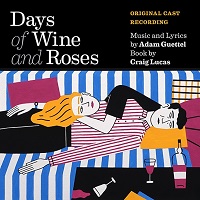 Original Cast, 2023 (Nonesuch)
  (5 / 5) Days of Wine and Roses marks the first musical with a score by composer/lyricist Adam Guettel that has been produced since Guettel’s triumph with The Light in the Piazza in 2005, and it was well worth the wait. Recorded in advance of the show’s Broadway premiere but after its initial production at the Atlantic Theater Company, this cast album is a beautiful gut punch. The music is different from any Broadway score of recent memory — full of earworms without being simple, and harmonically fascinating while remaining deliciously tonal. The orchestrations, which delight the ear, were also provided by Guettel. With a book by Craig Lucas, Days of Wine and Roses is based on the film of the same title. Brian d’Arcy James and Kelli O’Hara star as the show’s central couple, Kirsten Arnesen and Joe Clay, who meet on a boat (the album begins with the sound of rushing waves) and end up embarking on a devastating descent into alcoholism, each pulling the other further down. “Evanesce,” the song that the couple sings when they start drinking together, is a jazzy delight, complicated by ominous lyrics that predict their future (“Two dolphins breaking away / Two dolphins right to the grave/ Are we”). With the exception of the sweet-voiced Ella Dane Morgan as the couple’s young daughter, Lila, hardly any other performers are heard on the album; but James and O’Hara sing so well, and their voices blend so beautifully, that listeners won’t mind at all. O’Hara’s soprano has only become more colorful and expansive since she starred in Piazza, and “There Go I,” a beautiful ballad with evocative lyrics, serves as a showcase for her wondrous talent. “As The Water Loves The Stone” is one of the most heartfelt love songs this reviewer has ever heard, while the couple’s individual “mad scene” songs, “435” and “Morton Salt Girl,” would serve as playgrounds for any actor. The overall tone of the score is very sad, and many listeners may find themselves becoming emotional. It’s hard not to cry during “Turlycue,” the plaintive duet between a suffering mother and a confused daughter, and the joyfulness of “First Breath” becomes quite moving due to the direction of the plot. No musical theater maven should be without this recording; whether it haunts you, inspires you, or even triggers you, it’s certain to have a profound effect. — Charles Kirsch
Evening Primrose
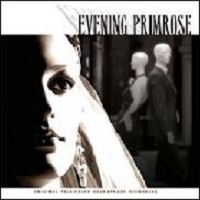 Television Cast, 1966 (Kritzerland) (3 / 5) Stephen Sondheim provided a brief but compelling score for this TV musical with a teleplay by James Goldman, based on a short story by John Collier. It tells the odd tale of a struggling poet named Charles, who decides to retreat from society by remaining in a Manhattan department store after closing time; he apparently intends to remain there alone indefinitely, retreating to the store’s nether regions during business hours, but soon he comes upon a small group of people who have decided to do the same thing. Charles falls in love with Ella, a young woman who has lived in the store since early childhood and barely remembers the outside world. In the telecast, Charles was played by Anthony Perkins, Ella by Charmian Carr. No cast album was released until 2008, when Krizerland transferred the soundtrack recordings of the songs to CD. Since it was never a stage musical and is unlikely ever to be one, Evening Primrose doesn’t warrant a lengthy review here, but it must be said that the four-song score contains two of the best ballads Sondheim ever wrote: Ella’s touching reminiscence “I Remember,” and the gorgeous duet “Take Me to the World.” Perkins, who had not very successfully tried his hand as a musical theater leading man in the 1960 Broadway show Greenwillow, is well cast and persuasive as Charles, while Carr, best known for her performance as Liesl in the mega-hit film version of The Sound of Music, is a plaintive Ella. The mid-’60s monaural sound quality of the recording is not great but acceptable. [Note: The full, 52-minute telecast is available separately on home video.] — Michael Portantiere
 Studio Cast, 2001 (Nonesuch) (4 / 5) The first part of this essential album contains the first commercial recordings of the songs that Sondheim wrote for The Frogs (see separate review, under that title). The second part is devoted to his even-briefer score for Evening Primrose, the 1966 TV musical that concerns the drop-out poet Charles’s encounter with, as Frank Rich phrases it in his notes for this recording, “a mysterious nocturnal society of eccentric shut-ins as well as the muse he’s been searching for, a sort of modern Rapunzel named Ella.” Here, Charles and Ella are sung by Neil Patrick Harris and Theresa McCarthy. Both do fine jobs of delivering the highlights of this mini-musical that are mentioned in the review above, as well as the score’s only other two numbers: Charles’s character-establishing “If You Can Find Me, I’m Here” and the extended duet “When?” All of the songs benefit greatly from Jonathan Tunick’s typically superb orchestrations as played by the American Theatre Orchestra under the baton of Sondheim specialist Paul Gemignani. The CD boasts Nonesuch’s usual, first-rate recorded sound: powerful but not harsh, ambient but not overly reverberant, with great dynamic range. — M.P.
Back to the Future
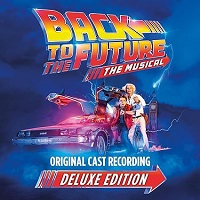 Original London Cast, 2022 (Masterworks Broadway) No stars; not recommended. These days, when you hear that a beloved movie is getting turned into a musical, it sounds less like an announcement and more like a threat. Yes, movies have inspired great musicals in the past., but the modern trend of these “adaptations” leans toward slavishly faithful recreations of the cinematic source material, with a couple of by-the-numbers songs pinned on. Enter Back to the Future: The Musical, which takes reverence to a new level. The script is by Bob Gale, who co-wrote the original movie’s screenplay and has spent decades overseeing the franchise; and the score is by Glen Ballard and Alan Silvestri, the latter of whom composed the music for the original movie and its sequels. Based on the classic 1985 original starring Michael J. Fox, the story tells of a kid living in the 1980s who accidentally goes back in time and meets his parents when they were teenagers. The stage musical version that yielded this recording first opened in the West End, then transferred to Broadway. (No cast album of that production has yet been recorded or released.) It’s a very lazy adaptation: From the beginning of the “Overture,” in which not a single note of any of the new music written for the show is heard, you can tell what the creative team’s intentions were. Instead, you get the movie’s recognizable theme in a heavily flourished arrangement, which ends up sounding like the product of a computer program. Ethan Popp and Bryan Cook’s orchestrations sound better in the actual songs, which unfortunately range in quality from instantly forgettable (“Got No Future” and “Future Boy”) to instantly regrettable (“My Myopia” and “Teach Him a Lesson”). Most of the lyrics sound like they were done on a first pass, while many of the melodies are vaguely reminiscent of better tunes. When the writers aren’t going for the most basic concepts in their songs, they decide to adhere even more faithfully to the movie by incorporating the exact same ’50s pop hits in the final sequence (“Earth Angel” and “Johnny B. Goode”) before tacking on the movie’s Oscar-nominated “The Power of Love” at the end. The cast is made up of talented singers, with Olly Dobson and Roger Bart starring as the iconic duo of Marty McFly and Doc Brown, respectively, but they’re mostly tasked with having to shoot for the ceiling of their vocal registers in every song. And when they’re not navigating the vocal demands, they’re forced into a competition of who can provide the most uncanny impression of their film counterparts; Hugh Coles as George McFly easily wins with an eerie imitation of Crispin Glover. If Gale, Silvestri and Ballard had been willing to take any creative chances, or alternatively had stepped aside for a team of writers who would have done so, this show might have been surprisingly delightful and/or enjoyably campy. But as it stands, there’s nothing about Back to the Future: The Musical that makes any strong argument for its existence. — Matt Koplik
13
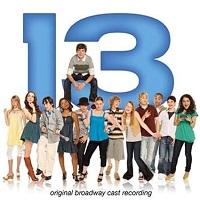 Original Broadway Cast, 2008 (Ghostlight) (2 / 5) Musical theater writers from Strouse and Adams to Pasek and Paul have tried to write musicals capturing the spirit of what it means to be a teenager. As a teen myself (at this writing), I have to report that Jason Robert Brown’s 13 is pretty far off the target. Brown, who has written brilliant and complex musicals about adults, did not apply the layers to these young characters that they deserve, instead choosing to employ stereotypes and a paper-thin plotline that does not merit such a lengthy score. The show tells the story of about-to-be Bar Mitzvah boy Evan (portrayed admirably by Graham Phillips), who finds his life uprooted after his parents get divorced and he is forced to move from New York City to a town in Indiana, referred to by the show’s best known song as “The Lamest Place in the World.” The opening number/title song is quite catchy and fun, but the score goes downhill from there. One of the oddest touches is “Terminal Illness,” a comedic song that Evan sings to his friend Archie (Aaron Simon Gross), who has been diagnosed with muscular dystrophy, as a way of convincing him to use his disease for emotional manipulation of others. The song comes across as not only tone-deaf, but so upsetting in reference to a 13-year-old boy that its place at the beginning of the album lost this listener. The more fun moments in 13 are conveyed in admittedly simple music and lyrics, such as the cheerleading blast “Opportunity” (cut from the stage show but included on the recording) and the doo-wop-inspired “Bad, Bad News.” This show deserves credit for casting actors whose ages were close to those of their characters, but that’s not entirely an upside, as the voices of the pubescent actors sometimes sound pretty rough and untrained. That said, 13 served as a very early credit for future superstars Elizabeth Gillies and Ariana Grande. Both of them give charming performances, but in the end, none of the earnest cast members can salvage the material, especially the show’s almost laughably predictable conclusion: “A Little More Homework.” Nor are they helped by the fact that every song is about twice as long as it needs to be. Puberty is unquestionably difficult to get through, but did a musical about it need to give us the same feeling? — Charles Kirsch
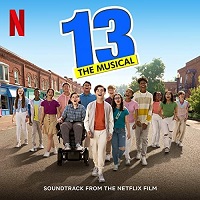 Film Soundtrack, 2022 (Netflix Music) (4 / 5) Right from the start of this recording, it’s easy to tell that the score of 13 has been completely redone for the Netflix film version — but that’s not a bad thing. Vocals are provided by child actors including the charming Eli Golden as Evan and Gabriella Uhl, who is talented beyond her years, as his neighbor Patrice. These performances combined with new, pop orchestrations make 13 what it always should’ve been: a high-octane, if slightly generic, romp. In this form, with 30 minutes of musical filler taken out and three new songs added, the score is far better suited to the thin story and manages to make more of an impact by trying to do less. Brown’s new compositions are noteworthy, especially “It Would Be Funny,” a heartfelt and catchy duet for Evan and the added character of his mother (played nicely by Debra Messing). “The Bloodmaster” is an excellent song for a moment that always should have been musicalized. “I’ve Been Waiting” uses the lead vocals of Lindsey Blackwell to bring a more up-to-date musical style to the score. Bonus tracks include an admirable rendition of “What It Means to Be a Friend,” sadly cut from the final product, and an auto-tuned cover of “Tell Her” by Alec Benjamin that effectively hides the song’s sappy lyrics. While purists will prefer a fuller version of the score, those seeking a shorter and sweeter listening experience should choose the Netflix album. — C.K.
Harmony
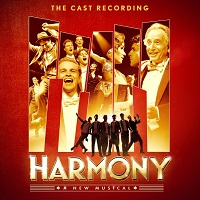 Original Broadway Cast, 2023 (Sh-K-Boom) (4 / 5) It took Barry Manilow and Bruce Sussman’s musical Harmony 26 years to get to Broadway, more than four times as long a period as the Comedian Harmonists themselves performed across the globe before being fractured by the Nazi regime. What we have here is not only a recounting of the sad but true story of that group but also a tribute to musical theater itself, with various songs reminiscent of the work of Gilbert & Sullivan, Sondheim, and Bock & Harnick. This score’s “The Wedding” has to be one of the most effective uses of traditional-sounding Jewish melodies since Fiddler on the Roof, and the 11 o’clock number ends with a dramatic rendition of the “Sh’ma,” in what may be a knowing nod to Jason Robert Brown’s Parade. The young men who play the Comedian Harmonists, including Sean Bell and Danny Kornfeld as the two who seem most central to the plot, unquestionably produce skillful and satisfying harmonies, even if the timbre of their voices doesn’t quite suggest the era in which the show is set. Chip Zien, as an older version of one of the group, is tasked with narrating the show, and his gravitas helps to balance out some of the less powerful lyrics. Two of the cast recording’s strongest points are the expert vocal performances of Julie Benko and Sierra Boggess, whose duet “Where You Go” is haunting and memorable; one only wishes they had more to do on the album. The songs range from sarcastic comments on the Nazi regime (“Come to the Fatherland”) to imitations of flimsy 1930s numbers (“We’re Going Loco,” which hews closely to Manilow’s hit “Copacabana”), and are made more enjoyable by the rich, snazzy orchestrations of Doug Walter. While this score may not be unique enough to merit a place of high honor in the canon, many listeners will agree that the 26-year journey paid off. — Charles Kirsch
Big City Rhythm
 Original Off-Broadway Cast, 1996 (Original Cast Records) (3 / 5) The heyday of the intimate revue may have been decades ago, but some good ones have surfaced more recently. Consider Barry Kleinbort’s winning song cycle Big City Rhythm, blessed with a high-powered cast and Christopher Denny’s tasteful piano arrangements. As a composer-lyricist, Kleinbort has lots of range and is willing to serve up old-fashioned melody or new-fashioned lack thereof as suits the material. Some inside jokes may be lost on some listeners — for example, the salute to Broadway leading ladies who can’t sing — but those in the know will love them. Lots of stuff more accessible to the general public is here as well, including an extended medley of proposed theme songs for unlikely movies, one of the funniest of which is “Psycho, Are You Lonely Tonight?” Marcia Lewis is adorable as a peripatetic sophisticate in “I Get Around,” Lewis Cleale and Eric Michael Gillett are stalwart leading men, and Melanie Vaughan is exceedingly funny as a difficult chanteuse just out of the Betty Ford Clinic. Some of the strongest numbers are from Kleinbort’s proposed musical version of Garson Kanin’s The Rat Race; they’ll make you eager to hear more. — Marc Miller
Bed & Sofa
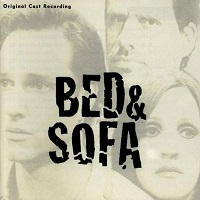 Original Off-Broadway Cast, 1996 (Varese Sarabande) (4 / 5) A stylized, three-character “silent movie opera” by composer Polly Pen and playwright Lawrence Klavan, Bed & Sofa premiered just over a decade after Pen’s avant-garde Goblin Market. Like that show, it was presented Off-Broadway by the Vineyard Theatre, was directed by André Ernotte, and was showered with awards and nominations. Based on the 1927 Soviet film Tretya meshchanskaya by Abram Room and Victor Shklovsky, the piece centers on a married couple that invites the husband’s homeless army buddy to crash indefinitely on the sofa in their tiny flat. When the husband leaves town on business, his wife and friend embark on a passionate affair. Returning to find himself displaced in the bed, the husband winds up on the sofa. For a time, the resulting ménage à trois works pretty well, but then it’s beset by conflicts such as how to deal with the woman’s pregnancy and the mystery of which guy is the sire. Eventually, the woman discovers that her new man is as flawed as the old one, and she departs, leaving both sofa and bed to the men. Pen is often accused of lacking a flair for melody, but here she delivers a stunning score with dulcet arias that owe a debt to Mussorgsky, Prokofiev, and Russian folk tunes. With supervision by Ernotte and musical director Alan Johnson, Terri Klausner gives the wife earthiness and vigor, while Michael X. Martin as her spouse and Jason Workman as the interloper complete an ideally balanced ensemble. — Charles Wright
The Beautiful Game
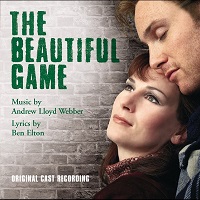 Original London Cast, 2000 (Telstar) (3 / 5) Those who would type Andrew Lloyd Webber as a purveyor of lightweight poperettas may not know what to make of this tragic love story set against a background of social strife in Northern Ireland. Although the score lacks emotional variety, with too many sweet melodies, and Ben Elton’s frequently profane lyrics are hardly cliché-free, it’s a sincere attempt at something different and challenging from a composer who could certainly have rested on his laurels. Josie Walker and David Shannon sing attractively as Mary and John, the young couple whose lives are destroyed by the escalating violence between Catholics and Protestants. Walker partners beautifully with Dianne Pilkington as a Protestant girl in the unsettling “God’s Own Country” and makes something wrenching out of “If This Is What We’re Fighting For,” a bitter denunciation of the self-righteousness behind the violence. The title number has a harsh, celebratory vigor that one rarely associates with Lloyd Webber, who did the orchestrations with David Cullen. Although this score is far from a total success, the recording is well worth a listen — David Barbour
Ballad for Bimshire
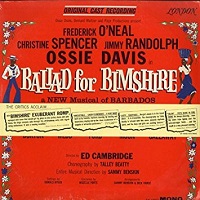 Original Off-Broadway Cast, 1963 (London/no CD)
  (1 / 5) This Off-Broadway oddity probably got produced because of the reputation of its composer, Irving Burgie — also known as Lord Burgess. Having written several songs that were popularized by Harry Belafonte, Burgie was one of the most prominent calypso writers of the period. But this show is more well meaning than well crafted; the writers and production team all had limited musical theater experience, and they produced a piece that, judging from the cast album, doesn’t seem to know what it wants to do or how to do it. Ballad for Bimshire clearly had a book — co-producer and co-star Ossie Davis, a driving force behind the production, narrates the story, but it’s not compelling and more than a little amorphous. The lyrics are negligible, which leaves only the tunes. They’re frequently appealing but, because they’re on their own, dramatically unrewarding. — David Wolf
Bubbling Brown Sugar
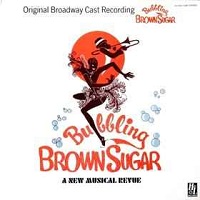 Original Broadway Cast, 1976 (Amherst) No stars, not recommended. This is arguably the least necessary Broadway album ever. Yes, the show was a hit (766 performances), and it served as the template for many black music revues to come, but this musical tour of Harlem in its renaissance days is the rough equivalent of one of those compilation albums that used to be hawked on cable TV. Jazz fans, who already know many recordings and arrangements of these songs, won’t be interested in over-theatricalized renditions of such standards as “Sophisticated Lady,” “Sweet Georgia Brown,” and “God Bless the Child,” while others will be puzzled by the occasional original number — one of which keeps reminding us that “Bubbling Brown Sugar is the stimulating Harlem treat.” This is one A train you don’t have to take — David Barbour
The Madwoman of Central Park West
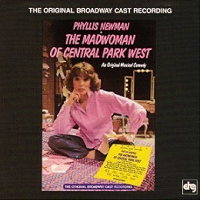 Original Broadway Cast, 1990 (DRG) (3 / 5) This show was a good time, but the cast recording — only 37 minutes in length — is of little help in bringing back the experience for those who saw it, or giving a good idea of it for those who didn’t. The Madwoman of Central Park West is about Phyllis Newman trying to get her life together. It begins as she drags herself out of bed, singing “Up! Up! Up!”, written for an unfinished Skin of our Teeth adaptation by Leonard Bernstein, Betty Comden, and Adolph Green (Newman’s husband). Other numbers included are “What Makes Me Love Him?” (from the Jerry Bock-Sheldon Harnick-Jerome Coopersmith musical The Apple Tree), Ed Kleban’s irresistible song “Better,” and a very funny version of the Bruce Sussman-Jack Feldman-Barry Manilow hit “Copacabana.” But the one item that makes this album essential is “Don’t Laugh,” written by Mary Rodgers and Martin Charnin for Hot Spot (which starred Judy Holliday), then doctored on the road by Rodgers’ friend Stephen Sondheim, who added the wonderful “show me” sections: “Show me a glass of water, I’ll show you a soggy dress / Show me a tube of toothpaste, I’ll show you a mess / Show me a fresh-laid sidewalk and guess where my footprints are / Show me a fire hydrant, I’ll show you my car.” (Note: There was a TV adaptation of The Madwoman of Central Park West, so you may be able to seek that out and see it for yourself.) — David Wolf
Make a Wish
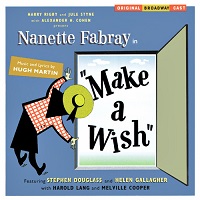 Original Broadway Cast, 1951 (RCA/Sepia) (4 / 5) A spiffy overture, a swell opening chorus (“The Tour Must Go On”), then out comes our heroine with an even better character-establishing number, “I Wanna Be Good ‘n’ Bad.” In Hugh Martin’s musical adaptation of Ferenc Molnar’s The Good Fairy, Fabray is a Parisian orphan who breaks away from the orphanage and runs smack into an aspiring barrister, played by Stephen Douglass. The two stars are strictly A-list. As the second couple, Helen Gallagher and Harold Lang play a bickering nightclub duo. The cast album is generous with song-setting dialogue, and Martin’s score is up-tempo and unpretentious, offering lots of chances for this gifted quartet to shine. The ballads are also choice, particularly Fabray’s “What I Was Warned About” and Douglass’s “When Does This Feeling Go Away?” Yet even with a Preston Sturges book and show-stopping Gower Champion dances (the music for one of the ballets is included here), this musical was not a hit — and you can hear why. Halfway through the recording, there’s a silly march (“Paris, France”), and most of what follows sounds like filler. By the time Fabray, Lang, and Gallagher are slamming across “Take Me Back to Texas With You” (“My poor eyes will get all watery / When I see Monsieur Gene Aut-e-ry”), you’ll realize what a hodge-podge the score is, its ambience careening uneasily between Paris and Passaic. Martin’s vocal arrangements, so much fun when he’s serving other composers, just sound garish when he’s working his own stuff into the ground, as in “That Face.” Still, the four leads are tops, and the gold in this mixed bag outweighs the dross. — Marc Miller
Avenue X
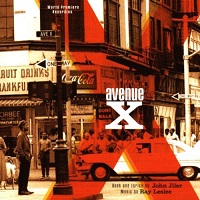 World Premiere Recording, 1997 (RCA) (4 / 5) Avenue X shows how some folks in the racially divided America of the early 1960s tried to achieve peace and harmony through rock and roll. The theme is similar to that of Hairspray, but here the locale is Brooklyn rather than Baltimore, and the show ends in tragedy rather than joy. A highly unusual feature of this musical is that all of the songs are sung a cappella, persuasively performed on this recording by an excellent cast. There are only eight singers — Colette Hawley, Cheryl Alexander, Ted Brunetti, John Leone, John-Martin Green, Jerry Dixon, Chuck Cooper, and Wilbur Pauley — yet their vocal harmonies are so lush that they sound like twice that many people. (Dixon is the music director.) Indeed, the wall of sound heard in the arresting “Prologue” may convince you that you’re hearing an orchestra playing along. Rather than advancing the plot or establishing and limning the characters, the songs by Ray Leslee (music) and John Jiler (lyrics) are performance pieces that skillfully conjure the style of the period. Highlights include the ensemble number “A Thousand Summer Nights,” Hawley’s “Woman of the World,” and the two songs that end the show: “Go There,” in which Alexander laments “There are dreams that die before they ever live,” and the touching “Where is Love” (not to be confused with the song of the same title from Oliver!). The CD booklet notes tell us that, “following an extended run Off-Broadway at Playwrights Horizons, [Avenue X] played in roughly two dozen cities, winning ‘Best Musical’ awards and nominations virtually everywhere it has gone.” This recording is a winner, too. — Michael Portantiere