 Studio Recordings by the Original Broadway Cast, 1935 (Smithsonian/no CD)
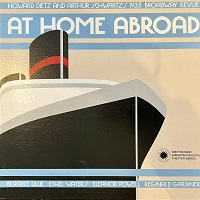
  (3 / 5) Star-packed musical revue were always welcome attractions on Broadway during the Depression years. Billed as “A Musical Holiday,” At Home Abroad bolstered its thin and engaging overall theme — Americans traveling to foreign countries — with a fine score by Arthur Schwartz and Howard Dietz and a cast headed by Beatrice Lillie, Ethel Waters, and Eleanor Powell. The show was designed and staged with a good deal of dazzle by a gifted newcomer, Vincente Minnelli; even so, its 198-performance run was felt to be something of a disappointment. Despite this, the cast members made a number of studio recordings of songs from the score, including Waters’ insinuating “Thief in the Night” and two definitive Bea Lillie numbers, “Paree” and “Get Yourself a Geisha” — the latter with its insistent refrain, “It’s better with your shoes off.” As part of an ongoing effort to reconstruct lost musicals, the Smithsonian Institution issued an LP that collected these items and added a few numbers recorded later by Karen Morrow, Nancy Dussault, and other performers. If the score lacks the classic stature of Schwartz and Dietz’s earlier The Band Wagon, there’s still a lot to treasure here, including Eleanor Powell’s extended tap breaks in “What a Wonderful World” and “Got a Bran’ New Suit.” As always with Smithsonian releases, the accompanying notes detail the recordings with both erudition and enthusiasm. — Richard Barrios
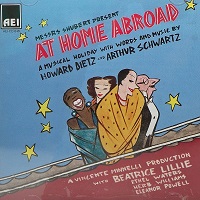 Live and Studio Recordings by the Original Broadway Cast, 1935 (AEI) (3 / 5) The Smithsonian collection might have seemed the last word on At Home Abroad, but guess again. It turns out that there also exists a set of decrepit discs containing recordings of large portions of the show in live performance. Whether or not the source was a radio broadcast is unclear; although the sound quality gives new meaning to the phrase “low fidelity,” the material was skillfully transferred to the digital domain by the intrepid folks at AEI. The studio recordings by Beatrice Lillie, Ethel Waters, and Eleanor Powell noted in the review above are also included on the CD, and the patient listener will be rewarded with a very good sense of how this big and bouncy show operated. AEI obviously took great care with the project, going so far as to splice parts of Lillie’s studio version of “Dinner Napkins” into an otherwise live recording so as to get the best overall sound quality possible. Especially to be enjoyed here are Waters’ live performances of “Loading Time” and “Got a Bran’ New Suit,” which she did not record otherwise. Unfortunately, the CD booklet notes are inadequate — a chronic failing with AEI. And it’s really too bad that the original recording technology sounds as if it relied on tin cans and strings. — R.B.
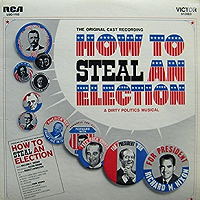
 (2 / 5) A young black man (Clifton Davis) and a young white woman (Carole Demas), both veterans of the disastrous 1968 Democratic National Convention in Chicago, somehow meet Calvin Coolidge (D.R. Allen), who essentially gives them a lesson in the various forms of chicanery that resulted in the election of many American presidents. Combining authentic songs from past political campaigns with Oscar Brand’s new book songs for the two young idealists, How to Steal an Election has Cal trying to convince the kids that at least some trickery is necessary for the system to work. (After the young woman sings “Mr. Might’ve Been,” about President Kennedy, Coolidge reveals that her hero was not above some questionable political maneuvers.) The new songs are of varying quality, the old songs are interesting and sometimes funny, and the show’s subject matter is surprisingly topical in the early years of the 21st century. But, of course, the lesson imparted here — that stealing elections is somehow a good thing — is highly debatable. — David Wolf
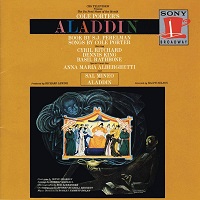
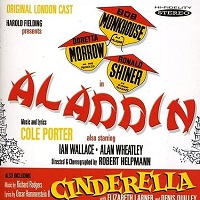
 (1 / 5) Cole Porter’s Aladdin was never adapted for presentation on Broadway, but the London stage production — tarted up as a Christmas pantomime — yielded this unfortunate recording. It includes a few songs interpolated from other Porter shows, none of which fit the spirit and tone of the original; they’re too jazzy and out-of period. Doretta Morrow displays a wonderful voice on the recording, but it sounds, shall we say, too mature for the character of the princess. (She does offer a first-class rendition of “I Am Loved,” interpolated from Out of This World.) Cyril Ritchard is sorely missed on this recording, as is the maturity and authority of Dennis King. And whereas the original TV production had great orchestrations by Robert Russell Bennett, this one features more “mod” arrangements that haven’t withstood the test of time. — K.B.
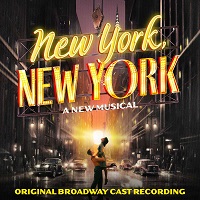
 (0.5 / 5) New York, New York is destined to go down in musical theater history books for its creative team, which includes the legendary composer John Kander as well as director/choreographer Susan Stroman and lyricist Lin Manuel Miranda, who spearheaded the two most Tony-nominated musicals of all time. Unfortunately, the show itself will be remembered as a colossal disappointment: Rather than a love letter to the city that doesn’t sleep, or even to the post-WW II era in which the action takes place, what we have here is a misguided mishmash of weaker items from the Kander & Ebb repertoire forced into a stage musical with the number of main and featured characters greatly expanded from the film on which it is very loosely based. The plot largely concerns the troubled romance between struggling musician Jimmy Doyle and struggling singer Francine Evans, but the creators seem to have determined that these characters weren’t interesting enough for an entire show. As a result, also on hand to clutter up the proceedings are an Hispanic immigrant and his abusive father and loving mother, a cleaning woman turned opera singer, a Jewish immigrant and his violin teacher, et al. “A Quell ‘Amor,” performed by the newly minted opera singer, is perhaps the nadir of the show; it makes no sense in or out of context, we never hear from its singer again, and the song’s title is 50% of its lyrics. Indeed, lyrics are not the primary concern of this production, as shown by the inclusion of six extended instrumental pieces titled “Morning in New York,” “New York in the Rain,” “New York in the Summer,” “New York in the Snow,” “New York at Night,” and “New York Concerto.” (Orchestrators Sam Davis and Daryl Waters have done an admirable job of creating a period feel and an excitement that’s lacking in the plot.) One of the oddest aspects of the show and this album is the fact that Colton Ryan, who portrays Jimmy Doyle, sings every song as if he were being strangled, emitting some of the ugliest vowel sounds ever heard. On the other hand, Anna Uzele as Francine raises the roof with her big numbers, but her acting is not quite at the level of her vocal ability. The only two pitch-perfect performances are from Emily Skinner, as the aforementioned violin teacher, and the sadly underused Clyde Alves, as the leading man’s best friend. Four demo recording are appended to this album, and in the tracks where you can hear Fred Ebb singing his own material, you start to understand what this show could’ve been if that great lyricist had lived longer: a unique, biting, entertaining final curtain call for Kander & Ebb. Instead, listeners may end up, to quote one of the show’s stronger songs, sorry they asked. — Charles Kirsch
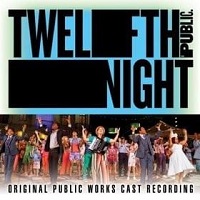
 (4 / 5) The first (and better) of Shaina Taub’s pair of Shakespeare-inspired scores for the Public Theater’s Public Works program, Twelfth Night marvelously marries Taub’s distinctive blues-inflected funk pop vocabulary with Mike Brun’s New Orleans brass arrangements. Taub turns Shakespeare into an ideal collaborator; spoken excerpts of the play’s text weave seamlessly in and out of the songs, and Taub finds the germ of each song in Shakespeare’s language. A well-constructed opening number, “Play On,” musically stresses the story’s love triangle. Nikki M. James (Viola), Nanya-Akuki Goodrich (Olivia), and Ato Blankson-Wood (Orsino) all sing terrifically, and Taub frequently throws her characters into sinewy, climactic counterpoints that capture the play’s tangled romantic webs. The comic material for Sir Toby Belch (Shuler Hensley) and Malvolio (Andrew Kober) is slighter stuff, but Taub adds in a few fun ensemble numbers (example: “Word on the Street”) for Illyria’s gossipy citizenry. Best of all is “Is This Not Love,” a ballad sung yearningly first by Taub herself as the clown, Feste, and then reprised powerfully by ensemble member Vivian Jett. — Dan Rubins