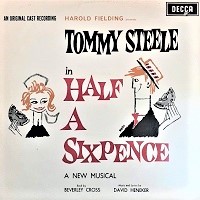
 Original London Cast, 1963 (Decca/Must Close Saturday)
  (3 / 5) There’s no question that Half A Sixpence, the musical adaptation of the H. G. Wells novel Kipps, was all about spotlighting Tommy Steele, the British singer, guitarist, and banjo boy who won teenage hearts in the late 1950s before turning to theater. Steele brings gregarious energy to the role of Arthur Kipps, a hard-working orphan who inherits a surprise fortune that leads him astray. (You can almost hear his grin through your speakers.) But although he may be the scene-Steeler here, the real star is David Heneker’s utterly lovely, music hall-inspired score, buoyed by the sweeping orchestrations of Arthur Wilkinson and Peter Knight and well conducted by Kenneth Alwyn. Marti Webb plays Arthur’s down-to-earth childhood sweetheart Ann with Cockney brassiness; the role would diminish a bit in subsequent productions, but Webb makes a meal of the substantial material she’s given here. Anna Barry as Ann’s rival, Helen, has a quirky operatic song, “The Oak and the Ash,” which would be gone by the time the show reached Broadway. And though this original London cast album doesn’t give us the most electric of Steele’s recorded performances in the role, it preserves a number of songs that aren’t available anywhere else in their original form, such as the Blue Danubey waltz “The Old Military Canal,” the gently bouncing duet “The One That’s Run Away” (which would be repurposed for the 2016 revisal), and a lengthy, two-part counterpoint number, “I’ll Build A Palace”/”I Only Want A Little House,” that seems like a British precursor to “An Old-Fashioned Wedding,” written by Irving Berlin for the 1966 Lincoln Center revival of Annie Get Your Gun. — Dan Rubins
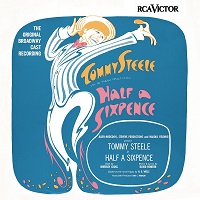 Original Broadway Cast, 1965 (RCA)
  (4 / 5) Judging from the cast album, the original London production of Half a Sixpence already seemed like The Tommy Steele Show, and the cuts and additions made for Broadway took that to the next level: Steele sings in all but one song on this recording. Once again, charm ripples across David Heneker’s melodies — now with even more gorgeous orchestrations from Jim Tyler, best known for La Cage aux Folles — especially in the lilting title song and a sweet ballad, “Long Ago,” for Arthur and Ann (Polly James). While the show is overstuffed with ensemble numbers (“The Party’s On The House,” added for the Broadway production and including a weirdly American-sounding swing section, is least essential), most of them are pleasant listens, with dance arrangements and orchestrations by Robert Prince. “If the Rain’s Gonna Fall” is an especially jubilant, strolling tune that showcases Heneker’s lyric-writing aptitude, so jovial that the occasional oddball rhyme can be forgiven. “What could be wetter or damper / Than to sit on a picnic hamper / Sipping a sasparilla / Underneath the leaky umbrella?” croon Steele and the cast, and it’s totally delightful. Equally rewarding are the instrumental gems scattered throughout the album — for example, Steele’s dextrous banjo solo in “Money to Burn,” a touching flute and violin duet in the middle of “Long Ago,” and the short but sumptuous overture. — D.R.
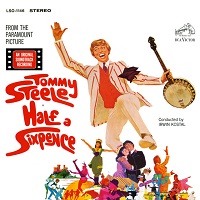 Film Soundtrack, 1968 (RCA; no CD) No stars, not recommended. All the joys of this score and in Tommy Steele’s performance can be found on the original Broadway cast recording, so there’s no need to brave the bloated soundtrack of the 1967 film adaptation in which Steele resurrected his banjo-toting Arthur Kipps. Here, every production number is extended towards eternity — “Money to Burn,” “If the Rain’s Got to Fall,” and “Flash, Bang, Wallop!” are now each seven minutes long — and whatever cinematographic choices merited such garish supersizing are obviously absent from the listening experience. Meanwhile, several songs have been cut and replaced, but of the new material, only Steele’s jaunty “Lady Botting’s Boating Regatta Cup Racing Song,” co-written by the legendary orchestrator Irwin Kostal, is worth checking out. Otherwise, Kostal’s jangly arrangements — far from his finest work — feature extensive circus and martial sounds, marching bands, and a tacky a cappella choral opening. Marti Webb, the original Ann in London, dubs Julia Foster’s singing in that role, but her soundtrack performance lacks grit: “I Know What I Am,” for instance, is plaintive and whimpery instead of boldly assertive. As for co-star Cyril Ritchard, a hammy upside of the film, his voice is basically unidentifiable on this album. Even Steele’s banjo solos here sound more interminable than impressive. — D.R.
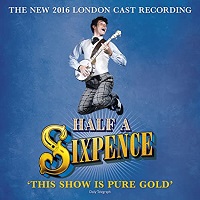 London Cast, 2016 (Exallshow Ltd)
  (1 / 5) Captured as a live recording, the aggressive revisal of Half a Sixpence that opened in 2016 at the Chichester Festival in England and later transferred to London’s West End largely drained the score of its sweet wittiness. As George Stiles and Anthony Drew had done with the stage adaptation of Mary Poppins a few years earlier, the team here again added numerous songs of their own to a pre-existing score while revising many of the originals. (There was also a brand-new book, by Downton Abbey’s Julian Fellowes.) Unfortunately, the new songs sound quite a bit like the ones that Stiles and Drew came up with for Poppins (the first two new numbers, “Look Alive” and “Believe In Yourself,” are almost rip-offs of “Cherry Tree Lane” and “Anything Can Happen”) but not at all like the work of David Heneker. And the eight and a half songs that do survive from the 1960s (“I Know Who I Am” is sadly truncated) are largely stripped of their warmth; William David Brohn’s orchestrations radiate slick bombast but seldom the tender charm of the originals. Charlie Stemp had a giddily agile presence and exuded a mix of puppy-dog innocence and deer-in-the-headlights bewilderment as Arthur Kipps on stage, but on record, he lacks the dynamic energy — not to mention the banjo skills — of Tommy Steele. Because this is a live album compiled from multiple performances during the show’s Chichester Festival Theatre run, before the West End transfer, each number is followed by lengthy applause that detracts from the listening experience, as does audience laughter at staging we can’t see. — D.R.
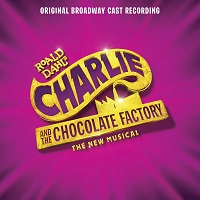
 (2 / 5) This Broadway recording is a marked improvement over the London cast album, not least for the reintroduction of most of the songs from the 1971 film Willy Wonka and the Chocolate Factory: “Candy Man,” “I’ve Got A Golden Ticket,” and “Oompa Loompa” all join “Pure Imagination.” Christian Borle has greater range than Douglas Hodge as Willy Wonka, and his opening rendition of “The Candy Man” sets a clearer tone for the character. The album generously rotates through the three young actors who played Charlie on Broadway, with Jake Ryan Flynn making a particularly terrific impression in a new, joyous waltz, “Willy Wonka! Willy Wonka!” and also in “The View From Here,” a sweet ballad with rousing counterpoint. Most of the other kids’ songs, including the deadly “Vidiots,” remain in some form; but a major casting change, with adults playing all the children except Charlie, makes the show’s added cruelties towards these characters somewhat more tolerable. That said, a notorious scene from this production, in which squirrels tear Veruca Salt (now inexplicably Russian) to pieces, is commemorated on the album in “Veruca’s Nutcracker Sweet,” which contains tasteless couplets such as “Veruca Salt was once en pointe / But watch as we dislocate each joint.” On the plus side, Trista Dollison is especially good in “The Queen of Pop,” Violet’s intro song, which recalls Shaiman and Wittman’s far superior work for Hairspray. The new, discomfiting song “When Willy Meets Oompa” seems to double down on the Oompa Loompa plot line’s colonial undercurrents, but there’s enough inoffensive sweetness elsewhere — courtesy of the three Charlies, John Rubinstein’s Grandpa Joe, and Borle’s ballads — to make this a listenable album. — D.R.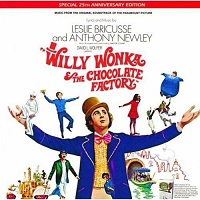


 (5 / 5) Based on David Lindsay-Abaire’s play of the same title, Kimberly Akimbo tells the story of Kimberly Levaco (Victoria Clark), a girl with a rare disease that causes her body to age rapidly, causing her to look 65 at the age of 16. Despite this major setback, Kimberly is determined to enjoy as much of her life as she can, since she’s unsure just how much longer her life will last. It’s that blend of sardonic edge and heartfelt optimism that ultimately makes this such a special musical. In their second collaboration, Lindsay-Abaire and composer Jeanine Tesori have created an unassuming work that hides its creativity and complexity in plain sight. Abaire’s lyrics are exceptionally intelligent, sometimes taking twisted turns (the hilarious “Better”) and sometimes deeply earnest (the quietly devastating “Before I Go”), but always organic to the story and characters, and never calling attention to themselves. Tesori, meanwhile, proves once again that she is one of the most versatile musical theater composers around. She has created here a score filled with pastiches of numerous song genres (’90s folk, ’70s disco, blues, current pop, faux-classical), yet the score never has the feeling of oscillating from one style to the other; rather, it seamlessly blends. The cast is exceptional. Steven Boyer and Alli Mauzey are appropriately narcissistic as Kimberly’s parents, getting a chance to show their characters’ messiness (in Boyer’s “Happy for Her” and Mauzey’s “Hello Darling” and reprises) while also displaying some depth (in “Hello Baby” and “Father Time”). Bonnie Milligan is a scene stealer as Kimberly’s delinquent aunt Debra, whose latest scheme consumes much of the plot of Act Two. Given the most off kilter humor of the show, Milligan offers dry delivery of dialogue and barn raising vocals that ground Abaire’s comedy, keeping songs such as “Better” and “How to Wash a Check” from going off the rails. Justin Cooley is incredibly charming as Kimberly’s classmate Seth, who has a passion for making anagrams (the show’s title is a blend of Kimberly’s name and the anagram Seth makes out of it). At the center of it all, Clark is other-worldly good in the title role. In songs like “Anagram” and “Make a Wish,” one can hear her communicate Kimberly’s teenage spirit while also embracing the character’s elderly body and voice, but Clark refuses to go broad or become a caricature. Like the musical itself, the simplicity of her performance is what makes it so profound. Happily, the audio quality of this recording is so crisp and clear that listeners can hear every nuance of the vocal performances, as well as John Clancy’s multi-faceted orchestrations and Tesori’s tight vocal arrangements for the teenage ensemble. One could keep going on about every minute aspect of this cast album, but the ultimate praise is to tell you to just go ahead and listen. And then listen again. And again. — Matt Koplik