 Original London Cast, 2024 (If I Believed Ltd)
  (2.5 / 5) This recording showcases the score of a charming, two-character musical, but it struggles to maintain momentum across its full runtime. The plot of Two Strangers (Carry a Cake Across New York) follows Dougal, a relentlessly upbeat young Brit played with wide-eyed energy by Sam Tutty, and Robin, a cynical New Yorker portrayed with grounded soulfulness by Dujonna Gift. The titular cake, which is only briefly mentioned on the recording, is for the wedding of Robin’s sister to Dougal’s father, and R&D are in charge of getting it to the wedding in one piece. The album gets off to a snappy start with the opening number, “New York,” but here and in other songs, the lyrics are often sloppy and contain a number of false rhymes. While Tutty and Gift have undeniable chemistry, some listeners may find the album disappointing as it indicates the show’s descent into a formulaic romantic comedy. On the plus side, there are chuckles to be had from “On The App,” a song that pokes fun at the frustrating dating app culture, as well as “Under the Mistletoe,” all about the forced, performative joy of the holiday season. And the score, by Jim Barne and Kit Buchan, does supply Robin with two well-written ballads: the forlorn “What’ll It Be” introduces us to her character, and in the touching “This Year,” she reflects on the passage of time and the quiet ache of her own unfulfilled expectations. Unfortunately, these highlights are counterbalanced by a repetitive folk-pop formula that’s wanting in terms of melodic distinction. This score works better when one is experiencing the show live as compared to hearing it out of context; the wit is present here, but the songs lack the “earworm” quality required to make them truly memorable, and for every moment of genuine vocal poignancy from Gift or infectious charisma from Tutty, there’s a stretch of musical dialogue that feels inert without the physical comedy to support it. In sum, this is a pleasant, well-produced album of an amiable entertainment, but it’s more valuable as a souvenir for those who are already fans of the show than an example of an entirely successful musical theater recording. — Forrest Hutchinson
 Original Broadway Cast, 2026 (Lux Pyramid)
  (3 / 5) The Broadway cast album of Two Strangers… represents an improvement on the original, if a marginal one. Listeners who had hoped this release would significantly expand upon the London recording with added material may find themselves disappointed; the track lists are largely the same, and in fact, the Broadway recording is slightly shorter in length. For every addition, such as the full version of “Under the Mistletoe” and a short finale reprise, there are frustrating cuts. The couple’s argument song, “What Did You Say?,” has been removed, and the dialogue is gone from the number “Be Happy.” There are also some minor but odd changes in the lyrics and dialogue — for instance, Dougal now wants to watch Lethal Weapon with his father instead of The Terminator. Reprising the role of Dougal, Sam Tutty really seems to have grown into the part, delivering a vocal performance with noticeably more character and depth. His quiet rendition of “About to Go In” near the end of the recording is touching, and his comic timing feels just right for the show and the character. Taking over the role of Robin, Christiani Pitts matches Tutty in the lighter moments and the emotional ones. She makes the most out of Robin’s standout ballads, and some listeners may prefer her more powerful belt to Dujonna Gift’s voice on the London recording. Both actors are aided by the refined orchestrations, which have a more grounded and polished tone. These small improvements that make the Broadway album the one to reach for to best appreciate this score. — F.H.
 (4.5 / 5) Michael R. Jackson has quickly become the prince of telling unlikely stories on stage, so it shouldn’t be a surprise that his unlikeliest project yet is highly successful. Teeth, based on the cult classic film of the same title, is all about Dawn O’Keefe, stepdaughter of an ultra-religious pastor and leader of the virginal “Promise Keeper Girls.” Only her geeky stepbrother, Brad, knows her secret: Dawn has a set of teeth inside her vagina that will bite off the extremities of men who violate her. Brad found this out when he put his finger in as a child, but soon, Dawn’s boyfriend and an evil gynecologist discover her power the hard way — no pun intended. After those two involuntary attacks, Dawn learns that she has a condition known as “vagina dentata.” She also learns to use her power against her friend Ryan, who non-consensually tapes their sexual encounter; against her pastor stepfather; and finally, in a Little Shop-esque finale, against all evil men in the world. That the plot is so unusual makes it all the more impressive how smoothly and intelligently Jackson’s lyrics tell the tale. Some of his turns of phrase are extremely clever: “To keep from getting routine and banal with girls like you / I just go spelunking in the birth canal with girls like you” is a particular gem. Anna K. Jacobs’ music is expressive and appropriately lurid, even if the orchestrations here are overblown. At the center of the show, Alyse Alan Louis as Dawn is that rare phenomenon, a supernova talent with a truly unique vocal quality and presence. If there’s a more achingly real expression of desire than her performance of “Shame in My Body,” this reviewer has yet to hear it. Steven Pasquale, in the dual role of the pastor and the gynecologist, has a field day with the delightfully vulgar pastiche “Girls Like You,” and Jason Gotay as Tobey runs the gamut from nicely restrained in “Modest is Hottest” to downright threatening in “When She Gave Birth” (a musical highlight). If Teeth is a difficult show to pitch in an elevator, it’s a remarkably easy one to be amused, thrilled, and challenged by. — Charles Kirsch
 (2 / 5) Not much seems worth immortalizing when it comes to the Broadway adaptation of Natalie Babbitt’s beloved 1975 children’s novel Tuck Everlasting, in which eleven-year-old Winnie meets a family blessed (or is it cursed?) with eternal life. What the cast album does partly capture for prosperity is the creative team’s misguided attempt to stretch Babbitt’s compact storytelling into a two-act musical. The score sags especially in the elongated reveries of Mae Tuck (Carolee Carmello), remembering how her husband loved her back in their double-digit days; the scheming vaudeville turns of the evil Man in the Yellow Suit (a much-put-upon Terrence Man), who has come to steal the immortalizing spring water; and the comic detective numbers for Michael Wartella and Fred Applegate. John Clancy’s folk-doused orchestrations do most of the heavy lifting here, with lots of pizzicato plucks and pan-flute toots doing their best to distract from Chris Miller’s often underdeveloped melodies. Nathan Tysen’s lyrics are marred by a forced series of rhymes such as “handbook” / “exactly as planned, look” / “cranny and nook.” Miller and Tysen do succeed dramatically in “The Story of the Tucks,” in which the family members talk over each other trying to tell Winnie their big secret. Although Sarah Charles Lewis as Winnie sounds older than her pre-teen years, and Andrew Keenan-Bolger sings with a boyish charm, the show never resolves the squeamish courtship between a 104-year-old man in a 17-year-old’s body and an 11-year-old girl (“I’ll wait for you / ’Till you turn seventeen,” he sings in the discomfiting act one finale). Also, the Broadway production’s most-praised sequence, “The Story of Winnie Foster” — a ballet in which Winnie lives a full life and then arrives at a peaceful death in old age — has hardly the same impact without the emotional narrative in the staging. — Dan Rubins
 (4 / 5) Right from the start of this recording, it’s easy to tell that the score of 13 has been completely redone for the Netflix film version — but that’s not a bad thing. Vocals are provided by child actors including the charming Eli Golden as Evan and Gabriella Uhl, who is talented beyond her years, as his neighbor Patrice. These performances combined with new, pop orchestrations make 13 what it always should’ve been: a high-octane, if slightly generic, romp. In this form, with 30 minutes of musical filler taken out and three new songs added, the score is far better suited to the thin story and manages to make more of an impact by trying to do less. Brown’s new compositions are noteworthy, especially “It Would Be Funny,” a heartfelt and catchy duet for Evan and the added character of his mother (played nicely by Debra Messing). “The Bloodmaster” is an excellent song for a moment that always should have been musicalized. “I’ve Been Waiting” uses the lead vocals of Lindsey Blackwell to bring a more up-to-date musical style to the score. Bonus tracks include an admirable rendition of “What It Means to Be a Friend,” sadly cut from the final product, and an auto-tuned cover of “Tell Her” by Alec Benjamin that effectively hides the song’s sappy lyrics. While purists will prefer a fuller version of the score, those seeking a shorter and sweeter listening experience should choose the Netflix album. — C.K.
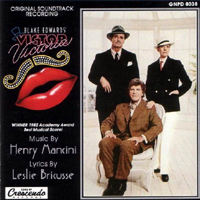
 (1 / 5) The Blake Edwards film that served as the basis for Julie Andrews’ last Broadway musical is really a comedy with a few incidental songs. Based on a 1933 German film, it stars Andrews as Victoria, a light opera soprano stranded in 1930s Paris. She’s taken in by Toddy (Robert Preston), a gay nightclub performer who reinvents her as Victor, a Polish female impersonator. Trouble sets in when King Marchan, a Chicago gangster (James Garner), finds himself attracted to “Victor.” The wildly padded soundtrack disc is filled with instrumental interludes from Henry Mancini’s easy-listening score. The film’s few actual songs, with lyrics by Leslie Bricusse, are heard repeatedly in different versions; for example, the silly specialty item “The Shady Dame From Seville.” Andrews and Preston are never less than pros, but this recording is barely worthwhile. — David Barbour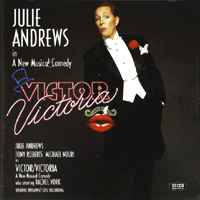
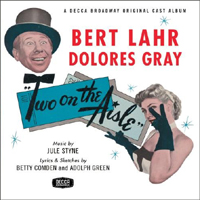
 (5 / 5) How does a recording of a second-rank show become an irreplaceable treasure? Here’s how: By 1951, the big-star Broadway revue was beginning to gather up its stars and skits for a finale, largely due to competition from television variety shows. Nevertheless, Betty Comden and Adolph Green still had a few satirical tricks up their sleeves. In collaboration with composer Jule Styne, they came up with a smart throwback to the days of headliner-packed revues, and that’s where Two on the Aisle shone most brightly, in that it starred Broadway’s premier clown and one of the greatest singers ever to set foot on a stage. Nor were their tasks circumscribed, for Bert Lahr could sing (in a unique fashion) and Dolores Gray was an ace comedienne. There were also supporting actors, none of them too impressive, and a rather gruesome pair of singing lovers. Fortunately, the cast album focuses on Lahr and Gray in both musical and comedic modes, without conveying their well-documented backstage feud. All here is golden, or close to it: Lahr’s mock-Pagliacci ode to “The Clown”; the chorus’s “Show Train,” an amusing précis of then-current stage hits; and Lahr and Gray as a vaudeville team invading the Metropolitan Opera (“You’ll be Lucia,” he blusters, “and I’ll be Sextet”). Gray is sensational, her songs perfectly tailored to her fabulous singing — intimate yet volcanic, funny, sexy, and so technically accomplished (with that precise diction) that lieder recitalists should study it. Gray’s performance of “If (You Hadn’t but You Did)” alone earns her a place in the Broadway pantheon. — Richard Barrios