

 Original Broadway Cast, 2001 (RCA)
  (4 / 5) This show, which winks at Bertolt Brecht-Kurt Weill works and like-minded tuners, poses the musical question: Is it possible for a score to be too clever? The answer is probably yes. To complement a book about a Mahagonny-type burg where the citizens are oppressed by a corporation that controls all restrooms, composer-lyricist Mark Hollmann and lyricist-librettist Greg Kotis wrote a tuneful score that cannily mocks even as it pays homage. While hooting at musical cliches in song and dialogue, the creators walk a thin line with the agility of world-class aerialists. Spilling from this words-and-notes cornucopia are send-ups of such musical conventions as title tunes, double-edged ballads (“Follow Your Heart”), comedy turns (“Don’t Be the Bunny”), and heart-lifters (“Run, Freedom, Run!”). The cast is led by staunch Hunter Foster, full-of-his-bad-self John Cullum, cute-as-a-frayed-button Spencer Kayden, sincere Jennifer Laura Thompson, and Jeff McCarthy, who places his tongue very firmly in his cheek in the role of Officer Lockstock. All have the required fervor. The problem is an embarrassment of riches that begins to tire the listener as the songs, delivered by a dynamic ensemble, start to sound alike. Of course, those who experience Urinetown only via the recording can’t see the wonders worked by John Rando and John Carrafa, who followed the tunesmiths’ ribbing of various styles of musical theater writing by doing the same with their direction and choreography, respectively. Still, the score is far above average for contemporary musicals and very well played by a sassy five-person band, with Edward Goldschneider at the piano. — David Finkle
All posts by Michael Portantiere
The Unsinkable Molly Brown
 Original Broadway Cast, 1960 (Capitol/Angel) (4 / 5) “I ain’t down yet!” shouts/sings the title character of this rowdy musical based on the real-life story of Molly Brown, and that might also be the motto of the show itself. Composer-lyricist Meredith Willson wrote this score right after his spectacular success with The Music Man. In a sense, The Unsinkable Molly Brown is the feisty younger sister of that great American musical; it’s rough around the edges, but just as appealing in its own way. One reason for its initial success was the casting of the young Tammy Grimes and Harve Presnell, who were instantly recognized for their star quality in the show’s leading roles. Grimes’ inimitable voice is perfect for Molly, and her performance on the album is full of energy, especially in the rousing “I Ain’t Down Yet” and “Belly Up to the Bar, Boys.” Presnell’s gorgeous baritone is a joy; when he belts out “I’ll Never Say No,” goose bumps rise. The album is so well recorded that it makes you feel as if you’re seated front-row-center for this joyous musical. Oddly, although Johnny Brown’s “Colorado, My Home” is in the show’s printed score and the melody is heard briefly in the overture, the song is not sung by Presnell on the album. But the recording is otherwise quite full, and since so many numbers were cut from the film version of Molly Brown and its soundtrack album (see below), this is your best opportunity to hear the bulk of the original score, including “I’ve A’ready Started In,” “My Own Brass Bed,” “Bea-u-ti-ful People of Denver,” “Are You Sure,” “If I Knew,” “Chick-a-Pen,” and “Dolce Far Niente.” — Gerard Alessandrini
 Film Soundtrack, 1964 (MGM/Rhino-Turner) (4 / 5) Debbie Reynolds wrapped this musical around her little finger when she made the movie version. While the film is uneven, Reynolds propels it into the realm of a great MGM musical by shouting, grunting, and absolutely refusing to give less than 100 percent of herself to the role of Molly. Happily, Harve Presnell recreates his stunning Broadway performance as Johnny Brown; here, he sounds less big-baritonal and more tenorish than he does on the Broadway recording, but the effect is appropriate for the greater intimacy of the film medium. One of Presnell’s best numbers is the majestic “Colorado, My Home,” absent from the Broadway album. “I Ain’t Down Yet’ and “Belly Up to the Bar Boys” are the high points for Reynolds. Robert Armbruster’s musical direction is excellent, and the thrilling orchestrations are just about up to par with the great MGM musical sound of earlier decades. The only unfortunate aspect of the film and the soundtrack album is that so many of the Broadway songs were excised; missed most of all are “Beautiful People of Denver” and “Are You Sure?” Willson did write one new song for the film: “He’s My Friend,” a free-for-all dance number that helps keep the second half of the movie buoyant, at least until that scene where the Titanic sinks. Rhino’s expanded soundtrack CD is a delight. — G.A.
 Off-Broadway Cast, 2020 (Broadway Records/Yellow Sound Lab)
  (3 / 5) A top-to-bottom revamp of this not-quite-classic musical, the Transport Group’s revisal of a show they still insisted on calling The Unsinkable Molly Brown was embraced by some but deplored by others. Courtesy of Dick Scanlan, this production featured an unfocused new book with too many added, extraneous characters, plus a different song stack — a few Meredith Willson songs not found in the original score were thrown in, and there are also some omissions. The cast album eschews an overture and begins with “I Ain’t Down Yet,” which is probably just as well, considering the smallish orchestra heard here; and while David Aron Damane as JJ (f.k.a. Johnny Brown) brings a rich, warm baritone to “I’ll Never Say No” and other songs, we don’t get to hear him sing “Colorado My Home,” as that number is included only as a “bonus track” sung by the ensemble. (Michael Rafter is credited, or debited, with the “adaptation of Meredith Willson’s music,” and Joey Chancey is the music director.) To put it mildly, fans of The Unsinkable Molly Brown in its original form are likely to be nonplussed by all the cuts, additions, and rewrites made for this new creation. Still, the cast album is enjoyable on its own terms, highlighted by Beth Malone’s delightfully spunky performance in the title role, plus some lusty singing from the rest of the company. And for all of the objections that might be filed concerning the major changes made for this revisal, it is nice to have “He’s My Friend,” which Willson wrote specifically for the film version of Molly Brown, finally included in the show score. [Note: This production’s run was abbreviated by the COVID pandemic, and the cast recording sessions were delayed, which accounts for the fact that the album wasn’t released until the summer of 2022.] — Michael Portantiere
Two’s Company
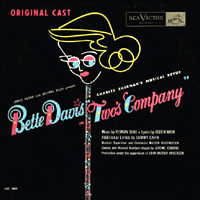 Original Broadway Cast, 1952 (RCA/Masterworks Broadway) (3 / 5) Bette Davis always claimed that she knew exactly what she was doing when she decided to star in this revue. “Just turn me loose on Broadway as a musical comedy girl,” she sings (?) here. Two’s Company certainly had some prime talent behind it: composer Vernon Duke, lyricists Ogden Nash and Sammy Cahn, choreographer Jerome Robbins, and a strong cast that included David Burns, Ellen Hanley, and Nora Kaye. But the critics were bewildered, and the star’s illness forced the show to close after three sold-out months on Broadway. Without this particular star, Two’s Company would have been just another late-entry collection of topical skits and so-so songs; with her, it has retained a status perched somewhere between legendary disaster and unparalleled curiosity. The cast album certainly makes for interesting listening. The material is adequate, the supporting cast and presentation are strong, and the opening “Theatre Is a Lady” is a worthy anthem. Onstage, Davis’s authority may have masked some of her musical deficiencies, but on the recording, she sounds like a drag impersonator in a piano bar just before last call. Her pitch is uniquely her own, and her phrasing is a harbinger of her odd line readings in her later films. In a hillbilly number, “Purple Rose,” she’s game but uneasy and not very funny, yet she’s touching in the torchy “Just Like a Man.” Since her only subsequent musical was the ill-fated, unrecorded Miss Moffatt, the Two’s Company album is a fascinating footnote to a long, magnificently uneven career. — Richard Barrios
Two on the Aisle
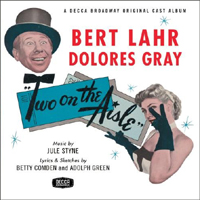 Original Broadway Cast, 1951 (Decca/MCA)
  (5 / 5) How does a recording of a second-rank show become an irreplaceable treasure? Here’s how: By 1951, the big-star Broadway revue was beginning to gather up its stars and skits for a finale, largely due to competition from television variety shows. Nevertheless, Betty Comden and Adolph Green still had a few satirical tricks up their sleeves. In collaboration with composer Jule Styne, they came up with a smart throwback to the days of headliner-packed revues, and that’s where Two on the Aisle shone most brightly, in that it starred Broadway’s premier clown and one of the greatest singers ever to set foot on a stage. Nor were their tasks circumscribed, for Bert Lahr could sing (in a unique fashion) and Dolores Gray was an ace comedienne. There were also supporting actors, none of them too impressive, and a rather gruesome pair of singing lovers. Fortunately, the cast album focuses on Lahr and Gray in both musical and comedic modes, without conveying their well-documented backstage feud. All here is golden, or close to it: Lahr’s mock-Pagliacci ode to “The Clown”; the chorus’s “Show Train,” an amusing précis of then-current stage hits; and Lahr and Gray as a vaudeville team invading the Metropolitan Opera (“You’ll be Lucia,” he blusters, “and I’ll be Sextet”). Gray is sensational, her songs perfectly tailored to her fabulous singing — intimate yet volcanic, funny, sexy, and so technically accomplished (with that precise diction) that lieder recitalists should study it. Gray’s performance of “If (You Hadn’t but You Did)” alone earns her a place in the Broadway pantheon. — Richard Barrios
Two Gentlemen of Verona
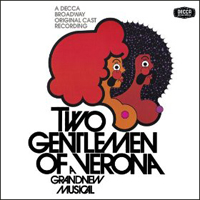 Original Broadway Cast, 1971 (Decca) (3 / 5) When you listen to the original cast recording of Two Gentlemen of Verona, you’ll know why this show won the 1972 Tony Award for Best Musical but not for Best Score. Even though the score, by composer Galt MacDermot and lyricist John Guare, is hopelessly locked into the 1970s, the album is an enjoyable listen; it captures a show of tremendous youth, vivacity, and edge, a unique mixture of Shakespeare and rock. The result is a century-spanning musical party. Sure, there are some duds, such as “Thurio’s Samba,” in which swear words and vulgarities are rhymed with nonsense syllables. But the standouts — “Summer, Summer,” “I Love My Father,” “Night Letter,” “Hot Lover,” and the finale — are quite a bit of fun. A fine cast helps: the one-and-only Raul Julia, Clifton Davis, Diana Davila, and Jonelle Allen, all of whom sound as if they’ve having the time of their lives. — Matthew Murray
Two by Two
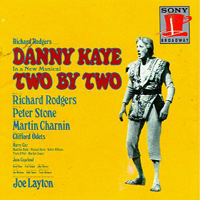 Original Broadway Cast, 1970 (Columbia/Sony) (3 / 5) With music by Richard Rodgers, lyrics by Martin Charnin, and a book by Peter Stone, Two by Two is an adaptation of Clifford Odets’ play The Flowering Peach. The show became notorious for the onstage antics of its star, Danny Kaye, who turned the whole thing into an unruly vaudeville act when he resorted to performing the role of Noah in a wheelchair after tearing a ligament. None of his bad behavior need be suffered on the cast album, although showpieces like “Ninety Again!” and “You Have Got to Have a Rudder on the Ark” do reveal a self-indulgent star. Get past that and you’ll hear mostly excellent, late-career Rodgers; the master infuses ballads like “I Do Not Know a Day I Did Not Love You” and “Something Doesn’t Happen” with his trademark warmth and melodic surprises. Eddie Sauter’s orchestrations have a comfy feel, and Charnin’s lyrics are probably the best of his career, pitched midway between the sentiment of Hammerstein and the dexterity of Hart. The supporting cast is as youthful and exuberant as Kaye is old-school and steeped in shtick: Walter Willison sings out with real Broadway juvenile brio, and Madeline Kahn nails a high C at the end of a vulgar piece of special material. The CD has a brief Act I finale track that’s missing from the LP, and it’s a much better sonic mix. — Marc Miller
Tuscaloosa’s Calling Me…But I’m Not Going!
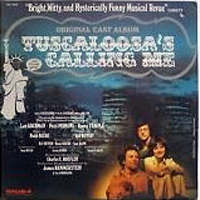 Original Off-Broadway Cast, 1975 (Vanguard/no CD) No stars; not recommended. The dated humor of this revue makes the cast album more of a time capsule than a listening pleasure. Written as a love letter to New York, the score, by composer Hank Beebe and lyricist Bill Heyer, takes lightly satirical swipes at Big Apple attitude (“Everything You Hate Is Right Here,” sung by “Sodom and the Gomorrahs”), nudity in the theater (“Things Were Out”), sex (“Fugue for a Ménage aTrois”), and the dating scene (“Singles Bar”). The archeologically minded will appreciate the two sketches included on the recording, especially the dialogue between a cab driver and an out-of-towner who complains about Broadway theater tickets costing 17 dollars. It’s all very lacking in distinction, although the title tune is rather stirring. Of the three-person cast, only Patti Perkins stands out with her childlike belt. Seventies nostalgists may change the rating above to one star. — David Barbour
Triumph of Love
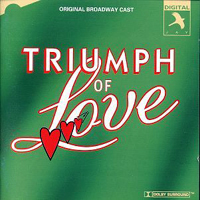 Original Broadway Cast, 1997 (JAY) (3 / 5) Pierre Marivaux’s 1722 farce La surprise de l’amour gets a musical workout and an English title, Triumph of Love, thanks to librettist James Magruder, composer Jeffrey Stock, and lyricist Susan Birkenhead. Christopher Sieber is Agis, a young Prince of Sparta, raised by his rationalist Aunt Hesione (Betty Buckley) and Uncle Hermocrates (F. Murray Abraham) to disdain emotional expression and the usurping Princess Leonide (Susan Egan). Naturally, the latter shows up, love blossoms, and complications multiply like rabbits. (This show sets a world’s record for mistaken-identity plot twists.) The narrative is wearying at times — even reading the synopsis in the CD booklet can lead to fatigue — but the songs are accomplished and often enjoyable. Stock has a definite gift for soaring, exciting melodies, orchestrated here by Bruce Coughlin, and Birkenhead’s lyrics are very witty. The best songs are the opener, “This Day of Days,” “Serenity,” and “Issue in Question,” in which Hesione and Agis struggle with feelings of love. “Teach Me Not to Love You” is a notably pretty quartet. The score is less successful when trolling for Broadway laughs via the clown characters played by Nancy Opel, Roger Bart, and Kevin Chamberlin, whose songs include “Mr. Right” and “Henchmen Are Forgotten.” The cast, however, is exemplary. Buckley’s singing is nothing short of heroic, especially in “Serenity” and “If I Cannot Love,” which was cut during previews but is offered here as a bonus track. Sieber and Egan provide sterling vocals, and Abraham is surprisingly effective in “Emotions.” (Note that the melody of “Mr. Right” is by Van Dyke Parks, and that of “Have a Little Faith” is by Michael Kosarin.) — David Barbour
A Tree Grows in Brooklyn
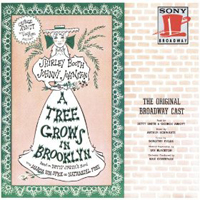 Original Broadway Cast, 1951 (Columbia/Sony) (4 / 5) With its high nostalgia quotient and dream ballet, this adaptation of Betty Smith’s beloved novel — scripted by Smith herself, with George Abbott’s help — may seem more like the work of Rodgers and Hammerstein than that of Arthur Schwartz and Dorothy Fields. Although A Tree Grows in Brooklyn didn’t quite recoup its investment during its eight-month run, the show felt like a hit at the time. And the cast album, produced by Goddard Lieberson with his usual finesse, captures the excitement of recording the score just after the rave reviews came in. Schwartz’s music shows his fine gift for evoking time, place, and mood in his songs, and Fields superbly captures the rough-and-tumble atmosphere of early-20th-century Brooklyn in her lyrics, which are poignant, salty, or hilarious by turns. As the tragic young Nolans, Johnny Johnston and Marcia Van Dyke are a bit on the dull side but are blessed with magnificent material, from his cocky “Mine ‘Til Monday” and “I’m Like a New Broom” to her pensive “Make the Man Love Me” and joyous “Look Who’s Dancing.” As sassy Aunt Cissy, Shirley Booth is occasionally off pitch but otherwise dead on, wringing every drop of bawdiness and poignancy from “He Had Refinement” and “Is That My Prince?” Some abrupt tonal shifts between comedy and tragedy betray the dramaturgical problems that may have contributed to the show not having a longer run, and a hokey hit-song finale fashioned especially for the recording was a mistake. Still, this is an overall excellent preservation of an undersung, affecting score. — Marc Miller
Tovarich
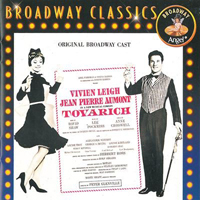 Original Broadway Cast, 1963 (Capitol/Angel) (3 / 5) In its CD and MP3 formats, this cast album is very different from the original LP edition in that, aside from the overture, no song is in the same position as it was on the original. Still, in any medium, Tovarich is a pleasant listen, with a score by composer Lee Pockriss and lyricist Anne Croswell. Film stars Vivien Leigh and Jean Pierre Aumont play the leads, Tatiana and Mikail, two Russian royals who flee to Paris after the revolution and hire themselves out as a butler and a maid. Most of the songs aren’t terribly dramatic, as their titles indicate: “You Love Me,” “The Only One,” “I Know the Feeling,” and “All for You.” But they’re all lovely, and they do have the right feel. Margery Gray and Byron Mitchell as the young adults in the household, who fall in puppy love with their new servants, have two undistinguished but fun songs together. And Mitchell gets to do a Charleston with Leigh in the tuneful paean to “Wilkes-Barre, PA.” — Peter Filichia
Touch
 Original Cast, 1970 (Ampex/no CD) No stars; not recommended. For years, this seemed the most ubiquitous of all show recordings. It turned up everywhere: at garage sales, school sales, library sales. If you moved into a new apartment, you’d find a copy of Touch in the closet. One has to wonder who on earth bought the thing, but lots of people had to if it ended up in all those places. For the record, this is a sweet-tempered, soft-rock musical, with a score by Jim Crozier and Kenn Long, that got decent notices and had a modest run Off-Broadway. With its environmental and social concerns, the show was certainly well meaning, but its dramaturgy is primitive and its songs are flavorless. There’s very little here to interest musical theater aficionados. — David Wolf
Top Banana
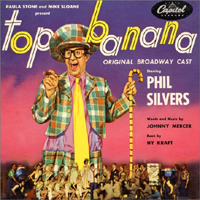 Original Broadway Cast, 1951 (Capitol/DRG) (3 / 5) Some types of comedy date very quickly, and this zany musical expedition into the world of vaudeville comics is an example of that. Still, it’s a wonderful time capsule from the early 1950s, performed by many of the leading comedians of the day. Phil Silvers, Jack Albertson, and Rose Marie joined forces to make Top Banana a solid hit in 1951, and Silvers’ performance won him the 1952 Tony Award for Best Actor in a Musical. While this star vehicle has faded into obscurity, the cast album is a spirited, buoyant tribute to showbiz of another era. The clever songs of the great Johnny Mercer are outstanding; yes, the legendary lyricist also composed the music for this show. The recording is full of gems such as “I Fought Every Step of the Way,” “A Word a Day,” and others that can still elicit guffaws. — Gerard Alessandrini
Too Many Girls
 Studio Cast, 1977 (Painted Smiles)
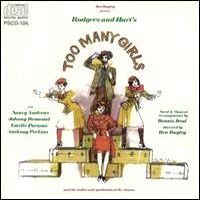
  (2 / 5) The world’s oldest collection of co-eds bops to a lower-drawer score by Richard Rodgers and Lorenz Hart in this Ben Bagley recording of a 1939 hit that hasn’t worn well. Although there are attractive songs sung on the campus of Pottawatomie College, including “I Didn’t Know What Time It Was” and “You’re Nearer” (the latter written for the 1940 film version), they’re undermined by Dennis Deal’s blaring arrangements and one of Bagley’s most indulgent exercises in camp interpretation. The vocal arrangements are subpar, too. As for the singers, undergrad Estelle Parsons croaks “My Prince”; Nancy Andrews injects some pizzazz into the glaringly non-P.C “Spic and Spanish”; Johnny Desmond and Arthur Siegel sing well enough without ever coming anywhere near a character. And Tony Perkins, whose ringing baritenor had surprised everyone in Greenwillow, pretty much whispers his vocals here — not ineptly, but without any special insight. Some of the songs do have the old Rodgers and Hart spirit. One example is the opening number, “Heroes in the Fall,” with lyrics ghost-written by Rodgers for the off-on-a-binge Hart. But many of the others (“She Could Shake the Maracas,” “Cause We Got Cake,” and “Sweethearts of the Team” in an excruciating rendition) sound like pale imitations of the team’s better work. — Marc Miller
Tommy
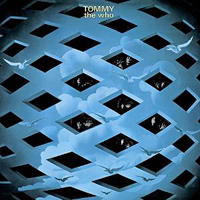 Studio Recording, 1969 (MCA) (5 / 5) Originally conceived for presentation on record, this seminal “rock opera” is thrillingly melodic and dramatic. Small wonder that it was subsequently adapted as a film and, later, a Broadway musical. Tommy was mostly composed for The Who by guitarist Pete Townshend, but there is additional material by two other members of that legendary rock band, John Entwistle and Keith Moon. Oddly, the score also includes “Eyesight to the Blind,” a pre-existing song by Sonny Boy Williamson; Townshend presumably added the number because it fits well into this story of a deaf, dumb, and blind boy who becomes world famous as a “Pinball Wizard.” Most of the character Tommy’s songs are performed by Roger Daltrey, who sings beautifully and persuasively; the other roles in the opera are sung by other members of The Who, with no guest soloists. Among the recording’s many highlights are “Amazing Journey,” “Go to the Mirror, Boy,” “I’m Free,” and “Sensation.” — Michael Portantiere
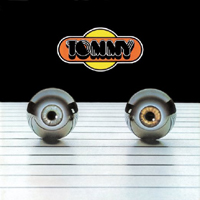 Studio Cast with Symphony Orchestra, 1972 (Ode) (3 / 5) Realizing that Tommy is filled with wonderful melodies that could benefit from symphonic treatment, Lou Reizner produced a complete recording of the score featuring the London Symphony Orchestra and Chambre Choir with soloists Pete Townshend, Roger Daltrey, and John Entwistle of The Who, plus Maggie Bell as the Mother, Steve Winwood as the Father, Ringo Starr as Uncle Ernie, Rod Stewart rasping out “Pinball Wizard,” and Richie Havens singing “Eyesight to the Blind.” Unfortunately, arrangers Wil Malone and James Sullivan threw out the baby with the bathwater, largely obliterating the rock-band sound of the piece as originally conceived with symphonic orchestrations. On top of that, the veddy proper-sounding choir creates an odd impression in numbers like “Pinball Wizard” and “We’re Not Gonna Take It,” as if they were performing Handel’s Messiah rather than a seminal rock opera. Among the most successful cuts on the album are “It’s a Boy” and “Amazing Journey,” if only because they retain something of an authentic rock sound. — M.P.
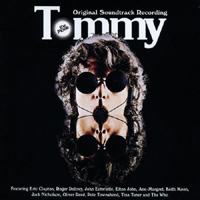 Film Soundtrack, 1975 (Polydor, 2CDs) (2 / 5) This recording has several things to recommend it: Roger Daltrey, at the peak of his vocal powers, is back again in the title role; The Who’s drummer, Keith Moon, does a fine job in the role of Uncle Ernie; and the rest of the band members make cameo appearances in the “Pinball Wizard” sequence and elsewhere. Ann-Margret sings well as Tommy’s mother (here called Nora), even if she sometimes over-emotes. The starry supporting cast includes Elton John (“Pinball Wizard”) and Eric Clapton (“Eyesight to the Blind”). On top of all this, the one-and-only Tina Turner is the definitive Acid Queen. But the album has two big strikes against it: The unrelenting deployment of synthesizers in the arrangements actually makes the score sound more dated than it does on The Who’s original recording, and Oliver Reed’s singing in the major role of Tommy’s mother’s lover is shockingly and painfully bad. (In this version of the story, young Tommy is traumatized into being deaf, dumb, and blind when the lover kills Tommy’s father — not vice versa, as on the concept album.) Legend has it that Jack Nicholson, having been cast in the film in the small role of the Doctor, was nervous about his singing ability, but when he heard Reed’s pre-recordings, he relaxed. It’s easy to understand why. — M.P.
 Original Broadway Cast, 1993 (RCA, 2CDs) (3 / 5) It wasn’t until almost a quarter-century after the release of The Who’s original recording of Tommy that the piece was finally adapted as a full-fledged stage musical. The resulting show had a lot going for it, as does the cast album, produced by the legendary George Martin. Michael Cerveris is persuasive in the title role, complete with a convincing if somewhat aggressive British accent. As Tommy’s mother and father, Marcia Mitzman and Jonathan Dokuchitz also sound credibly British. The three leads sing spectacularly well, and sharply etched supporting performances are turned in by Paul Kandel as Uncle Ernie and Anthony Barrile as Cousin Kevin. The musical adaptation pays homage to the original album while adding a theatrical flair; the addition of orchestrations to the basic rock-band sound is far more successful here than on the 1972 symphonic recording. (Steve Margoshes is credited with the orchestrations, while Joseph Church is listed as musical supervisor and director.) Director Des McAnuff oversaw a production that was praiseworthy in many respects. In fact, the show’s only major flaw was that Pete Townshend rewrote two key sections of the opera for no good reason. First, while Cheryl Freeman as the Gypsy does a fine job with the “Acid Queen” number, the song is strangely reconceived so that this drug-addicted prostitute sings about what she’s going to do to Tommy but never actually does it. Much worse, Townshend futzed with the ending of the piece in a way that completely contradicts the original point. In all previous versions of Tommy, the title character becomes the leader of a quasi-religious cult, and his followers turn against him when they realize that he’s attempting to control their minds; in this version, Tommy’s acolytes rebel because he tells them they should think for themselves! — M.P.
Titanic
 Original Broadway Cast, 1997 (RCA) (5 / 5) You’ll be hard-pressed to find more beautiful choral singing than that heard on the cast album of Titanic, the musical about the sinking of that famed “ship of dreams.” Composer-lyricist Maury Yeston’s score is grand and sweeping, and more than 40 voices are employed to represent the Irish peasants, middle-class professionals, wealthy society types, et al. aboard the doomed vessel. For this clash of classes, Yeston offers a suitable variety of music, from the stunning, operatic opening sequence to some Celtic-tinged tunes. A rag number and Yeston’s own lovely version of “Autumn” — supposedly one of the last songs played by the musicians on deck as the ship went down — give the score a sense of time and place, while Jonathan Tunick’s lush orchestrations evoke the feelings of adventure, hope, and loss that the disaster still inspires; you can hear the growl of an angry ocean in the overture, and you can see the black night described by a sailor in the haunting “No Moon.” Yeston shows remarkable theatricality and innovation throughout the score, notably in two sequences: “The Blame,” a heated colloquy sung by the ship’s owner, builder, and captain; and “Mr. Andrews’ Vision,” in which the horror-struck ship builder foresees the ship’s chilling final moments. All of the lyrics are strong, and Yeston is fortunate that Michael Cerveris, Brian d’Arcy James, David Garrison, John Cunningham, Victoria Clark, and a superlative cast of actor/singers preserved his words and music for this recording. — Brooke Pierce
Tip-Toes
 New York Concert Cast, 1998 (New World, 2CDs) (4 / 5) Enchanting piffle from 1925, Tip-Toes has a funny Fred Thompson-Guy Bolton book, a dancey Gershwin score, and an insuperable cast in this Carnegie Hall concert performance. The orchestral materials, as Rob Fisher relates in his liner notes, were in good shape except for the Arden and Ohlman dual-piano parts; Joseph Thalken and John Musto recreate these spectacularly. Fisher’s orchestra sounds just a tad underpopulated, and the conductor might have picked up the pace of such songs as “When Do We Dance?” and “Sweet and Low-Down.” The chorus is on the thin side, too, with just eight voices. But what a darling song collection this is — big on George Gershwin syncopation, blue-note harmonies, and lightly satirical Ira Gershwin lyrics. The cast members perform in perfect period style, and with total conviction. Emily Loesser is an ideal Jazz Age heroine, her light soprano caressing “Looking for a Boy” with great affection, and Andy Taylor is a young hero right out of a John Held, Jr. cartoon. Principal comics Lewis J. Stadlen and Lee Wilkof winningly sock across the silly jokes and puns, and enough dialogue is included to give you an idea of the book. This is a lighter, simpler show than other Gershwin gems — so patently innocent that, at one point, the hero and heroine sing to each other, “Goody-goody-goodnight, sleep tight.” But the charm never curdles, it just charms. (Note: Also included on this two-CD set is the score of the Gershwins’ Tell Me More.) — Marc Miller
Tintypes
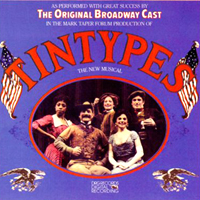 Original Broadway Cast, 1980 (DRG) (3 / 5) Allegedly, this was the first-ever digitally recorded cast album. A cavalcade of early-20th-century Americana, Tintypes sounds splendid here as its five-member cast and small band run through several dozen period songs — some classic, some virtually forgotten — in witty arrangements by Mel Marvin. Unlike so many other revues, the show has a real arc, and the songs comment wonderfully on themselves; for instance, “Toyland” becomes an anthem about America’s lost innocence, and “I Want What I Want When I Want It” is sung by a bellicose Teddy Roosevelt. Hearing “The Stars and Stripes Forever” or “Meet Me in St. Louis” for the zillionth time isn’t so thrilling, but trivialities like “Electricity” and “Teddy Da Roose” are well worth a listen, especially as rendered by this talented quintet: The fine character actor Trey Wilson and the elegant soprano Carolyn Mignini play the elites; the funny Mary Catherine Wright and the pre-directorial Jerry Zaks embody the downtrodden immigrant masses; and Lynne Thigpen is a marvel in everything she does. As Anna Held’s maid (it’s complicated, but the well-edited album supplies a context), Thigpen slowly builds the old Bert Williams favorite “Nobody” to a shattering finish. Wisely, this was the Act I finale; nobody in his or her right mind would have followed it. — Marc Miller
A Time For Singing
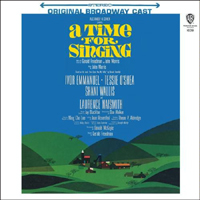 Original Broadway Cast, 1966 (Warner Bros./no CD) (3 / 5) Based on Richard Llewellyn’s popular book How Green Was My Valley, which inspired the acclaimed 1941 movie of the same title, A Time for Singing deals with the grim lives of Welsh coal miners. The John Morris-Gerald Freedman score surely sings out their tale, right from the a cappella opening to the tragic finale. The choral work is ample and terrific throughout, and leading man Ivor Emmanuel’s Welsh baritone is overpowering. Morris’s harmonies are not standard-issue Broadway; they’re wrapped up in evocative Don Walker orchestrations, and several ballads (“That’s What Young Ladies Do,” “There Is Beautiful You Are,” “Let Me Love You”) deserve rediscovery. What seems to have killed the show more than anything else is the casting. Shani Wallis is a simpering leading lady, while Tessie O’Shea and Laurence Naismith are far too old to be convincing as the parents of eight-year-old Huw (Frank Griso, an irritating child actor). Elizabeth Hubbard and an up-and-coming George Hearn are wasted in supporting roles. Also, the score goes conventional just when it needs to offer something special, as in Wallis’s “When He Looks at Me” or the wimpy title tune. Still, this deeply felt neo-operetta doesn’t deserve the obscurity it has suffered for decades, and its great ensemble work is all over the cast album. — Marc Miller
tick, tick…BOOM!
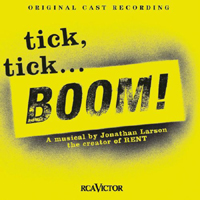 Original Off-Broadway Cast, 2001 (RCA) (3 / 5) This minor but appealing Off-Broadway effort was adapted by playwright David Auburn from a semi-autobiographical, one-person show that had been written and performed by songwriter Jonathan Larson. It also incorporates material from an unproduced Larson project titled Superbia. Arguably, the show’s main weakness is that some audiences may find it a little hard to care very deeply about the angst suffered by an unsuccessful musical theater songwriter as he approaches age 30. But there are many mitigating factors, not the least of which is one’s knowledge that Larson would die unexpectedly a few years later. The show and the cast album also provided an early showcase for the brilliant singing actor Raúl Esparza. Equally effective are Amy Spanger as Jon’s increasingly fed-up lover, Susan, and Jerry Dixon as his best friend, Michael, who has given up bohemia for business and who harbors a heartbreaking secret. Then there are the songs, which confirm Larson’s thrilling talent. They include the touching trio “Johnny Can’t Decide”; the witty “Sunday,” a number about working in a diner that’s also a parody of a certain Stephen Sondheim ballad; and the fervent “Come to Your Senses.” The impassioned finale “Louder Than Words,” with its wounded idealism, is excellent. A moving bonus track features Larson himself singing a cut number, “Boho Days.” — David Barbour
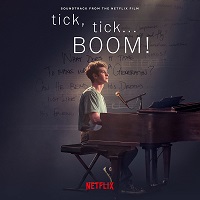 Film Soundtrack, 2020 (Masterworks) (5 / 5) Lin-Manuel Miranda’s film version of tick, tick…BOOM! is a triumph. Steven Levenson’s screenplay deftly expands the three-person stage piece into a large-cast feature film while referencing its solo-show origins. Thus, we see Jonathan Larson (Andrew Garfield, in a stunning, out-of-left-field performance) onstage at New York Theatre Workshop, providing running commentary and cueing several numbers, backed up by Joshua Henry and Vanessa Hudgens. From the score’s first jittery piano chords, we are in masterful hands. Garfield, his voice reedy and soulful in quiet moments and gutsy where it counts, delivers full-throttle renditions of the panic-stricken “30/90” the ruminative “Why,” and “Louder Than Words,” arguably Larson’s finest number. As Michael, Robin de Jesús provides fine sardonic contrast, kvelling over his posh new apartment in “No More” and confronting his mortality in “Real Life.” As Susan, Alexandra Shipp shares her character’s big number with Hudgens, their voices coming together gorgeously in “Come to Your Senses.” The luxuriously cast Henry buttresses every number with his lustrous vocals. And even without the listener to this album being able to see the uproarious parade of cameos in the film’s “Sunday” sequence — “There’s Chita! There’s Bernadette! There’s Daphne Rubin-Vega!” — the song is a triumph, a wicked bit of self-mockery folded into a loving parody of a signature Stephen Sondheim anthem. The tune stack varies from the stage version in certain respects, beginning with the song order: “Boho Days,” heard as an extra on the 2001 CD, is now integrated into a party scene, while “Green Green Dress” has been moved to the final credits, and the the tender ballad “See Her Smile” has been cut entirely. Bits of Larson’s Superbia heard in the film are not to be found here, but several numbers cut from early versions of tick, tick…BOOM! have been interpolated, including “Play Game” (a rap commentary on Broadway commercialism, delivered by Tariq Trotter of the hip-hop group The Roots) and “Swimming” (in which Larson hits a pool while fretting about his problems). Among the bonus tracks are a pop cover of “Come to Your Senses” by R&B singer Jazmine Sullivan; the disco-tastic “Out of My Dreams,” by dance-music diva Victoria Jackson; and “Only Takes a Few” by the indie folk group The Mountain Goats. (It would be interesting to know the provenance of these numbers, all credited to Larson.) A heartfelt tribute from one young musical theater master to another, the film and the recording are musts. — D.B.
Through the Years
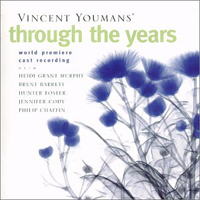 Studio Cast, 2001 (PS Classics) (2 / 5) Hats off to PS Classics for issuing the premiere recording of this interesting curio, a 1931 Vincent Youmans flop — and hats back on for their having made such a muddle of it. Not that the material, adapted from the old stage weepie Smilin’ Through, isn’t tricky, with its confusing, multi-generational love story and subsidiary comic romance. Youmans seems to have written two scores for the two stories: one long-lined and elegant, the other standard musical comedy, both melodically and harmonically beguiling. But, instead of the original orchestrations, the recording presents a soupy reduction by conductor Aaron Gandy, played by a 12-piece group that sounds like the Mantovani Chamber Ensemble. Leading lady Heidi Grant Murphy, much admired in opera, is flat-out dull here, while leading man Philip Chaffin ably navigates Youmans’ melodic leaps without sounding much engaged. Even the usually impeccable Brent Barrett is droopy, although he does come to life in “How Happy Is the Bride,” a tricky Youmans melody saddled with awkward Edward Heyman lyrics. The best work comes from the real-life couple Hunter Foster and Jennifer Cody, who handle the lighter pieces with a fine understanding of 1930s style. Snatches of dialogue evoke what must have been a long evening of romantic entanglements punctuated by some pretty Youmans melodies. — Marc Miller