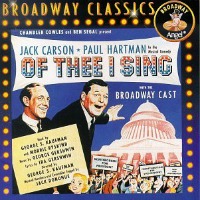
 Broadway Cast, 1952 (Capitol/DRG/Angel)
  (3 / 5) The first musical to win a Pulitzer Prize, Of Thee I Sing (1931) is glorious. With music and lyrics by George and Ira Gershwin, and a book by George S. Kaufman and Morrie Ryskind, the show’s Jazz-Age score is exuberant and ingenious, and its skewering of American politics — particularly presidential campaigns — has, if anything, grown more relevant with the passing years. There is no cast album of the original production, but a 1952 revival, directed by Kaufman himself, yielded this recording. All the principal music is here, with revised orchestrations by Don Walker and a few rewritten lyrics by Ira Gershwin. Jack Carson may have seemed an unlikely choice for presidential candidate John P. Wintergreen, but he sings smoothly, exhibiting real warmth in “Who Cares?” His Mary, Betty Oakes, is bland. As his running mate Throttlebottom, Paul Hartman shares star billing but claims only one number. Jack Whiting’s Chief Justice has this song-and-dance man’s customary panache, while Lenore Lonergan as Diana Devereaux offers a truly bizarre performance; throaty and off key, she turns her vocal liabilities into character points and is quite funny and original. Maurice Levine conducts with energy and briskness. — Marc Miller
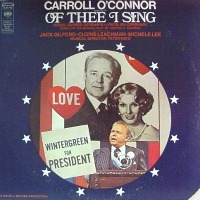 Television Cast, 1972 (Columbia/no CD)
  (1 / 5) In 1972, with “Archie Bunker for President” bumper stickers on every Ford Pinto and a theater-of-the-absurd presidential race in full swing, CBS trotted out Of Thee I Sing as a vehicle for some of its top sitcom stars. Carroll O’Connor played Wintergreen, and the network advertised, “Tonight: Archie Bunker becomes President!” O’Connor displays a serviceable Irish tenor and a nice way with a lyric. His Mary, Cloris Leachman, is similarly passable, and Michele Lee is a high-voltage Diana Devereaux. Otherwise, this hard-to-find LP is not worth the search. The score is garishly orchestrated and conducted, and the generous helping of laugh-track-supported dialogue that’s included confirms one’s suspicions that this is a fatally dumbed-down adaptation of the original show, replacing the smart Kaufman-Ryskind dialogue with exchanges better suited to Green Acres. — M.M.
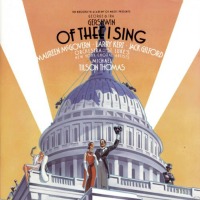 New York Concert Cast, 1987 (Sony, 2CDs; paired with Let ‘Em Eat Cake)
  (2 / 5) Conducted by Gershwin scholar Michael Tilson Thomas and presented with great fanfare at the Brooklyn Academy of Music, a 1987 concert version of this gem of a show yielded a studio recording that is the most complete, most faithful Of Thee I Sing album available. Unfortunately, gleeful as the material is, the presentation is a little stiff. Larry Kert as Wintergreen is a fine singer, but here he exhibits all the personality of tofu. Maureen McGovern as Mary Wintergreen has more presence but less to do. Jack Gilford, who had played Throttlebottom on TV, is endearing — but, by this time, his voice had aged and weakened almost to a whisper. The best performance comes from Paige O’Hara, whose Diana Devereaux is vocally secure and dizzily funny. Yet even she over-punches her line readings; I smell a director who insisted on socking everything across the footlights, even in the recording studio. The digital stereo helps bring out the brassy orchestrations, and the notes in the accompanying booklet are authoritative. — M.M.
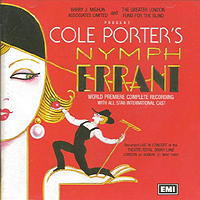
 (5 / 5) Here is a rare find: a lost gem of a musical by Cole Porter that was produced in England but never on Broadway. This star-studded 1990 concert performance of the score was recorded live in London. The music represents Porter at his melodic best, and the lyrics are so sublimely witty that they warrant repeated listening for one to fully grasp the sharpness and comedic effect of his remarkable word play. So much of the album is laugh-out-loud funny that you’ll want to play many of the tracks several times to savor all the jokes. Among the luminaries in the cast are Alexis Smith, Larry Kert, Lisa Kirk, Kaye Ballard, Patrice Munsel, and Patricia Hodge, who offers a pristine rendition of that wonderful Porter paean to life and lust, “Experiment.” Other standout cuts are “The Cocotte,” “Solomon,” the hilarious throwaway number “Sweet Nudity,” and “How Could We Be Wrong?” The ballad “You’re Too Far Away” is lovely, but the most famous song in the score is the comic marathon “The Physician,” sharply performed by Lisa Kirk, who sails through the various choruses with glee and relish. For this performance, the entire score was reorchestrated by Jim Tyler and Michael Gibson; with Donald Pippin and David Firman at the twin pianos, the effect is gloriously authentic. Steven Hill’s vocal direction is impeccable, and the recording culminates in a bouncy choral reprise of “Experiment.” Those searching for a classic show score that’s fresh, naughty, and not over-familiar should seek out this album. — Gerard Alessandrini
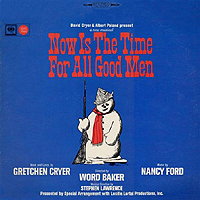
 (4 / 5) With a book and lyrics by Gretchen Cryer and music by Nancy Ford, Now Is the Time for All Good Men is set in a small town in the Midwest. Its central character is Mike Butler, a new teacher whose liberal views have a strong effect on the townspeople. In its attempt to be hard-hitting, contemporary, and relevant, the show was helped by a solid score written in a theatricalized late-’60s pop style. Heading the first-rate cast, David Cryer — then married to Gretchen — is splendid as Mike in two haunting solos, “What’s in the Air?” and “All Alone.” His leading lady is Gretchen Cryer, performing under the name Sally Niven. But there’s no vanity casting here; she’s perfect as Sarah, a shy schoolteacher who’s swept up in the events that Mike’s liberalism sets in motion. Sarah’s growing affection for Mike is showcased in “He Could Show Me,” a fine ballad, and Mrs. Cryer’s light soprano mixes well with her husband’s solid baritenor in the charming duets “Tea in the Rain” and “Rain Your Love on Me.” Better still is “My Holiday,” a poignant twin-soliloquies song about Christmas season loneliness; it’s a gem that deserves to be a holiday standard. Other standouts: David Sabin offers a sweet rendition of “A Simple Life,” Judy Frank sings a raucous, country-rock-flavored “Stuck Up,” and Steven Skiles and Anne Kaye are impressive in “Down Through History.” — Jeffrey Dunn

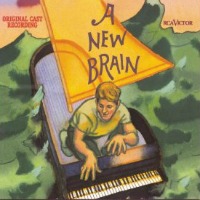
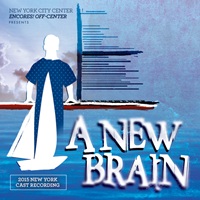
 (2.5 / 5) As the central character of A New Brain sings at one point, “You’ve got to have heart and music,” words that were not always remembered in the making of this recording — a skilled yet strangely impersonal performance that scants both the material’s wisecracking veneer and a sorrowful undertone rooted in divorce, dysfunction, and the specter of early death. This is a slightly revised version of the score; the new stuff is mostly filler, updating us on Gordon’s medical status. (You won’t be hearing “Craniotomy” in a piano bar anytime soon.) Jonathan Groff sings with his usual proficiency, yet with a surprising placidity that doesn’t suit the character. Ana Gasteyer does a solid enough job with “The Music Still Plays On,” but Penny Fuller’s guts and passion are much missed in this song. Rema Webb sounds a bit like Mary Testa, though without the latter’s edgy humor. Christian Borle (subbing for Dan Fogler, who appeared in the Encores! production) is a poor substitute for Chip Zien and his amusingly tyrannical delivery. The best work here comes from Josh Lamon, charmingly world-weary in the relatively minor role of the nurse. Adding a touching note, Roger (Gordon’s lover) is sung by Aaron Lazar, who recently went public about his struggle with ALS, thereby calling to mind Gordon’s situation. Note: In an especially odd bit, this show now features a joke about Fun Home, which was also recorded by PS Classics. Product placement? — D.B.