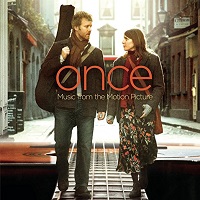
 Film Soundtrack, 2007 (Columbia)
  (4 / 5) This is the deservedly popular soundtrack album of a gorgeously bittersweet indie film, set in Dublin, about the brief but intense romance and songwriting partnership of an Irish busker (Glen Hansard) and a Czech immigrant (Marketa Irglova). Their love affair ends due to other entanglements, but not before they record a demo together — and he buys her a piano as a parting gift. However close to real life the events and characters of the story may or may not be, the whole thing is lent a wonderful air of authenticity by the fact that all of the songs heard in the film and on the recording were written and performed by Hansard and Irglova. The gentle, simple, almost hypnotically lovely ballad “Falling Slowly” was the movie’s big hit, charting in Ireland, Canada, the U.S. and Brazil, and winning an Academy Award for Best Original Song. But there are several other delights here, such as “Say It To Me Now,” “Leave,” and the deliciously quirky “Broken Hearted Hoover Fixer Sucker Guy.” (The Hansard character repairs vacuum cleaners to earn a living.) This recording is eminently listenable and thoroughly enjoyable in its own right, aside from its interest as the soundtrack of a film that served as the basis for one of the most unexpected Broadway musical hits of its era. – Michael Portantiere
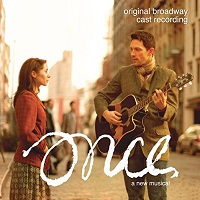 Original Broadway Cast, 2012 (Masterworks Broadway) (4 / 5) It probably never occurred to most fans of the film that a stage musical version of Once would ever be created or that it would be successful anywhere, let alone on Broadway, which generally tends to traffic in larger, faster-paced, less subtle entertainments. But the brief-candle romance of the lovers at the center of the story is potent enough that one could envision such a musical connecting with audiences if pains were taken to assure that the intimacy of the piece was retained. Which is exactly what happened. With a book by Enda Walsh (based on the screenplay by John Carney) and a score comprised almost entirely of the Hansard-Irglova songs from the movie, Once premiered at the American Repertory Theatre (ART) in Cambridge, MA in 2011 before transferring to the New York Theatre Workshop and then to Broadway, where it collected a bunch of 2012 Tony Awards — including Best Musical — and achieved a three-year run. Among the several wise decisions made in adapting the film to the stage were Bob Crowley’s unit set design, which created the feel of a homey Irish pub; and the fact that the cast also served as the onstage orchestra. Steve Kazee as “Guy” is a real charmer in these songs, sounding far more comfortable with this style of music than that of his previous big Broadway lead, Starbuck in 110 in the Shade. He and Cristin Milioti as “Girl” make beautiful music together in “Falling Slowly,” “If You Want Me,” and “When Your Mind’s Made Up.” She also does a persuasive job with “The Hill,” though some may find her rather thick Czech accent a bit distracting on repeated listening. The ensemble of actors/musicians includes familiar names such as as David Patrick Kelly and Anne L. Nathan, along with some super-talented newcomers. Cheers to them as well as to director John Tiffany and musical supervisor Martin Lowe for not radically changing or distorting Once in the stage transfer. – MP
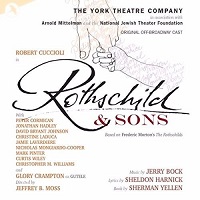
 (3 / 5) Here is a major revisal of the 1970 musical The Rothschilds, cut down to one-act and including several previously unheard Jerry Bock-Sheldon Harnick songs, plus some revisions by Harnick. The romance for son Nathan and the big ensemble numbers are gone, and the political leaders’ roles have been trimmed. The cast totals 11, compared to more than 30 on Broadway; when Mayer Rothschild (Robert Cuccioli) sings a shortened version of “He Tossed a Coin,” it’s clear that the Frankfurt fair isn’t crowded. Joseph Church has reorchestrated the score for four players, compared to Don Walker’s sumptuous originals. What if anything in this York Theatre Company production compensates for the loss of size and spectacle of the original? Lyricist Harnick and librettist Sherman Yellen (composer Bock died in 2010) had long wanted to refocus the story on the Rothschild family and less on the sprawling European setting. In this, they succeeded; Rothschild and Sons is an intimate piece that emphasizes feelings and relationships. Mayer’s wife, Gutele — a moving Glory Crampton — is a more significant presence as the action unfolds through her memories. She grows from being satisfied with “One Room” to standing strong against Metternich in the reprise of the driving anthem “Everything.” Crampton also gets the best of the added songs, “Just A Map,” in which she frets over her sons as they crisscross wartime Europe. Nathan (Christopher M. Williams) has lost his silly patter number, but here he makes mistakes on arrival in England (“Tea’s Hot”) and then butts heads with his father in “He Never Listens.” The heart of the show is Mayer, the father. Cuccioli’s voice sounds terrific — his “In My Own Lifetime” is rousing — yet he lacks the warmth and humor that Hal Linden found in the character. On the one hand (as another Bock-Harnick character said), it’s wonderful that this revisal may grant new life to the show. But on the other hand, while there are plenty of musicals about families, how many are as daring as The Rothschilds — set in the chaos of late 18th-early 19th century Europe, about a family relying on financial maneuverings and political cunning to survive, with a rich score evoking late Baroque and classical masters? Stick with the original. — L.F.
 (2 / 5) In 1939, Irving Berlin imagined a themed revue set at an inn that opens only on holidays, with songs highlighting seasonal celebrations. It didn’t make it to the stage, but the idea became the basis for the 1942 film Holiday Inn, starring Bing Crosby and Fred Astaire, and featuring the biggest-selling song in history, “White Christmas.” Success breeds success, so the inn setting, Crosby, and that song reappeared in the 1954 film White Christmas. Both movies became perennial holiday offerings on television, prompting theatrical adaptations. Berlin himself recycled songs like aluminum cans; the original Holiday Inn lifted “Easter Parade” and “Blue Skies” from earlier shows. In similar fashion, librettists Gordon Greenberg (who also directed) and Chad Hodge ransacked Berlin’s catalog for gems to shoehorn into the plot of the stage version. The nine interpolated songs sometimes work (“Shaking the Blues Away” as an obvious cheer-up number) and sometimes don’t (“Heat Wave” sounds out of place, “Cheek to Cheek” is sadly truncated). Three songs from the film were cut: “Lazy,” replaced by “The Little Things In Life,” a more satisfactory “I want” song for Jim Hardy, along with the Presidential tributes “I Can’t Tell a Lie” and the minstrelsy “Abraham.” The plot largely follows that of the movie, with nightclub performers Jim (Bryce Pinkham), his girlfriend Lila (Megan Sikora), their pal Ted (Corbin Bleu), and Connecticut gal Linda (Lora Lee Gayer) variously torn between their desires for show biz, settling down, and each other. Pinkham gives Jim an earnestness (“Blue Skies,” “It’s a Lovely Day Today”) that distances him from Crosby’s laid back portrayal. He wisely keeps “White Christmas” simple, with Gayer delicately joining him. The latter conveys Linda’s sweetness in “Nothing More to Say,” one of the lesser-known tunes. In contrast, Sikora’s Lila is sometimes just too brassy, and the talented Megan Lawrence is wasted here, squeaking weirdly on the title song. Bleu ably handles the production numbers, including the literally explosive “Let’s Say It With Firecrackers,” but he doesn’t have much of a character to develop. Larry Blank’s exuberant orchestrations generally fit the material, but there are some odd changes in tempo during “Cheek to Cheek,” and “Easter Parade” sounds lethargic. — Laura Frankos


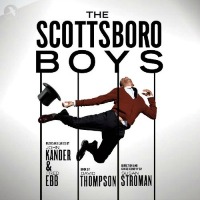
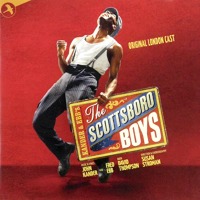
 (5 / 5) In several of their shows, John Kander and Fred Ebb have used various types of entertainment as the contextual setting for exploring historical and social issues. In Cabaret, sleazy nightclub routines parallel the excesses of Weimar Germany and the rise of Nazism; Chicago‘s vaudeville acts reveal the corrupt justice system of the Roaring Twenties. In The Scottsboro Boys, the tragic story of nine young African Americans who were unjustly accused of raping two white women in 1931 is told in the form of a minstrel show. The result is a searing, brilliant work with depth, power, and guts. Kander says they chose the format for the opportunities it provided: an ensemble, led by an Interlocutor (John Cullum), telling stories, jokes and songs. Mr. Bones and Mr. Tambo (the versatile Colman Domingo and Forrest McClendon) assist by playing multiple characters (“White men’s our speciality”). Needless to say, the minstrel show itself is a stark reminder of racism, reinforcing social injustice with every number. In the rousing opener, the lead among the accused men, Haywood Patterson (the impressive Brandon Victor Dixon), asks “This time, can we tell it like it really happened?” The Interlocutor benignly replies, “Of course.” Haywood’s resolve to tell the truth provides the score with a constant refrain, from his first defense (the Bert Williams style “Nothin'”) to the comic fable “Make Friends With the Truth” to “Zat So?” His defiant cry “You Can’t Do Me” sets up the boys’ refusal of the Interlocutor’s call for a cakewalk and a “happy ending,” subverting the minstrel show. The fates of the real-life Scottsboro Boys were anything but happy, but the final scene places their case in the broader context to the civil rights movement, giving a glimpse of a better future. The score also contains one of Kander & Ebb’s finest songs, the poignant “Go Back Home,” with a beautiful, wistful melody that reoccurs throughout the underscoring. (A bonus track has Kander performing the number.) Throughout the recording, Cullum shines as the unctuous Interlocutor, his genially racist attitude clear in “It’s Gonna Take Time” (cut from the subsequent Broadway production) and “Southern Days.” The Interlocutor misses Mammy’s ribs and mint juleps, but conveniently forgets the lynchings and cross-burnings. Domingo and McClendon’s talents are also evident throughout, especially when they assume the guises of the Attorney General and lawyer Samuel Liebowitz in savagely satirical numbers revealing Southern anti-Semitism and patronizing New York showmanship. (“Just ask my chauffeur, Rufus!”) Here was no easy subject, but this musical may be Kander and Ebb’s most important work; three years after the show opened, the Scottsboro boys were granted a posthumous pardon. — Laura Frankos