

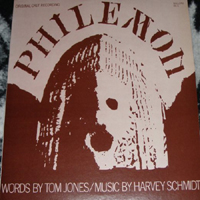
 Original Off-Broadway Cast, 1975 (Gallery/no CD)
  (3 / 5) Composer Harvey Schmidt has consistently written lovely, dramatic, and distinctive music. Philemon is the story of Cockian, a street clown in ancient Rome, who is pressured by a Roman commander to impersonate the Christian leader Philemon and who eventually becomes ennobled enough to experience martyrdom. Schmidt’s songs are striking and effective, as are the lyrics of his collaborator, Tom Jones. The opening number, “Within This Empty Space,” establishes the raw theatricality and elements of ritual common to so many Schmidt-Jones shows while also introducing us to Cockian and to the specific, vaguely primitive sound of this score. Jones’ script and lyrics are more complex than usual, and all of the characters are distinctly limned from a musical standpoint. The cast is solid without ever being flashy. It’s headed by Dick Latessa as Cockian; Howard Ross as the Roman Commander; Michael Glenn-Smith as a young prisoner whom Cockian betrays; Kathrin King Segal as Kiki, Cockian’s performing partner; Virginia Gregory as the wife he has abandoned; and Leila Martin as the real Philemon’s wife. If you’re curious, you may be able to track down this long-out-of-print recording, or a tape of the TV version of the musical that featured the original cast. — David Wolf
The Phantom of the Opera
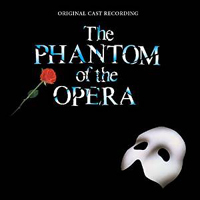 Original London Cast, 1986 (Polydor, 2CDs)
  (1 / 5) Andrew Lloyd Webber’s score for this virtually through-sung musical based on the famous novel by Gaston Leroux contains many wonderful melodies; unfortunately, as has been pointed out by sharp-eared critics, some of them are not quite original. Various tunes in The Phantom of the Opera owe much to the work of such composers as Claude Debussy, Giacomo Puccini, and Frederick Loewe. Of the songs that seem to be original, several are pretty but stylistically inappropriate to the time period in which the show is set; for example, “Think of Me,” with its aggressively dotted rhythms. For that matter, the arrangement of the title song makes it sounds like a disco number. Charles Hart’s lyrics (additional lyrics by Richard Stilgoe) range in quality from good to poor. The most successful sections of the score are its lighter moments, particularly the “Notes” / “Prima Donna” sequence. Given the general level of the material, the performance is not bad overall. Michael Crawford is quite compelling as the Phantom; his mannerisms and odd vocal timbre are well suited to a character who’s supposed to be a freakish madman, and with the help of skillful audio engineering, Crawford delivers some spine-tingling high notes. His Christine, Sarah Brightman, sounds fine when singing in the middle of her range at a dynamic level no greater than mezzo forte, but her soprano thins out and become shrill when it rises in pitch and volume, and her vibrato is too heavy for the weight of her voice. Steve Barton sings well as Raoul, especially in the beautiful “All I Ask of You.” The recording gets one grudging star for its few nice moments, but don’t take that as a recommendation to buy it. A final insult: In its initial release, this two-CD set wasn’t tracked, so the only way you could skip to various sections of the score was to press and hold the forward or backward search buttons on your CD player. Reportedly, Lloyd Webber insisted on this, because he had conceived Phantom as a unified, complete work and wanted listeners to experience it as such. (No comment!) — Michael Portantiere
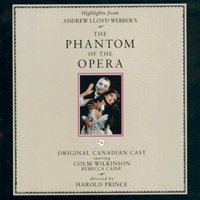 Original Canadian Cast, 1990 (Decca) (1 / 5) As the Phantom on this recording, Colm Wilkinson displays a strong, beautiful, emotionally expressive voice, yet some listeners will find his mannerisms and his Scottish accent intrusive. Also, the broad pseudo-British accents of several other members of the cast are laughably stilted. Rebecca Caine’s soprano is mediocre as heard in Christine’s songs, and her pronunciation is very poor. Byron Nease’s Raoul sounds fine when he’s not overacting and artificially darkening his voice. For some reason, many of the lyrics as set down on this recording are revisions of the originals — but the new versions aren’t superior, just different. This one-disc recording of the score’s “highlights” is a better option for purchase than the two-disc London album because it’s shorter, it’s cheaper, and you don’t have to sift through lots of dross to get to the few songs that are well written and don’t call to mind the melodies of other composers. — M.P.
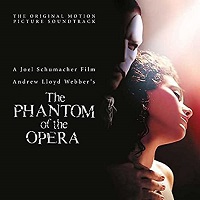 Film Soundtrack, 2004 (Sony) (1 / 5) Whatever one’s opinion of The Phantom of the Opera in musical or dramatic terms, its title role offers a golden opportunity for a leading man with a beautiful and distinctive singing voice. So it seems almost perverse that the fellow who was chosen to play the Phantom in the 2004 film version was — Gerard Butler, a Scottish stage and film actor who had no previous musical experience other than having sung in a rock band as a young man, and whose voice, as it eventually became clear to anyone who saw the film and/or heard the soundtrack recording, was not up to the demands of pop-opera arias like “Music of the Night.” In the role of Christine, Emmy Rossum displays a soprano that’s very pretty, if rather thin, and at least her singing isn’t plagued by that awful, quivering, Sarah Brightman vibrato. The best vocalist among the three major leads is Patrick Wilson as Raoul, though his all-American accent in both his songs and the dialogue included on the recording is distracting in context, making him sound like a fish out of water. Minnie Driver’s singing as Carlotta was dubbed by opera singer Margaret Preece, who does a fine job with “Prima Donna” and her other vocal moments — and, in recorded dialogue, we do get to hear the amusingly over-the-top Italian accent Driver developed for the role. As might be expected, the large orchestra hired to record the film soundtrack sounds wonderful playing lush orchestrations crafted along the lines of the stage originals. Like the Canadian cast recording reviewed above, the soundtrack album contains one disc’s worth of highlights, so if you want to hear more of the Phantom score as heard in the movie, you’ll have to buy or rent it on video. — M.P.
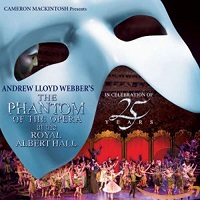 Royal Albert Hall – 25th Anniversary Cast, 2011 (Decca Broadway, 2CDs)
  (2 / 5) This live recording of a fully-staged presentation of Phantom at London’s Royal Albert Hall in celebration of the show’s 25th anniversary stars Ramin Karimloo, an Iranian/Canadian singer-actor who has become a major presence on the London and New York stages in recent years, and Sierra Boggess, the American musical theater star who originated the title role in The Little Mermaid on Broadway and who would go on to play the female lead in Andrew Lloyd Webber’s School of Rock. Both are extraordinarily gifted from a vocal standpoint — his strong, exciting bari-tenor has plenty of “ping,” her soprano is creamy and sumptuous, with no flutter — and are therefore a pleasure to hear in this music, if you like the score to begin with. Hadley Fraser sounds virile, romantic, and very appealing as Raoul. The performance, also available on video, features a cast and orchestra of more than 200, with special guest appearances by Michael Crawford and Sarah Brightman, plus Colm Wilkinson, Anthony Warlow (who played the title role in the Australian production), Peter Jöback (who has starred as the Phantom in the West End, on Broadway, and in Sweden), and John Owen Jones (from the London and 25th anniversary tour productions). It’s all quite lavish and over-the-top, very much in keeping with the general tone of a modern-day poperetta that has become a worldwide phenomenon. — M.P.
Phantom
 Studio Cast, 1993 (RCA)
  (4 / 5) Unfortunately, Maury Yeston (music and lyrics) and Arthur Kopit (book) began work on their own adaptation of the Gaston Leroux potboiler The Phantom of the Opera concurrently with the Andrew Lloyd Webber version, but Loyd Webber got his to the stage first; so this Phantom, with just as lush music and vastly superior lyrics, has never gotten any closer to Broadway than New Jersey. The whole sordid mess is recounted by Kopit in his notes for this recording, very well produced by Yeston, Steve Vining, and Bill Rosenfield. Yeston’s wide-ranging score roams from the Gothic breast beating of “Paris Is a Tomb” to the lilt of “Melodie de Paris” to the foxtrot “Who Could Ever Have Dreamed Up You?” The sturdy Richard White, in the title role, doesn’t really get to show his stuff till the revelatory 11-o’clock number, “My Mother Bore Me”; but he gives that song the full treatment, going vocally and histrionically to the top, yet not over it. Glory Crampton, as Christine, sounds sweet but thin in her upper range. On the other hand, it’s a pleasure to have the underemployed Meg Bussert as Carlotta, deliberately screeching her way through “As You Would Love Paree” and having lots of hammy fun with “This Place Is Mine.” Jack Dabdoub and Paul Schoeffler are helpful in supporting roles, and Jonathan Tunick’s orchestrations and conducting are, as usual, superb. Best of all, it’s refreshing to hear a Phantom that is musically satisfying and not lyrically pinheaded. — Marc Miller
Peter Pan (Styne, et al.)
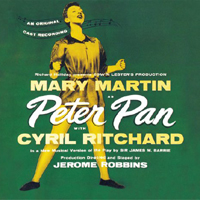 Original Broadway Cast, 1954 (RCA) (4 / 5) James M. Barrie’s ever-young story of the boy who wouldn’t grow up has been a favorite in print and on the stage and screen for more than a century. While Maude Adams was long the most celebrated of the stage Peter Pans, at least two generations of American kids had as their touchstone the all-singing, all-flying Mary Martin. The musical adaptation of the play in which she starred became legendary because of television, not Broadway, where it had a less than spectacular run; a West Coast tryout had been problematic, and before the show opened in New York, its Moose Charlap-Carolyn Leigh score was bolstered with some major new contributions from Jule Styne, Betty Comden, and Adolph Green. The result may not always be faithful to Barrie, but with Martin starring and director Jerome Robbins in charge, it’s irresistible. The cast recording preserves most of the production’s sparkle; the wonderful score includes “I Gotta Crow,” ”I’m Flying,” and all the sing-along others. Martin is in peak form, far fresher vocally than she would be for the 1960 television taping (two earlier telecasts had been live), and Cyril Ritchard is a peerless Captain Hook. Happily, the recording has received a clear, high-quality digital transfer. The album is pure magic, and not just because of Tinker Bell or fairy dust. — Richard Barrios
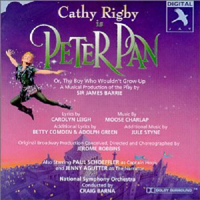 Studio Cast, 1997 (JAY) (3 / 5) Despite its difficult aerial demands, the Moose Charlap-Carolyn Leigh-Jule Styne-Betty Comden-Adolph Green Peter Pan has become a stage perennial. Two Peters have fared especially well: Sandy Duncan, who starred in a smash Broadway revival in 1979, and former Olympic gymnast Cathy Rigby, who toured extensively with the show in the 1990s-2000s and headlined four Broadway engagements. While the Duncan production did not yield a cast album, Rigby left both video and audio souvenirs of her performance. And guess what, kids: She’s good! Her voice has much of the sheen of Mary Martin’s, without the coyness, and her characterization is completely valid. “Mysterious Lady,” which always seemed more a Martin showpiece than a fitting part of the show, is gone, but the rest of the score gets first-class treatment here. Alas, Paul Schoeffler as Captain Hook is no match for his energetic adversary — let alone for his predecessor, Cyril Ritchard, whose humor and verve are nowhere to be found here. The rest of the cast is acceptable. The theatrical thrill of the 1954 recording is replaced by a more generic 1990s performance style, but, as even staunch Martin devotees might admit, Rigby soars. — R.B.
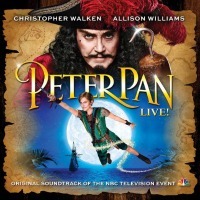 Television Cast, 2014 (Broadway Records) (2 / 5) The ratings for the 2013 NBC live telecast of The Sound of Music were so high as to make a follow-up inevitable. If the choice of Peter Pan was predictable in some ways, it was also a tad perplexing, given the existence (and, now, availability on home video) of three versions starring Mary Martin. In the event, the ratings showed a marked falling-off from TSOM, and the reviews were mixed at best. There were, indeed, several odd casting and staging choices in the production, but it should be noted that it’s far less stressful to listen to this audio recording than to watch the show. Yes, Christopher Walken’s Captain Hook is still monumentally peculiar, but just hearing his odd tones is less disorienting than seeing him as well. Unlike Walken, Allison Williams can sing, and her Peter sounds appealing, if somewhat generic. As with the aforementioned NBC Sound of Music, genuine musical theater pros were cast in support, here Christian Borle as Smee/Mr. Darling and Kelli O’Hara as Mrs. Darling. (Why does Smee, rather than Captain Hook, double in the role of the father? Well, would you want Walken’s Hook for your dad?) Several new songs were added to so-so effect, and there was little surprise that “Ugg-a-Wugg” was given a lyrical overhaul to avoid offense to Native Americans. The “Tarantella” and “Tango” were expanded to amusing effect, but though this recording overall is relatively painless and well done, it’s no match for the superb original cast album. — R.B.
Peter Pan (Bernstein)
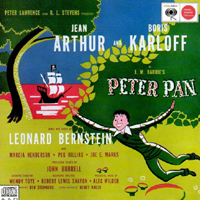 Original Broadway Cast, 1950 (Columbia/Sony) (1 / 5) This is a little-known, unusually lackluster score by Leonard Bernstein, not the beloved Peter Pan musical of four years later. Except for students of its composer, it’s hard to imagine anyone actually wanting this recording. It presents a straightforward version of James Barrie’s play, edited for records in the manner of a radio drama, with some songs interspersed. Only five musical selections are included; the ballet music and “Never Land,” written for two mermaids, were not recorded. A song for Captain Hook (“Walk the Plank”) and one for the Pirates (“Pirate Song”) are both exactly what you’d expect. The other numbers, sung by Wendy, are “Peter, Peter” (the only song with any dramatic function), “Build My House” (a soprano snooze), and “Who Am I?” Bernstein wrote both music and lyrics for the songs, which he wanted to reuse when he was asked to provide a score for the subsequent production of Peter Pan that would star Mary Martin. Here, Jean Arthur is rather charming as Peter. Boris Karloff is a surprisingly effective Captain Hook, and Marcia Henderson sings Wendy’s songs in a soprano that you may appreciate more than I do. — David Wolf
Pete ‘n’ Keely
Original Off-Broadway Cast, 2001 (Fynsworth Alley) (3 / 5) James Hindman’s goofy, marvelous spoof/homage Pete ‘n’ Keely stars George Dvorsky and Sally Mayes as Pete Bartel and Keely Stevens, a pair of bitterly divorced songbirds who have been coerced into performing on a TV reunion special. Material that might have been overly campy in other hands is just right when delivered by the divine Mayes and Dvorsky. The song list combines standards (“This Could Be the Start of Something Big,” “But Beautiful”), a patriotic classic (“The Battle Hymn of the Republic”), and new songs by director-lyricist Mark Waldrop and musical director-composer Patrick Scott Brady. “Wasn’t It Fine?” is the one serious song among the new ones, and it’s lovely. The comic highlights are the hilarious “Cross Country Tour,” a six-minute medley that mentions every state in the union, and then some; “Tony ‘n’ Cleo,” which presents highlights from the couple’s one Broadway show, a stereotypical 1960s musical ostensibly based on Shakespeare’s Antony and Cleopatra; and “Love,” not a funny song in itself, but interspersed with hilarious, rapid-fire rounds of jabs. Brady leads the crack eight-piece band, and production photos in the CD booklet offer a glimpse of Bob Mackie’s lavish costumes. — Seth Christenfeld
Personals
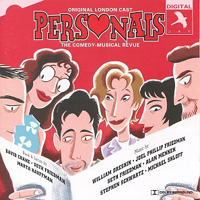 Original London Cast, 1998 (JAY) (3 / 5) Before their huge success with TV’s Friends, David Crane and Marta Kauffman wrote this amusing theater piece in collaboration with lyricist Seth Friedman and various composers. No cast album of the original 1985 Off-Broadway production was made; this is a recording of the 1998 London staging that featured David Bardsley, Martin Callaghan, Marcus Allen Cooper, Christina Fry, Ria Jones, and Summer Rognlie. As the title suggests, Personals is about people who run “personals” ads. The characters include a shy teenager who, believing that he’s the last remaining virgin, advertises for a teacher of “extra-curricular activities” and gets nearly 100 responses; a young woman who’s open to dating for the first time since her marriage broke up; and a lonely man who’s trying to concentrate on a book while hoping for the doorbell to ring. The typesetter who works on the ad page sings about the pleasures that he and his wife have found with their new partner, a bisexual dwarf: “So my wife and I have fallen for a guy who’s three foot two — well, so would you!” Despite its seemingly absurd premise, the song becomes moving at the end. In the best piece, “Moving In With Linda,” a man’s old girlfriends pop out of his suitcases and trunks; the music and lyrics for this item are by Stephen Schwartz, who also wrote the impressive opening and closing numbers. The rest of the songs are by Michael Skloff, Alan Menken, Seth Friedman, Phillip Friedman, and William Dreskin. — David Wolf
Passion
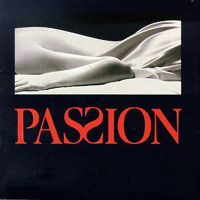 Original Broadway Cast, 1994 (Angel) (3 / 5) One of Stephen Sondheim’s most daring achievements, Passion is also one of his most divisive: Some people respond to the work’s uncompromising nature, while others find its story off-putting from beginning to end. Nevertheless, the score is committed and, yes, passionate. With a book by James Lapine, the show is based on Ettore Scola’s 1981 film Passione d’Amore, which was adapted from Igino Ugo Tarchetti’s 1869 novel Fosca. It concerns an Italian military officer named Giorgio who is obsessively pursued by and eventually falls in love with an unattractive, infirm woman named Fosca — much to the chagrin of his lover, the already-married Clara. While many of the show’s situations border on the melodramatic, there’s a brutal honesty about the characters’ actions and feelings that gives Passion just the bite and heat it needs. The recording runs under an hour, and omits much music and dialogue, but what’s included is lush and heavily emotional. These songs embrace or suffocate you as they define every facet of the intertwining relationships at the musical’s core. Jere Shea (Giorgio), Donna Murphy (Fosca), and Marin Mazzie (Clara) give rich performances, pulsing with blood and full of heart. Murphy, in particular, brings a startling intensity to her every spoken and beautifully sung word. The supporting cast members have little to do, but both Gregg Edelman as Fosca’s cousin and Tom Aldredge as a military doctor are fine. — Matthew Murray
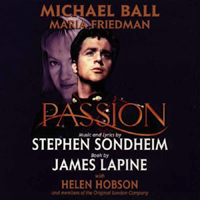 Original London Cast, 1997 (First Night) (3 / 5) This recording is almost 20 minutes longer than the Broadway album, containing more music as well as dialogue, but both are roughly equal in terms of performance quality. Maria Friedman’s Fosca is more strident than Donna Murphy’s; her portrayal is not as well layered and, therefore, is less sympathetic. Michael Ball brings a raw sexual energy to the role of Giorgio. Helen Hobson, as Clara, presents a casting problem: She seems harsh, cold, and false in her declarations of love for Giorgio, which somewhat reduces the overall effect of the piece. But, in supporting roles, Hugh Ross and Paul Bentley sound more dynamic than their New York counterparts. Fans of Passion will want to have both the Broadway cast album and this one. — M.M.
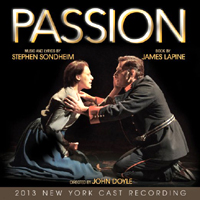 Off-Broadway Cast, 2013 (PS Classics) (3 / 5) The uncountable problems that plagued John Doyle’s 2013 Off-Broadway production of Passion matter far less on this recording than they did in the theater. Ryan Silverman and Judy Kuhn embrace their inner smoldering as Giorgio and Fosca, turning out performances of tangible if not expansive feeling that sell all the basic emotions at the musical’s heart. Though we get rather less fire and urgency than on the OBCR, their interpretations work given the generally pulled-back atmosphere of the proceedings, and Jonathan Tunick’s smart reductions of his own original charts (carefully conducted by Rob Berman) are in line with an appropriately intimate experience. The characterizations of the supporting cast, including Stephen Bogardus as the Colonel and Tom Nelis as the Doctor, are understated, but not destructively so. Rebecca Luker, who for the recording spelled the sidelined-by-illness third star, Melissa Errico, sounds older and more distant than Silverman and Kuhn, which results in a wobblier-than-ideal love triangle. Still, a bomb of a revival producing a reasonably persuasive recording is an achievement worthy of note by understandably incredulous Sondheim fans. — M.M.
Pardon My English
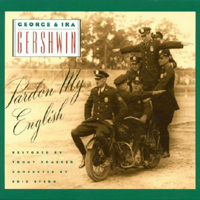 Studio Cast, 1994 (Elektra-Nonesuch) (4 / 5) Pardon My English, the 1933 musical that had the shortest Broadway run of any Gershwin show, makes for a most entertaining recording. The wonderful songs are mostly unfamiliar, but Eric Stern’s conducting is lively, and the original orchestrations sound strong rather than distractingly antique. The show has a troubled history: After a hellish gestation during which the original cast members quickly departed, Pardon My English was totally rewritten by Herbert Fields and Morrie Ryskind. Then Ryskind decamped, as well. Jack MacGowan, who had scripted Girl Crazy, came in and did last-minute doctoring just before the New York opening. Of course, George and Ira Gershwin had to do considerable jiggering of the score to suit the revised plot and characters. Although the story makes little sense, the songs are delightful. “Isn’t It a Pity?” is certainly the best of them, but obscure numbers such as “Where You Go, I Go” and “I’ve Got to Be There” are as enjoyable as some of the Gershwin gems you’ve been listening to and loving all your life. There are also a few “lyric fun” songs: “Freud and Jung and Adler,” “He’s Oversexed,” and “My Cousin in Milwaukee.” The first-rate cast of this recording is headed by John Cullum, William Katt, Arnetia Walker, and Michelle Nicastro. — David Wolf
Parade (Brown)
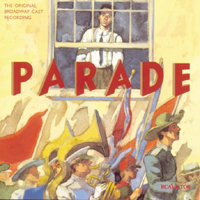 Original Broadway Cast, 1999 (RCA) (4 / 5) Composer-lyricist Jason Robert Brown earned a Tony Award for his work on Parade, his first Broadway score. Although this dark musical about the blatantly anti-Semitic murder trial, conviction, and eventual lynching of Leo Frank in Atlanta, GA during the early years of the 20th century had only a limited run at the Vivian Beaumont Theater, it yielded a fine cast recording. Alfred Uhry’s book for the musical is distancing, and so was Harold Prince’s direction of the show, but Brown’s score is excellent. Note the evocative Southern flavor that’s so vital to the story’s Georgia setting in the beautiful opening anthem, “The Old Red Hills of Home,” and the heavy blues strains in the chain-gang song “Feel the Rain Fall.” Also exciting: the eight-song trial sequence, which runs the gamut from sentimental to comic to soulful, and the show’s dynamic second-act duets, “This Is Not Over Yet” and “All the Wasted Time.” These are put across with gusto by Brent Carver and Carolee Carmello, who each have strong solo moments as well (his “How Can I Call This Home?” and her “Do It Alone”) but who truly soar when singing together. The rest of the cast is equally top-notch: Rufus Bonds, Jr., Don Chastain, John Hickok, Herndon Lackey, Jessica Molaskey, Evan Pappas, Christy Carlson Romano, John Leslie Wolfe, and the ensemble all come across beautifully. If not every song on the album is a gleaming gem, it’s an impressive score overall. — Matthew Murray
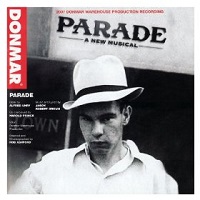 London Cast, 2007 (Warner Music Group) (3 / 5) The black-and-white cover suggests everything you need to know about this recording of Parade: It’s raw, intense, and quietly powerful. Jason Robert Brown’s glorious and moving score is presented compellingly with harsh but beautiful orchestrations, and most of the cast does an admirable job, even if their performances are not as extraordinary as their counterparts in the two Broadway recordings. The main attraction of this album is its completeness; entire scenes are preserved with dialogue included, making the listening experience especially intense. The recording’s primary detriment is the performance of Bertie Carvel as Leo Frank. Carvel is not Jewish, and the accent he uses for the role borders on offensive — not to mention that his Leo is so grotesque and unlikable that the focus of the show is thrown off center, and the relationship of the central couple is almost wholly unbelievable. As a result, the haunting “Sh’ma” that comes near the end of the show does not pack quite the punch that it should. On the other hand, Lara Pulver gives a lovely performance as Lucille Frank, her initial quietness building up to a powerful explosion in the show’s second act. Several of the supporting roles are doubled on this recording, and the concept is generally successful; Shaun Escoffery, as Jim Conley and Newt Lee, brings these two characters to such vivid and terrifying life that the listener is glad he was handed both roles. The ensemble cast is excellent: Malinda Paris brings a surprising but effective glee to “A-Rumblin’ and A-Rollin’,” and the sequence involving “The Factory Girls” is gripping. Overall, this recording succeeds in conveying the power of Parade, but with two other brilliant cast albums available, it’s likely that only completists will consider it a necessary possession. — Charles Kirsch
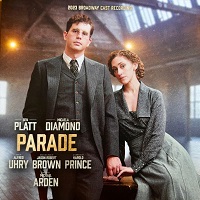 Broadway Cast, 2023 (Immersive Music/Interscope Records)
  (5 / 5) From the moment when Charlie Webb, as an anonymous Confederate soldier, begins to sing with incredible clarity and power of “The Old Red Hills of Home,” it’s clear that this is an excellent cast recording of a superb production of Parade. Indeed, it doesn’t miss a beat, with its pitch-perfect cast and stirring orchestrations by Don Sebesky and the show’s composer, Jason Robert Brown (slightly altered from the originals). Ben Platt is the ultimate Leo Frank: quiet, humorous, and with enough charisma that listeners may have to wipe quite a few tears from their eyes as the tragedy of his story unfolds. Micaela Diamond is a new Broadway phenomenon at the ripe age of 23, exhibiting a maturity befitting the character, along with a hauntingly lovely voice that makes songs such as “You Don’t Know This Man” ring out with pathos. In the midst of the debate about “authentic” casting, this production makes a strong case for it; the history of anti-Semitism speaks through Platt and Diamond in a way that it could not through some of their predecessors in these roles. On top of that, their voices blend with unbelievable beauty in “This Is Not Over Yet.” All of the other cast members perfectly embody their characters: Kelli Barrett’s “My Child Will Forgive Me,” which takes a journey from self-flagellation to a final moment of anti-Semitism, is a master class in musical theater acting; Alex Joseph Grayson’s “Blues: Feel the Rain Fall” is nothing short of terrifying; and Douglas Lyons and Courtnee Carter’s duet “A Rumblin’ and A Rollin’” provides powerful context for the story, along with beautiful vocals. This story is, in fact, so tragically real that the album can be hard to get through, but if you attend it all the way through to Platt’s heartbreaking “Sh’ma” and the finale, you may find the catharsis that only a truly great show can bring. — C.K.
Parade (Herman)
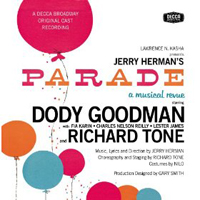 Original Off-Broadway Cast, 1960 (Kapp/Decca) (2 / 5) This topical revue served as a calling card for a young composer-lyricist named Jerry Herman. It remains a pleasant diversion if you’re in the right mood. By 1960, Herman’s remarkable facility for songwriting was fully in place — although it’s a little disorienting to hear the melody of “Show Tune,” later used for “It’s Today” in Mame, and an overture passage that was recycled for “I Want to Make the World Laugh” in Mack & Mabel. Dody Goodman and Charles Nelson Reilly deliver the comedy material, including the notably dirty “Save the Village,” in which Goodman protests shutting down the Women’s House of Detention on Sixth Avenue (“There’s love in the laundry / There’s love in the showers / There’s love in the clinic”); “Confession to a Park Avenue Mother,” in which Reilly shamefacedly admits loving a girl from the West Side; “Maria in Spats,” about Maria Callas’s banishment from the Metropolitan Opera (“Why can’t I play the Palace / If Judy can play the Met?”); and “Jolly Theatrical Season,” which spoofs flop shows. The uneven but generally enjoyable ballads are handled by big-voiced unknowns Lester James, Fia Karin, and the astonishing Richard Tone, who has one number only: “Two a Day,” a salute to vaudeville that brings down the house even on disc. — David Barbour
Panama Hattie
 Original Broadway Cast Members, 1940 (Decca) (3 / 5) Piggybacked onto the Decca CD issue of the Call Me Madam studio album starring Ethel Merman are four selections from Panama Hattie in their first appearance since their original 78rpm release in 1940. They certainly don’t represent Cole Porter at his best in songs such as “My Mother Would Love You” and “Let’s Be Buddies.” Still, it’s nice to have these recordings, along with ”I’ve Still Got My Health” (in a cut-down version) and “Make It Another Old Fashioned, Please.” Merman performs them exactly as you’d expect, joined by eight-year-old Joan Carroll, who speaks her lines rather than singing them because of the child-labor laws of the era! Forgive me for admitting a preference for Kaye Ballard’s more complete “I’ve Still Got My Health” on Ben Bagley’s Cole Porter Revisited and Carmen Alvarez’s more nuanced “Make It Another Old Fashioned, Please” on Bagley’s Decline and Fall album, but I wouldn’t want to be without these delightful Merman souvenirs. — David Wolf
Pal Joey
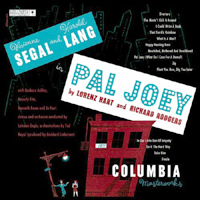 Studio Cast, 1950 (Columbia/Sony) (5 / 5) Joey, a small-time entertainer bent on opening his own nightclub, drops his girlfriend, Linda, to bed Vera, a rich dowager who’s bonkers for him and who backs his venture. When this sophisticated saga premiered on Broadway in 1940 as Pal Joey, the production did not generate a cast album. But, over the next decade, the Richard Rodgers-Lorenz Hart songs grew so in popularity that, by 1950, the score was ripe for a full recording. Conductor Lehman Engel and producer Goddard Lieberson created a cast album featuring the original Broadway leading lady, Vivienne Segal, as Vera. In place of Gene Kelly, who had been scooped up by Hollywood following his acclaimed stage portrayal of Joey, dancer Harold Lang was brought in, fresh from his Broadway triumph in Kiss Me, Kate. The results are spectacular. The performances on this recording are definitive and, for the most part, the original orchestrations are intact. Rodgers’ beloved melodies and Hart’s witty lyrics are a joy throughout. Segal delivers Vera’s solos, “What Is A Man” and “Bewitched, Bothered and Bewildered,” to perfection, and her two duets, “In Our Little Den of Iniquity” with Lang and “Take Him” with Beverly Fite as Linda, are just as great. Lang’s singing of “I Could Write a Book” as a duet with Fite is very persuasive, and his rendition of “You Mustn’t Kick It Around” will set you to dancing in your living room. — Gerard Alessandrini
 Broadway/Studio Cast, 1952 (Capitol/Angel/DRG) (3 / 5) This first Broadway revival of Pal Joey, in 1952, was prompted at least in part by the solid success of Lehman Engel’s 1950 studio recording of the score (see above). Since that album was on the Columbia label, Capitol Records had to replace Vivienne Segal and Harold Lang, who starred in the revival, with two singers from its stable for the revival cast album. So here we have a cast recording without the stars of the production it was based on. Jane Froman as Vera and Dick Beavers as Joey sing the songs well from a musical standpoint, but they don’t quite connect with the caustic aspects of Hart’s lyrics — and another huge strike against this recording is the fact that some of those great lyrics have been rewritten and, in a few instances, sanitized. Also, the score has been re-orchestrated, and the results are pleasant enough but inferior to the originals. The album’s ace in the hole is Elaine Stritch’s unsurpassed performance of “Zip,” which catapulted her to stardom. Helen Gallagher’s tracks are also brilliant and brassy. (Note: A DRG CD reissue of this recording includes Jane Froman performing selections from With a Song in My Heart. It’s a nice match). — G.A.
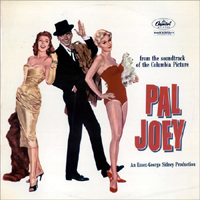 Film Soundtrack, 1957 (Capitol) (2 / 5) Here’s a terrific Frank Sinatra album that has little to do with Pal Joey as seen and heard on Broadway, seeing as how the show’s score and story are all but lost in the film version. The arrangements, by Nelson Riddle and George Dunning, are swinging and cool. They make for some fine pop recordings of Richard Rodgers’ music, but Lorenz Hart’s brilliant work is not served as well. Most of his caustic and/or risque lyrics were changed, dropped, or clumsily “cleaned up” for the movie by an uncredited hand; gone, for example, are such great Hart lines as Vera’s “I’m vexed again, perplexed again, thank God I can be oversexed again!” Some of the background scoring is pleasant, owing more to the flexibility of Rodgers’ music than to Morris Stolloff’s musical direction. There is also an attractive “Joey” theme running through the film and recording, but it doesn’t seem to have been written by Rodgers — another uncredited mystery. The album’s best selections are “The Lady Is a Tramp” and “I Didn’t Know What Time It Was” as sung by Sinatra. Both are classics, but neither song is from the original Pal Joey score. — G.A.
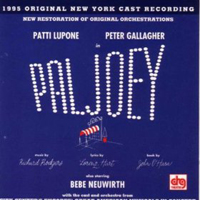 Encores! Cast, 1995 (DRG) (2 / 5) This is a worthy attempt at a complete stereo recording of Pal Joey, but even though the production that yielded it was performed by solid pros, the cast album is generally dull. The major exceptions are Patti LuPone’s contributions. Perfectly cast as Vera, LuPone delivers Hart’s wry lyrics with savvy, and her versatile, pitch-perfect voice serves Rodgers’ music very well. Her standout number is “Bewitched, Bothered and Bewildered,” complete and uncensored. On the other hand, Peter Gallagher is not in good vocal form here, however well suited he is for the role of Joey in other respects. Many of Gallagher’s sustained notes in the ballads are slightly flat, and in the up-tempo numbers, he sounds lethargic. In the supporting role of Melba, Bebe Neuwirth doesn’t come across with enough sass or brass. And while the original orchestrations are here, the orchestra as conducted by Rob Fisher sounds sloppy and sometimes lags behind the singers. In sum, this recording is worthwhile mostly for LuPone’s performance and for the inclusion of “I’m Talkin’ to My Pal,” a great Rodgers and Hart song that was originally slated to end the show but was dropped during the pre-Broadway run in Boston. — G.A.
The Pajama Game
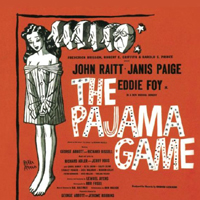 Original Broadway Cast, 1954 (Columbia/Sony) (3 / 5) For a primer on the state of musical comedy in the mid-1950s, look no further than here. The Pajama Game was based on notably “unmusical” source material: a novel called 7 1/2 Cents that took a lighthearted look at labor-management conflict in a Midwestern pajama factory. Songwriters Richard Adler and Jerry Ross created a score full of songs that were (mostly) tied to the action yet stood on their own as pop tunes: “Hey There,” “Steam Heat,” and “Hernando’s Hideaway.” The show ran for well over two years, followed by Adler and Ross’s next hit, Damn Yankees. (Alas, further triumphs would not be possible; Jerry Ross died in 1955.) The original cast album, while acceptable, is not the best souvenir of this show. Fortunately, John Raitt is in charge as Sid Sorokin, and that tenorial baritone of his can attack a mediocre number like “A New Town Is a Blue Town” and glorify it. When he gets a truly good song, such as “Hey There,” the bliss factor rises accordingly. Opposite him as Babe, Janis Paige belts with gusto even if she’s occasionally off-pitch. Dancer Carol Haney, who made a major impression in the show with “Steam Heat” and “Hernando’s Hideaway,” is not terribly comfortable as a singer. Showbiz veteran Eddie Foy, Jr. has no such problem, and he and Reta Shaw sail happily through “I’ll Never Be Jealous Again.” — Richard Barrios
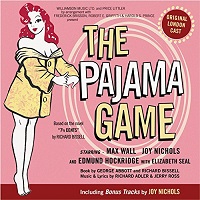 Original London Cast, 1955 (HMV/Sepia) (3 / 5) This is one of the most enjoyable, stylistically apt London cast albums of an American musical ever recorded. Australian performer Joy Nichols sounds great as Babe Williams, whether belting with complete assurance or effecting a lovely, lyrical sound in the “Hey There” reprise that’s happily included here; she has as much charm and personality as Janis Paige, but without her predecessor’s vocal quirks and pitch problems. In the role of Sid Sorokin, Canadian baritone Edmund Hockridge may sound just a bit stuffy and stolid as compared to John Raitt, but he still has a gorgeous voice that’s a pleasure to hear in such songs as “A New Town is a Blue Town” and, of course, “Hey There.” According to Wikipedia, native Brit Elizabeth Seal “shot to fame” with her performance as Gladys in the production that yielded this recording, and it’s easy to understand why — even though, of course, the album doesn’t allow us to experience her dancing in “Steam Heat,” etc. Max Wall, who receives top billing on the album cover, is fun as Hines in his solo moments and when duetting with Joan Emney as Mabel in “I’ll Never Be Jealous Again.” Bonus tracks on Sepia’s latter-day issue of this recording feature the wonderful Nichols in a bunch of songs by various writers. Most of them are forgettable, obscure pop tunes or novelty numbers, but a shining exception is “I Talk to the Trees” from Paint Your Wagon, here sung with great vocal beauty and deep emotion. — Michael Portantiere
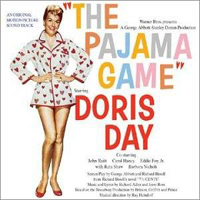 Film Soundtrack, 1957 (Columbia/Collectables) (4 / 5) Hollywood treated The Pajama Game grandly. Most of the songs, dances, and Broadway cast were retained. As Gladys, Carol Haney comes across much better here than on the prior recording; her smoky tone in “Hernando’s Hideaway” now insinuates through the number’s tango rhythms with ease. As Sid, Raitt is again exemplary. “A New Town Is a Blue Town” is gone, but not much missed, and Raitt’s singing of “Hey There” and everything else he does is wonderful. Where the movie really trumps Broadway is in its Babe; Doris Day is so ideally cast that such songs as “I’m Not at All in Love” seem to have been written for her. Another Hollywood addition is the memorably squeaky-voiced Barbara Nichols as Poopsie. Eddie Foy, Jr. and Reta Shaw are again in fine form, and the album contains a fair amount of dance music. — R.B.
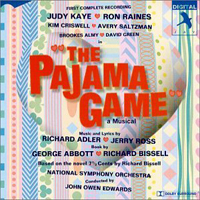 Studio Cast, 1996 (JAY, 2CDs) (2 / 5) The Pajama Game has remained a favorite of stock companies and community theaters. The show even enjoyed a staging by the New York City Opera in 1989, and the leading lady of that production, Judy Kaye, heads this London studio cast album. Every scrap of music was recorded and, as a result, posterity now has a complete aural document of the score. The most important addition is the “Jealousy” ballet, in which Carol Haney had shone in the original production. Solid pro Ron Raines as Sid the finest of the leads, while Kim Criswell sounds a bit uncomfortable as Gladys. Kaye works hard as Babe, sometimes ratcheting up to overblown, but on balance, she comes through well. The rest of the mixed American-British cast sings enthusiastically. — R.B.
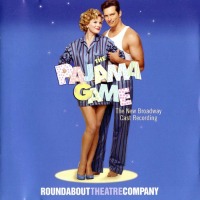 Broadway Cast, 2007 (Columbia) (3 / 5) Since the first Broadway revival of The Pajama Game, in 1973, was both unsuccessful and unrecorded, the show was over half a century old by the time a New York revival made it to the recording studio. The limited-run production by the Roundabout Theatre Company was well received, copping Tony Awards for Best Revival and for choreography. It was less a reimagining of the show than a primary-colored hommage, and that’s how it comes across on the cast album. The score holds up well, and with the exception of Megan Lawrence’s over-mannered Gladys, the cast delivers commendably and with gusto. Much of the interest in the show centered around Harry Connick, Jr. making his Broadway debut as Sid. (He also co-produced this recording.) While the one-time wunderkind of jazz-pop makes for a lighter-voiced hero than is traditional, many listeners are likely to feel that his performance works, Sinatra inflections and all. Perhaps it’s not too surprising that Connick gets an added piano break in “Hernando’s Hideway,” presumably to satisfy his fans. Fortunately, he performs opposite Kelli O’Hara, whose Babe is perhaps less gutsy than Janis Paige’s or Doris Day’s but, in its own right, is full of character and spunk. Michael McKean is a good Hines, and Roz Ryan a dandy Mabel. The orchestra and chorus are as polished as they are enthusiastic, and on the whole, this is about as good a version of the old show as could have been expected on 21st-century Broadway. (Note: The original issue of the cast album on CD packaged it alongside a second disc that featured Connick and O’Hara singing songs from Connick’s score for Thou Shalt Not. The stand-alone Pajama Game disc was issued subsequently.) — R.B.
Paint Your Wagon
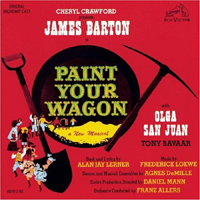 Original Broadway Cast, 1951 (RCA) (4 / 5) A show with a magnificent score but an inferior book, Alan Jay Lerner and Frederick Loewe’s Paint Your Wagon tells of an 1853 California gold rush, the lonely men of the mining camp, the peripatetic Ben Rumson, and his daughter’s love affair with a Mexican baritone. It’s a combination that calls for a heap of singing from a lusty male chorus, and they sound great right from the opening number, ”I’m on My Way.” (That’s Kay Medford as “Cherry,” with an amusing faux-French accent.) A couple of songs are missing from the album, and where is Loewe’s terrific music for those Agnes De Mille ballets? Still, what’s here is of a very high order. James Barton, capping a career that extended back to vaudeville, doesn’t offer much voice but whispers his way compellingly through “I Still See Elisa,” “In Between,” and “Wand’rin’ Star.” Olga San Juan is a fun, fiery soubrette with a throaty belt in “What’s Goin’ on Here?” and “How Can I Wait?” And if Tony Bavaar’s “I Talk to the Trees” is a little boring, his singing of “Another Autumn” makes up for it. Conductor Franz Allers does Ted Royal’s orchestrations proud, and there’s enough dialogue included to convey the contours of the plot. — Marc Miller
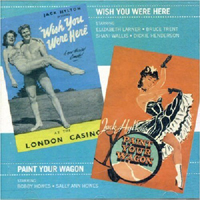 Original London Cast, 1953 (Columbia/Sepia) (1 / 5) It sounds like ideal casting: the lovable British comic Bobby Howes as Ben Rumson and his up-and-coming daughter Sally Ann Howes as Ben’s daughter, Jennifer. But this cast album shows neither performer at best advantage. The recording is in medley form — one chorus each of such songs as “All for Him” and “There’s a Coach Comin’ In” — and adds up to barely 13 minutes. Sally Ann Howes sounds a little raw, with stilted line readings and uncertain top notes. As her love interest, Ken Cantril is off pitch and doesn’t sound remotely Mexican. The one selling point is some tasty dialogue not heard on the Broadway album. (Note: The Sepia CD compilation includes selections from Wish You Were Here and Guys and Dolls as performed by members of the original London casts of those shows.) — M.M.
 Film Soundtrack, 1969 (MCA) No stars; not recommended. There are not quite three minutes of fine singing here, when Harve Presnell in the role of “Rotten Luck Willie” sings “They Call the Wind Maria” in the pouring rain. The rest is torture. Alan Jay Lerner and André Previn wrote five new songs for the movie, each more dismal than the next. All right: “A Million Miles Away Behind the Door” is an almost-good ballad, but Anita Gordon, dubbing for Jean Seberg, phones it in. When Clint Eastwood sings “I Still See Elisa” in a toneless, hoarse tenor, he sounds even less engaged than Gordon. Lee Marvin’s “Wand’rin’ Star” is sleep-inducing, and so is Nelson Riddle’s conducting. This album is for masochists only. — M.M.
 Encores! Cast, 2015 (Masterworks Broadway) (4 / 5) The 2015 New York City Center Encores! staging of Paint Your Wagon revealed a less-bad book than generally believed, and a rip-roaring score that has long deserved a far fuller performance than the one heard on RCA’s original Broadway cast album. It finally gets that performance here, with a couple of songs that are completely missing on the 1951 recording, longer versions of “Wand’rin’ Star” and other standards, and several flavorful Trude Rittman dance sequences that make you wonder what Agnes de Mille was filling the stage with. The casting, while not ideal, is pretty good. Keith Carradine as Ben doesn’t top the role’s creator, James Barton, but he’s pretty characterful, and while I prefer Olga San Juan’s throatier belt, Alexandra Socha acts Jennifer excellently. Justin Guarini is a romantic, persuasive Julio, and Nathaniel Hackmann sings the heck out of “They Call the Wind Maria.” A bonus track offers a performance with piano accompaniment of a cut song, “What Do Other Folk Do?”, based on an idea that Lerner and Loewe later put to better use in Camelot. The score of Paint Your Wagon is superb, with one of the highest testosterone levels in the annals of Broadway, and this long-overdue recording is one you’ll want to replay as soon as you’ve heard it. — M.M.
Pacific Overtures
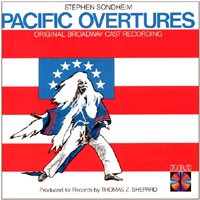 Original Broadway Cast, 1976 (RCA) (5 / 5) Only Harold Prince and Stephen Sondheim could find musical possibilities in the opening up of Japan to the West in 1853. Only Sondheim could make such a brilliant score out of such material, and only Prince would have the nerve to produce the show on Broadway. Pacific Overtures is based on a play by John Weidman about East-West diplomacy. (Hugh Wheeler provided additional book material.) Add a production utilizing Japanese theater techniques and (until the finale) an all-male, all-Asian cast, and you have a perfect recipe for box office poison. Although she show didn’t last beyond a few months on Broadway, it has a unique, brilliant score with clever, pointed lyrics set to austerely beautiful melodies informed by Japanese harmonies. Some numbers, such as “There Is No Other Way” (a tense exchange between a fearful wife and her husband) and “Poems” (in which two men trade haikus) are tersely eloquent, aided by Jonathan Tunick’s fine orchestrations. But the score also contains two of Sondheim’s most elaborate set pieces: “Someone in a Tree,” which recounts a treaty signing from multiple points of view, demonstrates that history is in the eye of the beholder; “Please Hello,” in which Japan is invaded by diplomats from abroad, blends pastiches of various musical genres into a scalding satire. The final number, “Next,” brings the story up to the present day, and is devastating in its irony. On this excellent recording, the original cast, led by Mako and Sab Shimono, performs with notable skill. Sondheim may have written more moving scores, but none surpass the glittering intelligence and excitement of his work here. — David Barbour
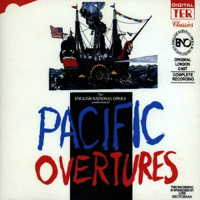 Original London Cast, 1989 (BMG/]AY) (2 / 5) Complete to the last word and note, this recording of the English National Opera production of Pacific Overtures offers the entire show, with its lengthy dialogue included. It may be archivally important, but it’s an uphill battle for the average listener. The non-musical sequences are tedious and lacking in authenticity, and the score, with its intensively rhymed lyrics, doesn’t really call for the skills of opera singers. Still, the cast sings well, and the recording includes material not heard on the Broadway cast album, such as the Kabuki lion dance that ends Act I. This version of “Next” updates the song to the late 1980s with new spoken lines that make ironic reference to Pearl Harbor. There is also some startlingly effective work from the percussionists in the orchestra. — D.B.
Pacific 1860
 Original London Cast, 1946 (Decca/Encore Box Office) (3 / 5) Noël Coward’s overstuffed postwar operetta plunked a visiting diva among some missionaries on the island of Samolo. The show failed to ignite the box office, even with Mary Martin in her London debut. But the attractive score contains Sir Noël’s singular lyrics and some original touches. It opens with two trenchantly satirical songs, “His Excellency Regrets” and “Uncle Harry.” But then there’s the unwittingly hilarious ensemble song “Fumfumbolo,” wherein Brit missionaries get down with the natives. The cast album covers nearly the entire score. Martin is at her vocal peak — hitting fine coloratura notes, donning a credible British accent, and outclassing her leading man, Graham Payn. Bonus tracks present a few songs from South Pacific as performed by Martin and Wilbur Evans, her co-star in the London production of that Rodgers and Hammerstein hit. The only drawback to the CD is the sound quality; the notes claim that the original recordings were “digitally edited and remastered,” but large swatches of the lyrics remain unintelligible. — Marc Miller
Lucky Stiff
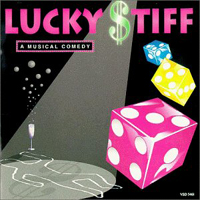 Original Off-Broadway Cast Members, 1994 (Varèse Sarabande) (3 / 5) “Promising” is the obvious word for Lucky Stiff, the first produced musical by composer Stephen Flaherty and lyricist Lynn Ahrens, but that would sell it short. It’s also professional, assured, and entertaining, if not entirely successful. The show tells the trivial story of a meek British shoe salesman who will inherit six million dollars if he agrees to take his uncle’s corpse, in a wheelchair, for one last holiday in Monte Carlo. The two are pursued (and occasionally kidnapped) by all kinds of people who, essentially, want the salesman’s money, although the pursuers each have their own particular farcical motivation. Perhaps because there’s so much convoluted plotting and exposition in this show, it’s hard not to wish that the score was a little less “integrated.” The songs are occasionally so busy doing plot work that they aren’t as much fun as they might have been. Still, they exhibit genuine skill and craft. Flaherty’s great gifts for melody and humor are already clearly in evidence, and some of Ahrens’ neatest and most effortless lyrics are to be found here. Partly because the characters are broad but not terribly rich, the accomplished farceurs who make up the cast don’t get the kind of musical moments that would elevate this show to another level, but the redoubtable Mary Testa, Evan Pappas, Judy Blazer, and Debbie (Shapiro) Gravitte come close. — David Wolf
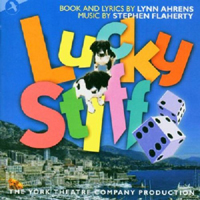 Off-Broadway Cast, 2003 (JAY) (3 / 5) This recording, which followed a five-performance “Musicals in Mufti” run of Lucky Stiff at the York Theatre, is better than its predecessor. The first recording was made years after the show had closed at Playwrights Horizons, without the participation of the director and with only a few of the original performers; this one has much more of a real cast album feel to it, with a company that had recently been through rehearsals and performances together. In fact, six of the 10 cast members here were also in the first production, though only two of them are heard on the original recording. All of their performances are looser, less frantic, and funnier this time around, with Mary Testa unleashed triumphantly. Among the newcomers, Janet Metz and Malcolm Gets make an appealingly believable leading couple, even if Gets’s British accent is a sometime thing. Musical director David Loud’s single-piano accompaniment is more attractive than the elaborate orchestrations of the first recording, which too often strain for comic effect. The material is mostly the same on both albums, though this one has a little more spoken dialogue, as well as the previously unrecorded Act I finale and “A Woman in My Bathroom.” As a bonus track, we get the charming “Shoes,” which was cut from the show. Both CD booklets feature uncommonly ugly cover art. — D.W.
Lucky in the Rain
 Studio Cast, 2000 (DRG) (1 / 5) For this musical, which was seen at the Goodspeed Opera House in 1997, librettist Sherman Yellen wrapped a yarn of romance among expat American journalists in 1927 Paris around a batch of songs by Jimmy McHugh, with lyrics by Harold Adamson and Dorothy Fields. Don’t expect much; Yellen’s idea of historical realism includes Gertrude Stein singing “On the Sunny Side of the Street” and a newsroom full of reporters performing a musical tribute to Charles Lindbergh with “Comin’ In on a Wing and a Prayer.” Others passing through include Josephine Baker and Isadora Duncan. With its easily ignorable plot and most of the songs for each of the major characters sung by more than one performer, this studio cast album works best as a nod to McHugh by Broadway A-listers. Barbara Cook has several lovely tracks, but they appear to have been taken directly from her tribute album to Dorothy Fields, Close as Pages in a Book. Other notable participants are Malcolm Gets, Patrick Wilson, Debbie Gravitte, and Lillias White, but Peter Matz’s orchestrations are more evocative of a pop album than a Broadway show. —David Barbour
Louisiana Purchase
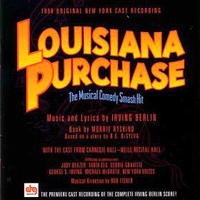 New York Concert Cast, 1996 (DRG) (3 / 5) This is a biting and funny satire of Louisiana’s byzantine politics in general, and of Huey Long in particular. Although Louisiana Purchase opened on Broadway in 1940 with a delightful sung disclaimer that all of its incidents were fictitious, composer-lyricist Irving Berlin and book writers Morris Ryskind and B. G. DeSylva — and, no doubt, delighted theatergoers — reveled in the show’s doses of reality-based topical material. This spirited musical had to wait more than a half-century for a recording. Fortunately, the wait was worth it. Based on a concert presentation at Weill Recital Hall in New York City, here’s a zingy and infectious performance that is more than complete; a number of cut songs, some of them quite good, were reinstated. (Who besides hard-core scholars knew of “I’d Love to Be Shot From a Cannon With You?”) Michael McGrath is aces as the wisecracking hero, Judy Blazer (with a hilarious German accent) makes a good partner for him, and veteran George S. Irving is predictably excellent in the role originally played by Victor Moore. Another veteran, Taina EIg, is charming if perhaps less assured than her part’s creator, Irene Bordoni. In a role that’s more Greek chorus than integral character, Debbie Gravitte offers some fine Broadway “can-belto.” Score-wise,this is not Annie Get Your Gun or As Thousands Cheer, but it’s a lot of fun. — Richard Barrios