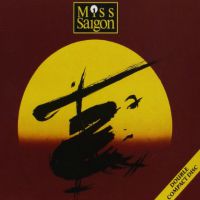
 Original London Cast, 1989 (Geffen, 2CDs) No stars; not recommended. As was the case with The Phantom of the Opera and Les Misérables, its equally lamentable predecessors, Miss Saigon was brought into the world by people who followed a crooked path to enormous popular and financial (but not artistic) success: Create a poorly written stage musical based on a story that has been beloved for generations and, with the help of shrewd marketing, it will run for years even if the adaptation is third-rate, or worse. The plot of Miss Saigon is based on that of the Puccini opera Madama Butterfly and its antecedents, with the action reset to the era of the Vietnam War. But the Claude-Michel Schönberg-Alain Boublil show built around that intriguing concept has one of the most impoverished scores ever contrived for the musical theater, including some dicey borrowings from the works of other composers; for instance, “Why, God, Why?” begins with a beautiful tune that was originally written by Richard Rodgers for “There’s a Small Hotel” in On Your Toes. The Francophone librettist Boublil’s collaboration with Richard Maltby, Jr. yielded lyrics that are awkwardly phrased to the point of semi-literacy. (A few examples among dozens: “God, the tension is high, not to mention the smell,” “My parents got themselves killed in the week you changed sides,” and “You must decide upon which side you’re really on.” ) The song “Movie in My Mind” illustrates the chasm between the creators’ goals and their abilities: The idea of the Vietnamese prostitutes imagining an alternate reality in order to bear the selling of their bodies is interesting, but the music and lyrics are utterly pedestrian. Although it’s difficult to identify the nadir of the score, one good candidate is “Bui Doi,” a shamelessly manipulative plea on behalf of children sired by American servicemen and left behind in Vietnam; experiencing Miss Saigon via audio recording at least spares one having to view the tasteless film that was projected onstage during this sequence. Listeners are also spared the spectacle of the completely Caucasian-looking and British-sounding Jonathan Pryce in the role of the Engineer, a reprehensible Eurasian pimp, but Pryce is badly miscast even from an aural standpoint. On the plus side, Lea Salonga sounds lovely and winsome as Kim. Simon Bowman as her lover, Chris, sings well but doesn’t sound American, which is a problem in terms of the plot. — Michael Portantiere
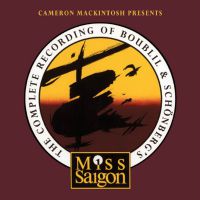 Studio Cast, 1995 (Angel, 2CDs) No stars; not recommended. The CD booklet notes assure us that there was much more to the success of Miss Saigon than the stunning onstage simulation of the landing and takeoff of a helicopter. Yet this recording begins with the whirring of chopper blades, as if to admit: “Yes, that special effect is what most people will remember about the show.” Billed as a “complete recording,” it includes revisions of the score that were made following the London production. The cast, drawn from several of the show’s worldwide productions, is backed by a huge orchestra. Joanna Ampil’s Kim is very much in the Lea Salonga mold, which is a good thing. The partly Asian Kevin Gray brings credibility to the role of the Engineer, but even he can’t triumph over such dreck as “The American Dream,” a hit-them-over-the-head number in which the title phrase is repeated 18 times. Like his recorded predecessor in the role of Chris, Peter Cousens, from the Sydney company, has a fine voice but is unable to sound convincingly American. Hinton Battle sings John’s “Bui Doi” for all it’s worth, which is very little, and the thankless role of Ellen is well handled by Ruthie Henshall. The orchestra, conducted by David Charles Abell, plays beautifully, and the sound quality of the recording is superb, but it’s all in service of a score that, unsurprisingly, seems to have had no staying power whatsoever outside of the show itself. — M.P.
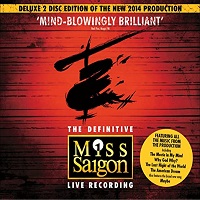 London Cast, 2014 (Verve, 2CDs) No stars; not recommended. Can the phrase “diminishing returns” be applied to the third cast album of a show when its score has so little worth to begin with? This is arrogantly billed as the “definitive recording” of Miss Saigon, and it’s probably best to leave it to fans of the show to decide whether or not they agree with that assessment. Many of the lyrics were rewritten for this 25th anniversary production, but not necessarily for the better. Some of the new lyrics do improve at least somewhat on the horrendous grammar of the originals, but the main impetus for the rewrites seems to have been to make the show more graphic in terms of sex and grit — so much so that this live recording bears an “explicit lyrics” warning. (Example, “If I’m your pin-up, I’ll melt all your brass, stuck on your ball with a pin in my ass.” Seriously.) As for the cast, Jon Jon Briones is an appropriately oily Engineer; Eva Noblezada’s voice is capable of sweetness and power as necessary in the role of Kim; and Alistair Brammer has a lovely, lyrical tenor, plus he’s the only recorded Chris who sounds convincingly American rather than British. (Note: After its run at the Prince Edward Theatre in London, this production transferred to Broadway, and Briones won a Tony Award for his performance. A high quality video of the production, captured in London, is also available for those who have any interest in such an item.) — M.P.
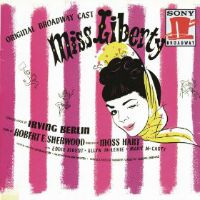
 (2 / 5) Irving Berlin’s highly anticipated follow-up to Annie Get Your Gun was one of those can’t-miss packages that missed. It had thick postwar nostalgia, Jerome Robbins choreography, direction by Moss Hart, sets by Oliver Smith, and a book by the distinguished playwright Robert E. Sherwood. The plot is slight: Reporter travels to 1885 Paris to interview Bartholdi’s model for the Statue of Liberty, bags the wrong girl, and hilarious complications ensue. Apparently, one of the show’s problems was that audiences rooted for the reporter to end up with his American girlfriend, not the jeune fllle who ultimately lands him. But the real trouble may have been the unexciting principals and Berlin’s lackluster score. Eddie Albert, a Broadway pro by 1949, was capable but hardly one to set a stage ablaze. The girls fighting for his affections, Allyn Ann McLerie and Mary McCarty, were promising young talents, the former more a dancer than a singer (Exhibit A: her high notes in “Just One Way to Say I Love You”) and the latter an ideal best-pal sort overselling middling material. Berlin packs some good foreign-relations jabs into “Only for Americans,” and the show’s finale, “Give Me Your Tired, Your Poor,” has the required dignity, although McLerie’s thin soprano undercuts it somewhat. Otherwise, the album is interesting as a document of how deeply ingrained sexism was in 1949. In “Homework,” career gal McCarty admits that her real dream is “Staying / At home and crocheting / And meekly obeying / The guy who comes home.” In “You Can Have Him,” she says that her greatest desire is to “give him babies, one for every year.” Sheesh! — Marc Miller
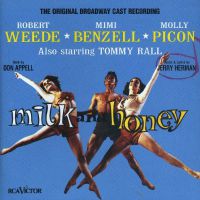
 (3 / 5) Jerry Herman’s first Broadway score is surely one of his best, an atmosphere-soaked tour through contemporary Israel in service of a tired soap opera plot. At age 30, Herman was already a melody master. Note his gift for well-judged production numbers (the minor/major-key intricacies of “Independence Day Hora”), stirring title songs (dancer-singer Tommy Rall delivers this one with vigor), 11-o’clock showstoppers (“Hymn to Hymie,” with Molly Picon socking across a funny lyric), and warmly appealing ballads (the ardent, chromatic “There’s No Reason in the World”). The orchestrations, by Eddie Sauter and Hershy Kay, are more interesting than those that Herman’s scores generally commanded — even his bigger hits. Robert Weede, fresh from The Most Happy Fella, could still play an aging romantic lead with the best of them. Unfortunately, this time he has less to play off of; leading lady Mimi Benzell is vocally precise but terminally dull, and she doesn’t let her hair down even when the lyrics demand it. The whole album feels a little hurried, incomplete, and short on dance interludes. But Herman comes out swinging: The opening number, “Shalom,” announces an extremely promising Broadway songwriter. That was this score’s hit song, but there’s plenty more to appreciate here. — Marc Miller
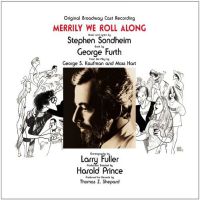
 (5 / 5) A big flop in its original Broadway production, this show boasts one of Stephen Sondheim’s best scores. George Furth’s book, based on a George S. Kaufman-Moss Hart disappointment, follows three erstwhile best friends — a composer-turned-producer, his former lyricist partner, and an author/journalist — backward in time from adulthood to their idealistic salad days in New York, reviewing the missteps, betrayals, and compromises made along the way. With its lurid “inside” view of showbiz, the musical was dramatically unworkable. Also, the production design was disastrous; and the performers, playing gin-swilling, backstabbing sophisticates through most of the show, were too young. But none of this matters when you’re listening to the recording. Savor the heartbreaking melodies and trenchant lyrics, or analyze the score’s jigsaw-puzzle construction in which themes and ideas are set forth, then quoted and reworked, creating a solid emotional substructure. (The melody that’s first heard as “The Hills of Tomorrow” is reused several times and serves as a strong musical through-line.) Jonathan Tunick’s orchestrations are brassy and driving, and the three leads are marvelous. As composer Franklin Shepard, Jim Walton displays a piercing tenor that shines especially in “Not a Day Goes By,” one of Sondheim’s most wounding ballads. Lonny Price is appealing as Charley, Frank’s collaborator; he easily navigates the tortuous lyrics of “Franklin Shepard, Inc.” and gives a heartfelt reading of the rueful “Good Thing Going.” Another plus is a young Jason Alexander as Joe. But the big revelation is Ann Morrison, devastating as Mary, the writer who descends into alcoholism while pining for Frank. She brings an overwhelming warmth and sadness to “Like It Was” and “Not a Day Goes By,” and is just as strong in the invigorating “Now You Know.” — David Barbour
 (4 / 5) This is a recording of a heavily revised version of Merrily We Roll Along, with substantial dialogue sequences included. The story line is still plagued by a breathless view of showbiz mores, and the idea that writing Broadway musicals is a career for noble souls while working on Hollywood films is iniquitous. New material includes “That Frank,” a reworking of “Rich and Happy”; “Growing Up,” sung by Frank and his second wife, Gussie; and the entr’acte, bows, and exit music. Also included is a song that was cut from the original production: “The Blob,” Gussie’s disenchanted description of the guests at her New York party. This lively, up-tempo performance has strong work from its mostly British cast, especially Michael Cantwell as Frank and Jacqueline Dankworth as Beth, Frank’s first wife. Maria Friedman strains for brittle sophistication as Mary, but she partners nicely with Dankworth and Cantwell in “Not a Day Goes By.” American performer Evan Pappas is a very capable Charley, especially in “Good Thing Going.” Louise Gold is an aptly cynical Gussie. Minor flaws include some shaky American accents and occasionally over-emphatic performances, but it’s interesting to hear the score performed by an adult cast. — D.B.
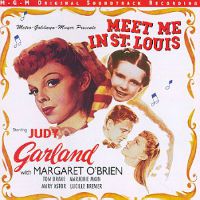
 (1 / 5) Based on a series of stories by Sally Benson that originally appeared in The New Yorker, Vincente Minnelli’s Meet Me in St. Louis is one of the glories of MGM’s Arthur Freed unit, but the film doesn’t have enough noteworthy music or interesting vocal performances to fill a soundtrack album. Judy Garland renders Hugh Martin and Ralph Blane’s “The Boy Next Door,” “The Trolley Song,” and “Have Yourself a Merry Little Christmas” with an exquisitely light touch. She also does a lovely job with “Boys and Girls Like You and Me,” a Rodgers and Hammerstein song that wound up on the cutting-room floor. About half of the Rhino-Turner CD consists of musical underscoring from the movie, which means that a few vocal gems alternate with long stretches of orchestral tedium, even though the instrumental tracks do feature luxurious orchestrations by Conrad Salinger. — Charles Wright