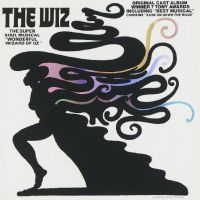
 Original Broadway Cast, 1975 (Atlantic)
  (3 / 5) L. Frank Baum hit pay dirt with The Wonderful Wizard of Oz. Two years after the novel’s publication in 1900, Baum and partners launched a musical extravaganza based on the tale; the show was a sensation, racking up hundreds of performances in New York and around the country. After countless other adaptations, including an obscure 1939 film that starred some nobody named Judy Garland, Dorothy and her pals returned to Broadway in The Wiz, an African-American musical version of the story with a brisk book by William F. Brown and fun songs by composer-lyricist Charlie Smalls. Among the very few Broadway tunes to become mainstream hits since the 1960s, this score’s infectious “Ease on Down the Road” got a lot of airplay, and Dorothy’s yearning 11-o’clock number, “Home,” put Stephanie Mills (who played the heroine) on the pop map. The Wiz enjoyed a long run and nabbed a bunch of Tony Awards, including Best Musical. Geoffrey Holder’s clever costumes and inventive direction helped turn the old tale into a fresh hit. Heard on the recording are several stellar turns in character roles: Clarice Taylor’s Addaperle (think Good Witch of the North) is a daffy, knowing delight; Tiger Haynes’s Tin Man is a smooth song-and-dance man; Hinton Battle’s Scarecrow is sweet as pie; and Ted Ross’s Lion is full of bravado. Mabel King sounds like a truly wicked witch, and her gospel-inflected “Don’t Nobody Bring Me No Bad News” proves that, for Evillene, double negatives ain’t the half of it. André De Shields is perhaps a bit too campy as the Wiz, sounding like a real friend of Dorothy. The arrangements are terrific, full of energy and Soul Train-style bounce. — Robert Sandla
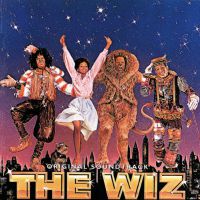 Film Soundtrack, 1978 (MCA, 2CDs)
  (1 / 5) What is it about Hollywood versions of Broadway musicals? Time and again, shows that worked onstage bomb big-time on screen. The Wiz seemed a natural for filming: It was a Tony-winning Broadway success, some of the songs had hit the pop charts, and the central concept of adapting the classic tale of The Wonderful Wizard of Oz for performance by a black cast was timely and hip. But what had been a brisk stage production was turned into a lumbering film, and the soundtrack album is better only in that you don’t have to watch the movie. The gifted Quincy Jones adapted and supervised the music, and he engaged A-talent such as Toots Thielemans, Grady Tate, and Patti Austin to work with him. But almost everything is overblown here, lacking the drive and imagination that mark Jones’s other work. Some negligible new musical material was contributed by Jones, Luther Vandross, and Ashford and Simpson. Diana Ross was too old for the role of Dorothy, and although she sings well enough on this album, she begins every song as if she’s just been on a week-long crying jag. (Cut from the movie but present on the soundtrack recording is a new ballad for Ross, “Is This What Feeling Gets?”) A young Michael Jackson is irresistible as the Scarecrow, and Nipsey Russell has an affable vaudevillian flair as the Tin Man. Ted Ross repeats his Broadway role as the Lion, but his big moments are diminished here. Richard Pryor plays the title role, and since he’s not a singer, the propulsive “So You Wanted to Meet the Wizard” is reduced to bits of woeful dialogue. On the other hand, Mabel King reprises her show-stopping stage turn as Evillene to even more hilarious effect; and the glamorous Lena Horne, in the role of Glinda, gives her all to “If You Believe.” — R.S.
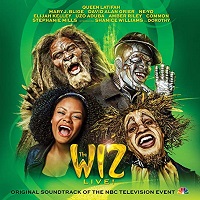 Television Cast, 2014 (Masterworks Broadway) (3 / 5) This cast album is far more enjoyable on its own terms than the live television production it represents, for several reasons. The book of The Wiz has never been considered a masterpiece to begin with, but Harvey Fierstein’s heavy-handed rewrites for the TV presentation were almost all for the worse, so it’s nice to be able to enjoy this fine performance of the score without having to experience all of that — not to mention the flat direction of Kenny Leon, or the production and costume designs, which might be described as garish rather than fun and fanciful. But the most obvious way in which the audio-only experience of this Wiz satisfies far more than watching the video is that Shanice Williams’ vocal performance as Dorothy comes across so much better when not hampered by her limitations as an actress on screen, specifically her limited range of facial expressions. Only 19 years of age when The Wiz was telecast, Williams has an exceptionally beautiful and supple voice that’s lovely to hear in the sweeter moments of Dorothy’s music, and when she’s required to riff or to belt at the top of her range, it all sounds organic rather than like someone just showing off. Her rendition of “Home” is spectacular, as great a success on its own terms as that of Stephanie Mills, who happily turns up here as Aunt Em. Most everyone else in the cast does a fine job with the vocal showcases for their characters, including Elijah Kelly as the Scarecrow, Ne-Yo as the Tin-Man, David Alan Grier as the Cowardly Lion, Amber Riley as Addapearle, and Uzo Aduba as Glinda. The only exception is Queen Latifah as The Wiz, wasted in a role that makes no sense when played by a woman. And it is a disappointment that Kelly doesn’t get to sing the wonderful song originally written for the Scarecrow, “I Was Born on the Day Before Yesterday,” but instead was handed “You Can’t Win,” the far inferior number that Michael Jackson performed in the movie. It would be nice eventually to have a fully satisfying film or TV adaptation of The Wiz, but in the meantime, this cast album is an overall worthy addition to the catalog. — Michael Portantiere
 Broadway Cast, 2024 (Immersive/Interscope) (1 / 5) The 2024 Broadway revisal of The Wiz — actually, a production that came to New York City as one stop on a U.S. national tour — was felt by some critics and audience members to be misdirected, over-produced, over-amplified, and over-sung. That last-named flaw is replicated on the cast recording. It starts out well with a new overture combining three of the score’s biggest hits: “Ease on Down the Road,” “Believe in Yourself,” and “Home.” But that track segues into another brief foretaste of “Home” with a vocal by Nichelle Lewis as Dorothy, a product of one of the oddest decisions made in regard to this production: The addition of the plot element that Dorothy is a New York City girl who has had to come live with her Aunt Em in Kansas after the death of her parents, and is very unhappy about the situation. (So then, umm, why does she sing so longingly of home when she finds herself stranded in Oz?) Once past this huge road bump, the cast album may be enjoyed by listeners who revel in or, at least, can tolerate a whole lot of vocal riffing from pretty much all of the soloists. For example, though Lewis is a major talent with a beautiful, emotionally full, expertly controlled voice, she riffs far more extensively than some listeners will feel is appropriate for the rather naïve, young Dorothy. If the weird double casting of the roles of Aunt Em and the wicked witch Evillene is another of this production’s missteps, Melody A. Betts offers distinctive vocal characterizations of each in “The Feeling We Once Had” and “Don’t Nobody Bring Me No Bad News.” Avery Wilson, Phillip Johnson Richardson, and Kyle Ramar Freeman bring charm and humor to (respectively) the Scarecrow, the Tinman, and the Lion; Freeman’s performance is more palatable here than in the show itself, because the stereotypically “gay” gestures and facial expressions he affected in the part onstage are happily absent. Though Wayne Brady doesn’t make a strong impression as The Wiz, Deborah Cox brings star quality to Glinda, who here gets to sing “He’s The Wiz” (along with Allyson Kaye Daniel as Addaperle) in addition to “Believe in Yourself” — but again, was so much riffing necessary? While some listeners may be disappointed by the replacement of the Scarecrow’s “I Was Born on the Day Before Yesterday” with “You Can’t Win” (from the film version of The Wiz), the good news is that much of the former song has been reconfigured and inserted later in the action under the new title “We’re Gonna Make It.” Also included is “Wonder, Wonder Why,” cut from the original Broadway production. (This song was previously reinstated for the 1984 revival of The Wiz, which did not yield a cast album.) Throughout the recording, the new orchestrations and arrangements by Joseph Joubert and Allen René Louis are for the most part pleasurable if sometimes a little too busy. –- M.P.


 Original Broadway Cast, 1978 (Columbia/Masterworks Broadway)
  (4 / 5) Studs Terkel’s Working, the 1972 best-selling volume of interviews with Americans discussing the pros and cons of their occupations, struck Stephen Schwartz as a good basis for a musical; so he set about rounding up a group of songwriters, in addition to himself, to musicalize Terkel’s pungent, poignant chats. Craig Carnelia, Micki Grant, James Taylor, Mary Rodgers, Susan Birkenhead, and Schwartz turned out the song vignettes, and everyone from a newsboy to a housewife to a cleaning lady to a retiree showed up onstage to declare their highs and woes. A number of the songs — including Carnelia’s “Just a Housewife” and “The Mason,” and Schwartz’s “It’s an Art” — became popular on the cabaret circuit. Grant’s swinging “Cleaning Women” is another catchy item, as is just about everything else on this resonant recording, which benefits from Kirk Nurock’s tingling arrangements of the songs. To represent the hard-working multitudes, Schwartz tapped some stalwart performers: Lenora Nemetz, Joe Mantegna, Amy Freeman, Susan Bigelow, David Patrick Kelly, Bob Gunton, and others put elbow grease into their singing. The cast is so rich in talent that Patti LuPone appears in the ensemble, with no solo spot. Fynsworth Alley’s CD includes six bonus tracks, four of them featuring Carnelia singing his own songs in his tremulous baritone. — David Finkle
 Los Angeles Cast, 1999 (L.A. Theatre Works, 2CDs)
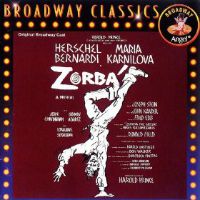
 (5 / 5) Are you sitting down? When I saw Zorba in its original Broadway production (not the horrible Anthony Quinn revival; see below), I thought it a better show than Cabaret, the previous Broadway outing of the team that put this show together: composer John Kander, lyricist Fred Ebb, and director Harold Prince. To me, Zorba is more emotional, deals with life more broadly, and is brilliantly theatrical. Whereas many Kander and Ebb musicals are made up of a succession of special-material songs, this one has an honest, mature, character- and plot-driven score. The opening number, “Life Is,” perfectly sets the theme of the evening. (The first line, “Life is what you do while you’re waiting to die,” was watered down to “Life is what you do till the moment you die” for later productions.) “Happy Birthday” is a wonderfully touching number for the death scene of Madame Hortense, while “Why Can’t I Speak” is a very beautiful song that exemplifies the protagonist Niko’s emotional problems. Although some of the events in Joseph Stein’s libretto are tragic, the audience leaves the theater moved, enlightened, even uplifted — and the cast album has the same effect on the listener. Herschel Bernardi, Maria Karnilova, John Cunningham, Carmen Alvarez, and Lorraine Serabian drive the recording with their sincerity, energy, and abundant talent. — Ken Bloom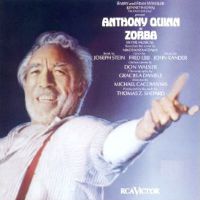
 (2 / 5) Anthony Quinn and Lila Kedrova, who so memorably played the title character and Mme. Hortense in the 1964 non-musical film Zorba the Greek, starred in this revival of the Kander-Ebb-Stein musical Zorba under the direction of Michael Cacoyannis, who had directed the film. Unfortunately, Quinn sings so poorly here that many listeners will find this recording unlistenable. The other performers, including Robert Westenberg as Niko and Debbie Shapiro (later Debbie Shapiro Gravitte, later Debbie Gravitte) as The Woman (previously known as the Leader), fare much better, but the original Broadway cast recording is the one to get. — K.B.