

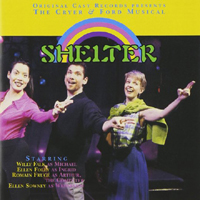
 Off-Broadway Cast, 1997 (Original Cast Records)
  (3 / 5) Seven years after the 1973 Broadway failure of Shelter, librettist-lyricist Gretchen Cryer and composer Nancy Ford rewrote the show, combining it with the first act of their earlier musical The Last Sweet Days of Isaac. In 1997, a newly titled revision, The Last Sweet Days, was presented by the York Theatre Company; that production was recorded under the title Shelter, and that’s the cast album under review here. (Got it?) But rather than solving the problems of their two unsuccessful musicals, all the team did was create a third show that substitutes a certain verbosity for dramatic action. In the first act of Shelter, Isaac is more than a little crazy. In the second act, the character (who has changed his name to Michael) monstrously mistreats his wife, his girlfriend, and a woman named Ingrid, whom he had known earlier and has just met again and bedded. This plot twist adds no resonance or meaning to the piece. In sum, Shelter is a tedious, sedentary soap opera about “relationships,” albeit one filled with imaginative touches and a bunch of good songs, nicely sung here by Willy Falk, Ellen Foley, Ellen Sowney, and Romain Fruge as the voice of Arthur, a singing computer. — David Wolf
Category Archives: Q-S
She Loves Me
 Original Broadway Cast, 1963 (MGM/Polydor)
  (5 / 5) “Charming, romantic, perfect” — those words from the song “Dear Friend” define She Loves Me, a true masterpiece of the American musical theater. A two-LP recording transferred to one fabulous CD preserves almost the entire score. Based on a play that inspired the films The Shop Around the Corner, In the Good Old Summertime, and You’ve Got Mail, the show tells of warring Budapest shop clerks who don’t realize they’ve been sending anonymous love letters to each other. The songs, by composer Jerry Bock and lyricist Sheldon Harnick, blend seamlessly with the work of librettist Joe Masteroff, and the recorded performances of the cast are flawless. Barbara Cook is so much more than a typical ingenue, finding nuance and complexity in the role of the needy, neurotic, vulnerable Amalia; her renditions of “Dear Friend,” “Ice Cream,” and “Will He Like Me?” exemplify what great musical theater singing is all about. When Cook does “I Don’t Know His Name” with Barbara Baxley as “bad girl” Ilona, the vocal contrast is divine; and it’s a moment to treasure when Cook raises her voice to a hysterical soprano-belt in the frenzied “Where’s My Shoe?” duet with Daniel Massey. As “Dear Friend” Georg, Massey is convincingly shy and nervous in “Tonight at Eight,” and winning in the exultant title song. Baxley rips into “I Resolve” and then simply oozes out “A Trip to the Library.” Jack Cassidy, as the suave roué Kodaly, caresses “Ilona” seductively and makes the grandest of exits in “Grand Knowing You.” The roles of Maraczek (“Days Gone By”), Sipos (“Perspective”), and Arpad (“Try Me”) are done to a turn by Ludwig Donath, Nathaniel Frey, and Ralph Williams, and Wood Romoff is very funny as the Headwaiter in “A Romantic Atmosphere.” I defy you to listen to the finale of Act II as sung and acted by Cook and Massey without getting tears in your eyes. — Jeffrey Dunn
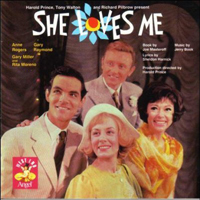 Original London Cast, 1964 (HMV/Angel)
  (4 / 5) An abridged recording of a great score, this cast album lacks “Days Gone By,” “Goodbye, Georg,” “Tango Tragique,” “Where’s My Shoe?”, “Will He Like Me?” and the dialogue leading into the finale. “I Resolve” is replaced by a new song for Ilona titled “Heads I Win,” sung here with blistering strength by Rita Moreno, who also does an amazing job with “A Trip to the Library.” The “Three Letters” sequence for Amalia and Georg was reconceived for London and features members of the ensemble as other lovelorn correspondents. Anne Rogers is a sweet if somewhat bland Amalia, Gary Raymond is a believable Georg, and Gary Miller is a dashing Kodaly. Gregory Phillips sings adorably as Arpad, but Carl Jaffe as the Headwaiter is shockingly off-key throughout “A Romantic Atmosphere.” For this first London production of She Loves Me, many of the show’s lyrics were Anglicized, and some were rewritten to rhyme with the British pronunciations. — J.D.
 Broadway Cast, 1993 (Varèse Sarabande) (5 / 5) This energetic recording of the Roundabout Theatre’s revival of She Loves Me has the skillfully reduced orchestrations by Frank Matosich, Jr. and David Krane that were heard in the theater, and there are a few changes to the original score: Georg’s “Tango Tragique” is heard only as an instrumental, a brief reprise of “Days Gone By” is eliminated, and some adjustments are made in “Twelve Days to Christmas.” A nice amount of dialogue, underscoring, and incidental music gives the album a real sense of theatrical flow. Diane Fratantoni (later known as Diane Sutherland) sings well as Amalia. Boyd Gaines may sound too emotionally secure as Georg, but he’s still charming, adding some nice touches to “Tonight at Eight” and “She Loves Me.” As Kodaly, Howard McGillin makes deceit and conceit almost likable in “Ilona” and “Grand Knowing You.” Louis Zorich, Lee Wilkof, and Brad Kane as Maraczek, Sipos, and Arpad are all fine in their solos. Sally Mayes is distinctive in Ilona’s numbers, Jonathan Freeman is a terrific Headwaiter, and the ensemble is high-spirited. — J.D.
 London Cast, 1994 (First Night) (4 / 5) The astonishingly versatile Ruthie Henshall is a delight as Amalia, and her chemistry with John Gordon Sinclair as Georg is palpable on this recording. The supporting cast is good, particularly Barry James as Sipos, Simon Connolly as Arpad, and Tracie Bennett as Ilona. Only Gerard Casey as Kodaly is outclassed by his predecessors in the role. This is another highly theatrical recording of She Loves Me; intriguingly, the lyrics that were Anglicized for the original London production have reverted back to the American originals. — J.D.
 Broadway Cast, 2016 (Ghostlight) (3 / 5) This is the cast album of the Roundabout Theatre Company’s second revival of She Loves Me, more than 20 years after their first successful production in 1993. Here we have bigger star power, a larger orchestra, and grander orchestrations by Larry Hochman. In fact, if you listen in chronological order, the two Roundabout recordings serve as bookends framing the company’s progression from a humble non-profit organization to a major Broadway heavyweight, providing us with a flashier She Loves Me the second time around. But therein lies a problem. This show has endured as an intimate musical comedy; its appeal lies in the fact that its characters are well defined and relatable, even when at their silliest. While this recording arguably offers the best sung rendition of the score, songs such as “Will He Like Me?” and “Dear Friend” lose some of their charm, and the wit of “Sounds While Selling,” “Ilona,” and other numbers gets lost, amid the quick tempos and lush, new orchestrations. Oddly enough, one of the more empowered songs in the score, Ilona’s “I Resolve,” is given a largely tearful rendition here by Jane Krakowski, though it eventually builds to a commanding finish. Once again, Roundabout has assembled an excellent ensemble cast, yet the generally broad approach of the production keeps them from being definitive in their roles. Laura Benanti is the funniest Amalia recorded, and Zachary Levi is an endearing Georg, but he is a less powerful presence than she, which leads to an imbalance in the pair’s chemistry. The rest of the company, including Krakowski, Nicholas Barasch as Arpad, and Michael McGrath as Sipos, all do fine work, though Gavin Creel could be a touch smarmier as Kodaly. For a more fulfilling listening experience overall, you might want to try the original or 1993 revival cast albums; but if you’re interested in a fizzier, highly energetic interpretation of one of Broadway’s best scores, this recording certainly has something to offer. — Matt Koplik
70, Girls, 70
 Original Broadway Cast, 1971 (Columbia/Sony) (3 / 5) This show flopped on Broadway, but the cast recording is too much fun to pass up. Scored by composer John Kander and lyricist Fred Ebb, 70, Girls, 70 has a book by Ebb and Norman L. Martin (with an adaptation credit for Joe Masteroff), based on the English play Breath of Spring. The characters are residents of a Manhattan hotel for the aged who turn to grand larceny to spice up their lives. Perhaps what doomed the musical was the overly complicated show-within-a-show concept, in which the veteran performers frequently step out of the action to perform numbers about the vicissitudes of old age. These songs — including “Old Folks,” “Broadway, My Street,” and “Coffee in a Cardboard Cup” — are the most enjoyable in the score, especially as delivered by this ball-of-fire cast. The title tune, with its rousing banjo passages, is a gem. Less interesting are “The Caper,” which lays out the plan for the first robbery, and “The Elephant Song,” an overlong 11-o’clock number in which leading lady Ida (Mildred Narwick) announces her own imminent death. However, Natwick, is delightful throughout — especially in “Home,” an inviting rhumba, and “Yes,” a lively tune that sums up the songwriters’ live-for-today philosophy. Equally peppy are Hans Conreid, Lillian Roth, and Lillian Hayman. A standout number is “Go Visit (Your Grandmother),” featuring Yiddish-theater veteran Henrietta Jacobson with Tommy Breslin; the song includes some eyebrow-raising lyrics (“Go ahead and give the old lady a laugh / You went to Fire Island last summer? / For God’s sake, show her the photographs!”). Don Walker’s orchestrations make extensive use of onstage pianist Dorothea Freitag and provide a propulsive undertow for every number. — David Barbour
 Original London Cast, 1991 (JAY) (3 / 5) This is an appealing alternative to the Broadway album. The London production of 70, Girls, 70 starred Dora Bryan and featured a new book by David Thompson and Norman L. Martin that eliminated some of the lesser numbers while adding two pleasant, new ones: “Well Laid Plans” and “I Can’t Do That Anymore.” Julian Kelly’s new, more intimate orchestrations work nicely. The recording offers lively renditions of the score’s highlights, sparked by Bryan’s warbly but witty singing. — D.B.
Seventh Heaven
 Original Broadway Cast, 1955 (Decca)
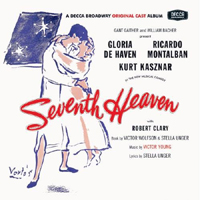
  (2 / 5) Seventh Heaven received mixed-to-negative reviews and closed fairly quickly, but the show’s impressive music earned it this recording. Composer Victor Young’s rich melodies are paired with Stella Unger’s often catchy, sometimes silly lyrics: ”I’m richer than Midas, I’m high as a kite is” and “To all headwaiters named Francois, I wish you all a very cordial au revoir” are two examples. Yet the stronger numbers outweigh the weaker ones, and the performers put the material over skillfully. Robert Clary, as a pickpocket, performs the humorous “Happy Little Crook” and the delightful “Love Sneaks Up on You” with the baby-voiced Patricia Hammerlee as a prostitute. Clary also leads the ensemble in the rousing “C’est La Vie,” which opens and closes the musical. Chita Rivera and Gerrianne Raphael as happy hookers join Hammerlee in a fun rendition of “Camille, Colette, Fifi,” but they don’t do as well with the lesser song “Love, Love, Love.” Leading lady Gloria DeHaven’s “Where Is That Someone for Me?” is a solid ballad, but her “If It’s a Dream” is not up to snuff; nor is Ricardo Montalban’s “A ‘Miss-You’ Kiss” or “A Man With a Dream,” although he does good work in the waltz “Remarkable Fellow.” The one duet for Montalban and DeHaven, “Sun at My Window, Love at My Door,” has lyrics that may give you the giggles (and not in a good way), but the melody and the performances will satisfy. There’s also some lovely dance music: “The White and Gold Ballet” as listed on the LP, “Chico’s Reverie” as listed on the CD. One of the two bonus tracks is Marian Caruso singing “Blessings,” the other is DeHaven doing a pop version of “Where Is That Someone for Me?” with Victor Young and his orchestra. — Jeffrey Dunn
1776
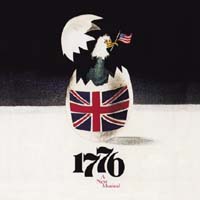 Original Broadway Cast, 1969 (Columbia/Sony) (4 / 5) History teacher-turned-songwriter Sherman Edwards got the idea for a musical about the writing and adoption of the Declaration of Independence, and the result was 1776, one of Broadway’s most distinctive hits. Although Peter Stone’s libretto has deservedly garnered great praise ever since the show’s premiere, Edwards’ score is seldom given its due, but it’s replete with flavor, character, and stirring emotionalism. The original Broadway cast album documents that score — with Eddie Sauter’s grand orchestrations and Peter Howard’s top-notch musical direction — in its freshest, most exciting recording to date. William Daniels is the definitive John Adams, displaying a combination of fire, ice, desperation, and dry humor in songs like “Piddle, Twiddle, and Resolve” and “Is Anybody There?” Rex Everhart does quite well as the ribald Benjamin Franklin, spelling original cast member Howard da Silva, who had suffered a heart attack and was absent for the recording sessions but eventually returned to the show. Ken Howard brings an earnest likability to Thomas Jefferson; Ron Holgate’s joyful bombast as Richard Henry Lee is infectious; Paul Hecht as John Dickinson and Clifford David as Edward Rutledge make formidable opponents in Adams’ quest for independence. “Molasses to Rum,” in which David as Rutledge takes on the infamous Triangle Trade, is one of the recording’s most brilliant highlights. Virginia Vestoff gives a vibrantly romantic performance as Abigail Adams, while future Broadway powerhouse Betty Buckley belts out Martha Jefferson’s coyly suggestive “He Plays the Violin.” — Matthew Murray
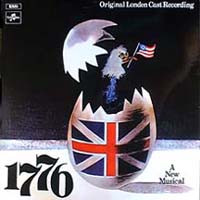 Original London Cast, 1970 (Columbia/no CD) (3 / 5) The London production of 1776 had a brief run, and the cast album is now a difficult-to-find curiosity, but a few of the performances are truly remarkable. Lewis Fiander’s John Adams is sweeping and energetic, the best-sung Adams recorded, and Ronald Radd’s booming baritone provides Franklin with that role’s lustiest interpretation. Vocally challenging items like “Cool, Considerate Men” and “Mama, Look Sharp” receive rich renditions by Bernard Lloyd and David Firth, respectively, while David Kernan’s “Molasses to Rum” is first-rate. Under Ray Cook’s musical direction, the ensemble is full of dynamic singers and the orchestra is clear and precise. Still, the recording is not without its problems: John Quentin has trouble with what little music Jefferson is asked to sing, Vivienne Ross’s voice is distractingly thin for Abigail, and Cheryl Kennedy’s Martha is somewhat cloying. — M.M.
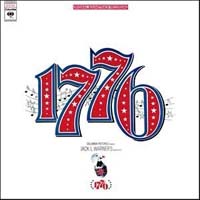 Film Soundtrack, 1972 (Columbia/no CD) (3 / 5) With so many of the original Broadway leads retained, the film version of 1776 is one of the most faithful screen adaptations of a stage musical, and the soundtrack recording documents that very little was lost in the transition. Daniels, Vestoff, Howard, and Holgate recreate their roles, and they all sound better here than on the Broadway cast album. Howard da Silva finally got to record his Franklin, and he’s delightful in the role. Blythe Danner is a softer, more tentatively sung, yet ultimately more effective Martha Jefferson than Buckley. John Cullum assumes the role of Rutledge and provides a solid “Molasses to Rum.” — M.M.
 Broadway Cast, 1997 (TVT) (2 / 5) This is a frustrating recording of the 1776 score. It’s the most complete, with all of the usual songs, a fair amount of dialogue, “Compliments,” all of “The Lees of Old Virginia,” and the full lead-in to “Is Anybody There?” But most of the performances are problematic. Though Brent Spiner sings well enough, his Adams always sounds annoyed. Pat Hingle’s Franklin is frail and uncertain, Lauren Ward’s Martha is somewhat flavorless, and a number of the other portrayals lack bite. On the plus side, Linda Emond sings Abigail quite attractively; Gregg Edelman’s Rutledge and Michael Cumpsty’s Dickinson are vivid; and Paul Michael Valley is the best-sung Jefferson on record. But Brian Besterman’s orchestrations for a reduced number of musicians are conducted too sedately by Mark Mitchell, preventing the recording from ever really getting off the ground. (Paul Gemignani was the musical director for this Broadway revival.) — M.M.
Seventeen
 Original Broadway Cast, 1951 (RCA/Masterworks Broadway) (2 / 5) “Willie, get a wiggle on!” That characteristic, gee-whiz, chorus-boy exhortation, in a song called “Weatherbee’s Drug Store,” opens the cast album of this aggressively homespun show chronicling the 1907 Hoosier romance of Willie Baxter (Kenneth Nelson) and flirty Lola Pratt (Ann Crowley). Based on a Booth Tarkington novel, and positively wallowing in the same postwar nostalgia that sired so many movie musicals of the day, Seventeen aims for charm in its score by Walter Kent and Kim Gannon. The treacle gets thick in songs like “Summertime Is Summertime” and “A Headache and a Heartache,” while the performances are often arch; get a load of the vocal preening in “This Was Just Another Day” and “Ode to Lola.” Still, there are a couple of fine show tunes here, “I Could Get Married Today” and “Reciprocity,” supported by plush Ted Royal orchestrations. And though the cast isn’t starry, the album does offer early audio peeks at The Fantasticks‘ Nelson and that distinctive Greenwillow ingenue, Ellen McCown. The recording is barely 40 minutes in length, but what’s here is a like a rich ice cream soda: very foamy and sweet, yet it still goes down easily. — Marc Miller
Seussical
 Original Broadway Cast, 2000 (Decca) (4 / 5) Whatever was wrong with producers Barry and Fran Weissler’s attempts to cobble a musical out of bits and pieces of Dr. Seuss’ cherished children’s books, it certainly wasn’t the Stephen Flaherty-Lynn Ahrens score. Flaherty’s unfailingly tuneful melodies run the gamut of always appropriate pastiche, including soft rock, jazz, blues, salsa, folk — and, yes, a little ragtime. This composer is always good for a great ballad or two, as well; here we have the yearning, soaring “Alone in the Universe” and “Solla Sollew,” a bewitching lullaby in the “Toyland” tradition. Ahrens’ lyrics are Seussier than Seuss, for example: “If you’re hungry, there’s schlopp in the frig-e-merator!” Happily, the “life lessons” demanded of a children’s musical aren’t pounded into the ground, although “A person’s a person, no matter how small” gets more airing than may be necessary. The sound effects-heavy cast album conveys all the ingeniousness of the score but also betrays some of the misjudgment that marred the short-lived Broadway production of Seussical. Making the Cat in the Hat the evening’s emcee is sensible, but the gifted mime David Shiner isn’t the man for the job; he’s simply not a good singer, and his over-emphatic line readings sound like they come out of Saturday morning cartoons. Sharon Wilkins’ Sour Kangaroo overshoots the runway, too, with her astringent blues inflections and contrived melismas. But most of the principals are just right: Kevin Chamberlin’s sweet-souled Horton, Janine LaManna’s hapless Gertrude McFuzz, Michele Pawk’s brassy Mayzie LaBird, Anthony Blair Hall’s non-cloying JoJo. And how nice to find Broadway veteran Alice Playten in the supporting cast as the Whoville mayor’s droll wife. — Marc Miller
 Off-Broadway Cast, 2008 (JAY) (4 / 5) Seussical has had a healthy afterlife, thanks in part to some post-Broadway rewrites as represented in a popular Theatreworks/USA touring production that had a stint at the Lucille Lortel Theatre in 2008. The recording of that production doesn’t sound like an Off-Broadway cast album, possessing a full (though synth-heavy) orchestra and a large chorus. It preserves the changes Ahrens and Flaherty had made to the show, which aren’t huge; if you feel about them as I do, you’ll like the new bits and miss some of the old. The new Horton (Brian Michael Hoffman) and Gertrude McFuzz (Karen Weinberg) may not have quite as much personality as their Broadway counterparts, but they’re fine, and the Cat in the Hat (Shorey Walker) is a marked improvement. The revisions do produce a tighter, more purposeful narrative, and a vigorous celebration of all things Seuss. This remains a tuneful, imaginative score in the classic tradition. I’ll give the Broadway version a slight edge for some of the performances, but both albums are delightful. — M.M.
Seesaw
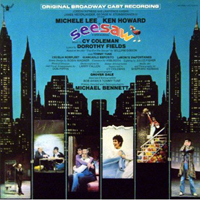 Original Broadway Cast, 1973 (Buddah/DRG) (3 / 5) “Up, down; up, down” goes a lyric in the title tune, and that’s a good barometer for this Cy Coleman-Dorothy Fields musical based on the William Gibson play Two for the Seesaw. First the good news: As the uptight Omaha lawyerJerry Ryan, Ken Howard sings the nicely teasing ballad “You’re a Loveable Lunatic” to his new-found girlfriend, the eccentric Gittel Mosca, played by Michele Lee. When he fully lets loose, Howard has an up-tempo gem in “We’ve Got It.” (Note the joyous Larry Fallon orchestration when Howard says, “Fred Astaire came from Omaha, y’know,” and the marvelous rideout at the end.) Gittel’s numbers aren’t as good, although “Nobody Does It Like Me” is a decent example of those self-deprecating songs that musical theater heroines sometimes sing. As for the bad material: “My City” is not inviting, and “Chapter 54, Number 1909” even less so. When show music buffs discuss the worst songs ever written for Broadway, this score’s “Ride Out the Storm” often comes up. On the other hand, “It’s Not Where You Start, It’s Where You Finish,” performed by Tommy Tune, is not only a good song but also an excellent metaphor for Seesaw, which started out shakily and righted itself only after director/show doctor Michael Bennett joined the team. — Peter Filichia
Secrets Every Smart Traveler Should Know
 Off-Broadway Cast, 1999 (RCA) (2 / 5) Many composers and lyricists turned out a mixed bag of songs and sketches for Secrets Every Smart Traveler Should Know, an occasionally clever revue. Nearly all of the numbers fall into the category of special material that’s more about the lyrics than the music. Given the show’s title, the obvious choices for song content are here — from the cute “Naked in Pittsburgh” (about lost luggage) to the round-trip finale titled (you guessed it!) “Home.” Musical supervisor-arranger Stan Freeman contributed the smart “See It Now” and the amusing running gag “This Is Your Captain Speaking.” An enjoyable detour is a clever Private Lives spoof, performed by Nick Santa Maria and Maribeth Graham. Several bits in Glen Kelly’s “The French Song,” sung by Graham and Denise Nolan, are also fun. Cabaret performers will find this recording chock full of potential comic material for their acts, but Secrets just doesn’t know when to quit, getting to the end of the road with songs about Montezuma’s revenge and traveling on “Aging Planes.” Also, the cast’s heavy-handed approach to comedy makes the ride bumpier; apparently, none of these secrets were meant to be whispered. As a result, the often-strident singing on this album becomes grating, so this is a trip that many listeners will want to take only once. — Morgan Sills
The Secret Life of Walter Mitty
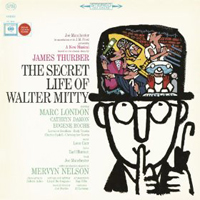 Original Off-Broadway Cast, 1964 (Columbia/Sony) (3 / 5) Based on a popular short story by James Thurber that had already inspired a film starring Danny Kaye, The Secret Life of Walter Mitty — adapted by librettist Joe Manchester — features a score by composer Leon Carr and lyricist Earl Shuman, who have not had a musical produced since. Despite reasonably positive reviews, the production had a short run. Yet this is a score of high quality, filled with inventive melodies and clever lyrics, and the cast is wonderfully talented. In the title role, Marc London conveys an apt nebbishy quality but springs into exuberant life when needed. He excels in “Now That I Am Forty”; “Don’t Forget,” a funny harangue duet with the big-voiced Lorraine Serabian, who plays Walter’s wife; and “Walking With Penninah,” a charm song for Walter and his daughter (Christopher Norris). As Willa de Wisp, Cathryn Damon exudes star quality in “Marriage Is for Old Folks” and in the French-chanteuse fantasy “Fan the Flame.” It’s fun to hear Rue McClanahan share the duet “Two Little Pussycats” with Lette Rehnolds, and there are entertaining numbers for the denizens of the bar where Walter hangs out — especially Eugene Roche’s “Hello, I Love You, Goodbye,” a smug lesson for Walter on how to deal with women. Then there is the first-act-ending “Confidence,” a march in which Walter makes the decision to change his life; if the tune sounds familiar, that’s probably because it’s been used as theme music for many sports telecasts. There are also some recurring themes, a few pleasant ballads, and a happy-ending finale. — Jeffrey Dunn
The Secret Garden
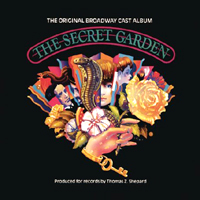 Original Broadway Cast, 1991 (Columbia) (5 / 5) The Lucy Simon-Marsha Norman musicalization of the beloved Frances Hodgson Burnett novel The Secret Garden worked its charm on Broadway for more than 700 performances. The writing, cast, and production were all first-rate, as is this cast album. A generous helping of dialogue on the recording helps establish the show’s story and its atmosphere. Norman’s intelligent, well-crafted lyrics (printed in the CD booklet) and Simon’s masterful score are even more rewarding with repeated listening. Mandy Patinkin, Rebecca Luker, Daisy Eagan, Robert Westenberg, John Cameron Mitchell, and Alison Fraser give well-sung performances rich with musical nuance and detailed characterization. Among the album’s highlights: Fraser has the chipper “If Had a Fine White Horse” and the closest thing in the show to an anthem, “Hold On.” Patinkin and Westenberg sing the powerful “Lily’s Eyes” to perfection. Mitchell is winning in a pair of quirky numbers, while Luker and Patinkin share the superb love duet “How Could I Ever Know?” Eagan is at the center of it all with her Tony Award-winning performance, well represented in dialogue and song on this splendid CD. — Morgan Sills
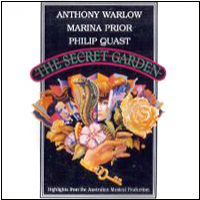 Highlights With Australian Cast, 1995 (Polydor) (2 / 5) Anthony Warlow, Marina Prior, and Philip Quast lead the cast of this recording, which consists of only eight selections from the score of The Secret Garden. The performances run the gamut from excellent to troubling. Tom Blair starts things off with a sluggish “Winter’s on the Wing.” Warlow’s “Race You to the Top of the Morning” and “Where in the World” are strong, and his “How Could I Ever Know?” with Prior is also effective. But Mary Lennox (Samantha Fiddes) is barely present here, showing up only to do her half of”Wick,” and Susan-Ann Walker doesn’t have the necessary power for “Hold On.” The orchestra, though full-sized, sounds strangely thin at times. — M.S.
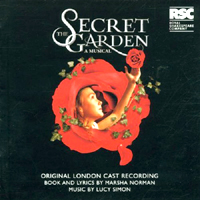 Original London Cast, 2001 (First Night) (4 / 5) A radically different Secret Garden is heard here, the show having undergone major rewrites for tightening and focusing purposes. The restructuring does a great job of helping to tell the story. Other bonuses include a large and lush orchestra and a goodly amount of underscored dialogue with enhancing, evocative sound effects. On the whole, the singers are less successful than those on the Broadway album in terms of musicality and characterization, but there’s one exception: the ultra-sharp performance of Linzi Hateley as Martha. In good company with her on this disc are Freddie Davies as Ben and some impressive chorus boys in the “Garden Suite.” But Craig Purnell struggles with the notes and lyrics of “Winter’s on the Wing,” Philip Quast lacks bravura, and Meredith Braun doesn’t sound quite right in “How Could I Ever Know?” — M.S.
The Scarlet Pimpernel
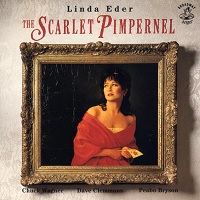 Concept Recording, 1991 (Broadway Angel) (2 / 5) Here’s a “concept album” for a musical that probably wasn’t a very good idea to begin with — at least, not as composed by Frank Wildhorn, whose show scores have almost all suffered from the fact that he loves to mix modern-day pop music with various other genres. As a result, few if any of his scores exhibit a cohesive style. Wildhorn tends to follow this patchwork method even in period pieces; that’s certainly the case with The Scarlet Pimpernel, which he and Nan Knighton adapted from a 1905 novel that tells a story set at the time of the French Revolution. The effect of careening from goopy pop ballads (“Home Again”) to period pastiche numbers (“Into the Fire,” “They Seek Him Here”) is exacerbated by the fact that the singers featured on this recording represent disparate stylistic worlds, from Linda Eder (Wildhorn’s muse, later his wife for a few years) to Chuck Wagner to Peabo Bryson. All of that said, one of the highlights of the album as beautifully sung by Eder is “Storybook,” a lyrical 3/4 ballad that has a wonderfully timeless feel to it. Ultimately, Pimpernel never achieved real success as a full-fledged musical, but fans of the score may wish to sample this first recording to hear how it all started. — Michael Portantiere
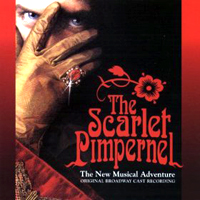 Original Broadway Cast, 1997 (Atlantic) (3 / 5) Despite the antipathy leveled at this effort by composer Frank Wildhorn and lyricist Nan Knighton to adapt the Baroness Orczy’s classic novel into a lavish neo-operetta for Broadway, The Scarlet Pimpernel has its merits as heard on this recording. The score nods at current conventions but also loads up on fanciful, 18th-century atmosphere, although Wildhorn does occasionally stoop to cheap effects (he never met a key change he didn’t like). Knighton’s lyrics wouldn’t rob Sondheim of any sleep, but they’re at least competent and occasionally better; check out her genuinely witty “The Creation of Man,” which has the nerve to rhyme “haberdashery” with “make a splash, cherie.” Christine Andreas gets the best material, or maybe it’s just that her lustrous soprano makes it sound that way: a luminous “When I Look at You,” a lively “Vivez!” and a Piaf-like “Storybook.” Douglas Sills, in a high-profile debut, brings a rangy tenor and an engaging brio to the title role. As Chauvelin, Terrence Mann growls his way through some lesser, Les Miz-knockoff material. The hard-sell big finishes, needless reprises, and all those key changes can be grating, but such is the stuff of operetta. — Marc Miller
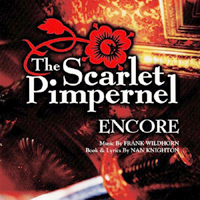 “Encore” Recording, 1999 (Atlantic) (2 / 5) Although it lost millions of dollars, The Scarlet Pimpernel ran for two years on Broadway, during which time its songs were rearranged, reassigned, etc. This recording, lavishly packaged in its CD edition, reflects all the revisions. The 2.0 version of the show featured not only new material but also new performers in the roles of Marguerite and Chauvelin: Rachel York and Rex Smith, the latter’s rock-star snarls and posturings amusingly out of place amid all the Louis XVI trappings. Changes to the score, all of them unabashedly populist, include a new, heavy-breathing ballad called “I’ll Forget You,” the repositioning of “Storybook” at the top of the show, and so on. Although York is a pro, she hasn’t quite the vocal finesse of Andreas, but Douglas Sills remains in fine, swashbuckling form as the hero. You may also enjoy Smith’s sneering performance, which accomplishes a high-wire feat previously considered impossible: He’s hammier than Terrence Mann! — M.M.
Say, Darling
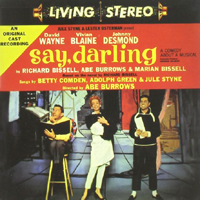 Original Broadway Cast, 1958 (RCA/DRG) (2 / 5) First, novelist Richard Bissell wrote 7½ Cents, which was turned into the hit musical The Pajama Game. Then he wrote a novella about his experiences on that show, which in turn served as the basis for Say, Darling, a moderately successful “comedy about a musical.” That designation clues us in: This is not really a musical at all, just a play with some incidental songs by Jule Styne, Betty Comden, and Adolph Green. Most of the numbers are performance pieces that don’t advance the plot; some of them, such as “The Husking Bee” and “Chief of Love,” are intentionally cheesy. The two leads, Johnny Desmond and Vivian Blaine, are respectively oily and bland, although it’s interesting to hear Blaine use her contralto belt instead of her Adelaide adenoids. David Wayne, playing a small-town innocent who mixes with Broadway sharpies, has more personality than either of the stars; he puts over the unimpressive “Something’s Always Happening on the River” through sheer force of will. The title song and the waltz “Dance Only With Me” are sweet ballads, and the arrangements and orchestrations by Sid Ramin — created specifically for the recording — are supercharged. But, after a rousing Styne overture, there’s just not much going on here. — Marc Miller
Saturday Night Fever
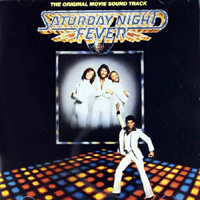 Film Soundtrack, 1977 (Polydor) (2 / 5) Iconic though this movie may be, the blockbuster soundtrack album of Saturday Night Fever is distressingly dated. Even if individual songs are terrific, how much disco can you stand in one sitting? That’s the defining factor here. The Bee Gees deliver “Stayin’ Alive,” “Night Fever,” and “How Deep Is Your Love?” largely in falsetto, and so on and so on. In addition to two versions of “More Than a Woman,” there’s Walter Murphy’s “A Fifth of Beethoven” — a disco version of Beethoven’s Ninth Symphony — and “If I Can’t Have You,” performed by Yvonne Elliman. Also included are a few instrumental tracks written by David Shire. — Seth Christenfeld
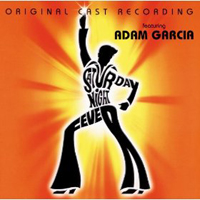 Original London Cast, 1998 (Polydor) No stars; not recommended. This recording begins with an overture that quotes “Stayin’ Alive,” and then it just gets worse. The film soundtrack has better versions of all the songs, even if it lacks the two new items that the Bee Gees wrote for the stage show: the unpleasant battle-of-the-sexes dance number “It’s My Neighborhood” and the bad ballad “Immortality.” Adam Garcia may have been charismatic as Tony Manero onstage, but on the cast album, he’s just another mediocre singer. Tara Wilkinson’s “If I Can’t Have You” is an unmemorable performance, and the efforts of the other cast members aren’t any better. The recording is mercifully brief, containing only about half of the score and none of Nan Knighton’s “book” for the musical. In this case, less is definitely more. — S.C.
Saturday Night
 Original London Cast, 1998 (First Night)
  (1 / 5) With music and lyrics by a 24-year-old Stephen Sondheim and a book by Julius J. Epstein, Saturday Night was supposed to be produced on Broadway in the mid-’50s; but there were problems, and the show didn’t have its first fully staged performance until four decades later in London. So this cast album of that production is the world premiere recording, documenting the show as presented at a fringe theater. The 12 British actors struggle with American accents, and although they don’t have much to offer as vocalists, they do exhibit great energy. Sam Newman is passable as Gene, but Anna Francolini is inept as a phony Southern belle. Six musicians play orchestrations that are competent but do not fully reveal the beauty of Sondheim’s music. — Jeffrey Dunn
 Original New York Cast, 2000 (Nonesuch) (5 / 5) Sondheim has described Saturday Night as his “baby pictures.” Although an anticipated move to Broadway for the 2000 Second Stage production did not happen, this lavish recording was made with 36 musicians! Jonathan Tunick’s excellent orchestrations, conducted by Steven Freeman, have the thrust of a 1950s Broadway musical, yet they sound entirely appropriate for 1929, the year in which Saturday Night is set. In the evocative, beautifully delivered title song that begins the show, four young men — played by Kirk MacDonald, Greg Zola, Joey Sorge, and Michael Benjamin Washington — lament that they are dateless on the biggest night of the week. Gene, the show’s central character, is introduced in “Class,” a complex melody perfectly sung by David Campbell. The young Australian leading man also uses his solid baritenor to excellent dramatic effect in the beautiful duet “Too Many People,” with Lauren Ward, and in the clever trio “A Moment With You,” which Campbell and Ward sing in counterpoint with a record. Ward is delightful in “Isn’t It?” and in the fine ballad, “All for You.” Other standouts are Christopher Fitzgerald in “Exhibit A,” slyly explaining to his buddies his modus operandi with women, and Andrea Burns and Clarke Thorell as a married couple cutely reminiscing about their first date in “I Remember That.” Wonderful group numbers — “Delighted, I’m Sure,” “In the Movies,” “One Wonderful Day,” and “What More Do I Need?” — fully reveal who the characters are and give all of the cast members chances to shine. — J.D.
Saratoga
 Original Broadway Cast, 1959 (RCA) (3 / 5) Edna Ferber’s Saratoga Trunk had already been adapted as a hit film, so the stage musical version, developed for Broadway as Saratoga and rumored to be the most costly production of its day, was eagerly awaited. But the show turned out to be a crushing failure. Morton da Costa was in charge of both the book and the direction; Harold Arlen and Johnny Mercer supplied the songs. Tryouts were nightmarish, and Arlen departed in disgust, leaving Mercer to compose some of the music. The recording doesn’t reflect what was reportedly an exceedingly talky script, but it does reveal the score to have many incomplete musical statements: A nice melodic line suddenly stops without resolution; a jazzy rhythm has little to play against; and nothing is at all memorable. The cast was headed by Carol Lawrence, whose soubrettish manner falls flat, and Howard Keel, who sings well but without much individuality. The humorous “Finding a Man,” given its full due by Carol Brice and Odette Myrtil, is the closest thing to a big-time musical moment. — Richard Barrios
Sarafina! The Music of Liberation
 Original Cast, 1988 (RCA) (4 / 5) Conceived and directed by Mbongeni Ngema, Sarafina! is the “little musical that could.” Despite considerable financial hardship in moving the show to production, it premiered in Johannesburg, South Africa and, within three months, was transported intact to New York for a limited engagement at Lincoln Center. It proved so popular there that it moved to Broadway, where it received five Tony Award nominations and ran for 597 performances. Sarafina! concerns apartheid and its repressive conditions as reflected in the lives of a group of high school students in Soweto during the 1980s. The title character is an endearing rebel who retains her zeal for civil rights despite harassment and incarceration. The score, by Ngema and Hugh Masekela, features the stomping dance rhythms, electronic keyboard, blasts of brass, and idiosyncratic vocal harmonies that are trademarks of Mbaqanga, the pop sound of South Africa’s black townships. The album offers exhilarating, letter-perfect performances that pulse and spin inexorably toward the climactic number, “Bring Back Nelson Mandela,” during which Sarafina (Leleti Khumalo) impersonates the then-imprisoned leader and imagines what he might say upon release. — Charles Wright
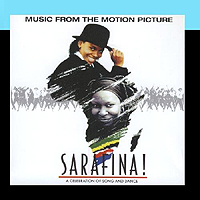 Film Soundtrack, 1992 (Next Music) (2 / 5) The fair-to-middling film Sarafina! The Sound of Freedom, based on the exhilarating stage show Sarafina! The Music of Liberation, was released in 1992. The original musical captivated New York audiences in part because it depicted the ongoing injustice of South African apartheid and the then-current liberation movement; the film appeared a year after repeal of the apartheid laws. This soundtrack recording features various artists performing selections from the exciting musical score by Mbongeni Ngema and Hugh Masekela: Leleti Khumalo repeats her stage role of Sarafina, the irrepressible juvenile activist; the great singer and civil rights activist Miriam Makeba is her mother, who has slaved her whole life for members of the white ruling class; and Whoopi Goldberg plays Mary Masembuko, the audacious teacher who defies the state-sanctioned curriculum in order to inspire and indoctrinate Sarafina. Ngema, who conceived and directed the original stage musical, is on hand in the role of a constable but has been displaced as director by Darrel James Roodt. The musical numbers, recorded under state-of-the-art conditions, are respectably performed but lack the exuberance and emotional range that make the original-cast recording so exciting. That’s hardly surprising; whereas the Lincoln Center/Broadway recording is like a handcrafted treasure from the workshop of a natural artisan, the film soundtrack is an aural document of a commercial enterprise trying to replicate that treasure for the masses. On stage, Sarafina! was lively agitprop that contributed appreciably to global support for the South African liberation movement. The screen version, coming after repeal of apartheid, celebrated change and anticipated the election that would make Nelson Mandela the country’s first black president two years after the movie’s premier. Almost a quarter century later, the film is a memento of concerted social action that proved things can get better. Despite the compromises necessary to get this bold material to mainstream screens, including star casting and the substitution of Roodt for Ngema, this 40-minute soundtrack recording is true to the spirit and purpose reflected in the original cast album, if not equal to it in quality or energy. – C.W.
Salvation
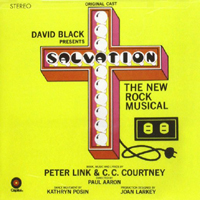 Original Off-Broadway Cast, 1969 (Capitol/Angel) (3 / 5) Unlike some other rock musicals of the period, Salvation had no dance or spectacle elements; the physical production was tacky, and the show played in an ungainly Off-Broadway space. Yet the songs, by Peter Link and C. C. Courtney, are uncommonly sweet and melodic. The style of the music is so time-specific that, to some modern ears, it may be meaningless. Still, there’s a touching simplicity in “Let the Moment Slip By,” all about a young woman who didn’t sleep with her boyfriend and regrets it after he’s killed in Vietnam. “Daedalus” is at once an odd and ravishing tune, especially as performed by jazz singer Yolande Bavan. “In Between,” “Gina,” “Let’s Get Lost in Now,” and “If You Let Me Make Love to You, Then Why Can’t I Touch You” are arresting ’60s rock. The cast, which includes songwriters Link and Courtney along with Joe Morton, Chapman Roberts, Marta Heflin, and Annie Rachel, is vocally strong. The CD edition of the cast album includes three songs that previously had been issued only on the eight-track tape version of the recording. — David Wolf
St. Louis Woman
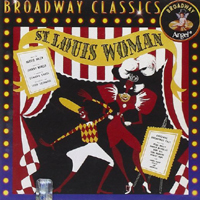 Original Broadway Cast, 1946 (Capitol/Angel) (4 / 5) Careening between musical comedy and musical tragedy, St. Louis Woman is a turn-of-the-century tale with an all-black cast and a score by Harold Arlen and Johnny Mercer that reflects the tonal uncertainty at both ends of the comedy/tragedy spectrum. One minute, the score strives for Porgy and Bess-like grandeur (“Leavin’ Time”), then it returns to standard-issue, albeit high-grade, Broadway (“Ridin’ on the Moon”). But Arlen’s music is amazing throughout, Mercer’s lyrics are adult and idiomatic, Leon Leonardi’s conducting is sensational, and the singers are terrific. June Hawkins infuses “I Had Myself a True Love” and “Sleep Peaceful, Mr. Used-to-Be” with operatic intensity. Ruby Hill is warm and appealing in “Lullaby” and sassy in “Anyplace I Hang My Hat Is Home.” Harold Nicholas was a great dancer without much of a voice, but he comes through in “Come Rain or Come Shine.” And a young Pearl Bailey is always in the wings, ready to deliver another insinuating comic specialty number. At just under 30 minutes, this is an uncommonly short cast album, but also an uncommonly sweet one. And the sound quality, for its age, is excellent. — Marc Miller
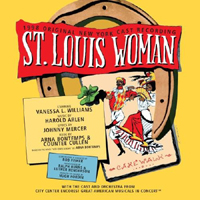 Encores! Concert Cast, 1998 (Mercury) (2 / 5) This album captures every note of a City Center Encores! concert staging of St. Louis Woman on a recording that’s more than twice as long as the original. But from the first few bars — a portentous drum roll, a brassy fanfare, a showy parade of unrelated themes — it disappoints. The original orchestrations have been tarted up with Vegas obviousness, and the big songs are punctuated with even bigger “buttons” at the end. (You’d think “Come Rain or Come Shine” was the “Eroica.”) Conversely, Rob Fisher’s conducting is strangely cautious, as though applying some heat to the score might scorch it. (Listen to the middle section of “Leavin’ Time,” so deliberate that it sounds like a school band is playing it.) To be sure, it’s terrific to have all the missing material restored for a recording; “I Feel My Luck Cornin’ Down” and “Li’l Augie Is a Natural Man” are joyous rediscoveries. But this cast doesn’t make much of the score’s riches. Vanessa Williams is a pleasant vocalist, but her much-vaunted va-va-voom doesn’t carry over to disc, and she’s short on individuality in the role of Della. Helen Goldsby’s Lila is a disaster as she mumbles her lyrics and sings stiffly. Leading men Stanley Wayne Mathis and Victor Trent Cook are competent but vapid. Only Yvette Cason measures up, offering a take on Butterfly that’s very different from but equally valid as that of Pearl Bailey. — M.M.
Sail Away
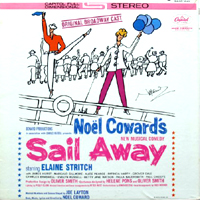 Original Broadway Cast, 1961 (Capitol/Angel) (4 / 5) Which musical has the best opening and closing numbers for its star? A good bet is Noël Coward’s Sail Away. The show-stopping songs, written expressly for Elaine Stritch, are “Come to Me” and “Why Do the Wrong People Travel?” Stritch is a stitch as a “professional pepper-upper” cruise director on an ocean liner, and her material is a hoot. Listen and guffaw at “Useful Phrases,” Coward’s clever parody of foreign guidebooks that give translations of sentences no one ever needs (“Please bring me some rhubarb”). Savor “The Little Ones’ A-B-C,” in which Stritch grapples with her passengers’ children. And when romance comes her way, the star is utterly convincing and tender singing “Something Very Strange.” Yes, the “Beatnik Love Affair” number, performed by Grover Dale, is an embarrassing attempt by Coward to be au courant. James Hurst is a disappointment as Stritch’s young lover — he’s supposed to be a breath of fresh air, but comes across as uptight — and Patricia Harty is simpering as the show’s soubrette. Still, Stritch keeps things happily afloat, so jump aboard for a good listen. — Peter Filichia
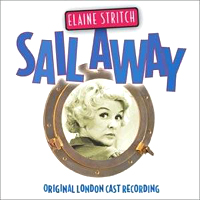 Original London Cast, 1962 (HMV/Fynsworth Alley) (3 / 5) A year after the show’s disappointing Broadway run of only a few months, Sail Away crossed over to London, where it was slightly more appreciated. Stritch was still strong at the helm, with David Holliday showing panache as her lover. One of the better songs on the original album, “The Little Ones’ A-B-C,” is missing here. But this recording does have one word more, “ass” — which, on the more demure Broadway album, was replaced by a trumpet bleat in “Why Do the Wrong People Travel.” Another addition is “Bronxville Darby and Joan,” a witty ditty for two minor characters that was cut from the New York staging, restored in London, and included here. Sadly, Irwin Kostal’s superb orchestrations have yielded to new, inferior charts by a person who is uncredited. We can understand why the culprit chose to remain anonymous. — P.F.